Exploring Mysticism and Parapsychology. This blog is also an attempt to promote awareness of a Modern Universal Paradigm known as Multi-Dimensional Science. It offers a "Scientific" testable Hypothesis for a more "objective" understanding of claimed Psychic and Spiritual Phenomena. A link to this subject should be found on this page or alternatively it can be found easily via a word search.Please note that the Internet articles here may not always reflect the views of the Blogger.
“If science proves some belief of Buddhism wrong, then Buddhism will have to change.”-- Tenzin Gyatso
“In questions of science, the authority of a thousand is not worth the humble reasoning of a single individual.”-- Galileo Galilei
"You cannot meet God until you carry within yourself the dagger of disbelief.”--Kabir
If Radhasoami really wants to be a science then it has to do that which it has failed to accomplish so far: be willing to be wrong.
Radhasoami satsangs, particularly those at Beas and at Dayalbagh, have advertised themselves as a scientific enterprise. However, on closer inspection they both seem to have much more in common with religion than science, despite their concerted efforts to create a “science of the soul.” Ninian Smart, the late Professor of Religious Studies at the University of California, Santa Barbara and author of many seminal books, argues that religion has seven major dimensions: 1) Myths; 2) Rituals; 3) Experiences; 4) Doctrines; 5) Ethics; 6) Social Aspect; 7) Material Forms. Radhasoami fits Smart’s model almost to a tee and by his yardstick would be cataloged as a religion, albeit a new and emerging one worldwide. Gurinder Singh (the current head of Radhasoami Satsang Beas) and P.S. Satsangi (the current head of Dayalbagh Satsang Agra) want to emphasize how Radhasoami serves as a scientific model for exploring higher states of consciousness. Yet, their respective definitions of science are invariably intertwined with a specific theological agenda. And, as such, gives one pause about whether Radhasoami is really a science or just wants to appear scientific so that its spiritual practices and aims will be taken more seriously.
This came into sharp focus for me this past year when I gave a talk in India at the International Conference on Quantum and Nano Computing Systems and Applications at the Dayalbagh Educational Institute in Agra. I argued that understanding how consciousness evolved in the first place was elemental and that would-be mystics should also be trained skeptics. Just as we can be deceived by our brain in this world (what my wife Andrea calls the “cerebral mirage”) without being aware of it, so too can the meditator being duped by in his/her interior explorations. It is a simple point, but one which has devastating implications for any religion that believes that it has already uncovered the ultimate truth of the universe. If our senses can (and do) betray us about what we see and hear and smell, so too can our consciousness mislead us about the reality of our inner experiences. The present guru at Dayalbagh, P.S. Satsangi, heard my entire talk and later after some impromptu remarks I made at a panel discussion, he spoke for about ten minutes expressing his disagreement with my emphasis on being skeptical of the mystical. It seemed as if my wife Andrea (whose talk was even more pointed than my own) and I had hit a sensitive nerve since we were calling into question the absoluteness of Radhasoami’s cosmological schema. It appears that Radhasoamis want to embrace science provided that it dovetails with their own belief system. Not once have I ever heard a Radhasoami guru (with the notable exception of Baba Faqir Chand) admit that a long held doctrine or tenet was mistaken. Not once has a Dayalbagh or Beas guru corrected a previous master in their lineage as being mistaken. Why? How can Radhasoami really be taken seriously as a scientific path if one cannot question its very foundation? While it is certainly true that Radhasoami is experientially based and advocates a systematic meditational technique, it never questions or doubt its founder’s writings at any point. Indeed, it accepts Shiv Dayal’s Sar Bachan as gospel and attempts to fit any and all scientific discoveries within its boundaries.
This is like physicists today never questioning Aristotle or never doubting Newton. Science progresses precisely because it doubts any and all authorities, even those with esteemed reputations like Albert Einstein or Niels Bohr. Biologists don’t bow dddown with bended knee to everything Charles Darwin wrote in On Origin of Species, despite how much they respect his insights. Chemists don’t take everything Linus Pauling wrote hook, line, and sinker. To be scientific is to question, to be corrected regardless of what status one might hold in the pantheon of reason. Have Radhasoami gurus at Beas and Agra demonstrated this same kind of apprehension about its leaders and their history? No, and herein lies the heart of the problem with Radhasoamis billing themselves as a science. They want the prestige that a scientific aura gives them without undergoing the hard work of trial and error that is endemic to any true science.
“There can be no ultimate statements science: there can be no statements in science which can not be tested, and therefore none which cannot in principle be refuted, by falsifying some of the conclusions which can be deduced from them.” -- Karl Popper
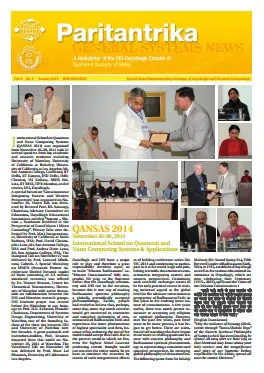
Is it reasonable to call various Radhasoami satsang Beas centers throughout the United States as “Science of the Soul Research Centers” when none of these places have laboratories or research facilities of any kind? Instead, they are big halls designed for satsangs where the guru or his designated representative gives talks for an hour or so based on the teachings of previous saints. No deep investigation or experiments or analysis is ever conducted at any one of these centers. What is Radhasoami Satsang Beas trying to accomplish by this sleight of hand entitlement? There are probably several reasons, but not one of them has anything to do with science as it is generally known and practiced. Dayalbagh, on the other hand, is genuinely trying to conduct original research in shabd yoga by studying the brain waves of deep meditators within their community. They have even built a specially designed room that others and I witnessed first hand. Dayalbagh has also devoted significant time and money to holding conferences on consciousness studies, including the one I attended with my wife Andrea. They have invited renowned scientists such as Sir Roger Penrose of Oxford University to give talks and have encouraged many in their community to pursue studies exploring the connection between quantum theory and the mind. This is altogether commendable. However, and my however here is a large one, Dayalbagh (like Beas) appears to have an underlying motive for why they are pursuing a neuroscientific understanding of consciousness and it is not as objective and value free as one might suspect. A recent official newsletter PARITANTRIKA: General Systems News (Volume 9, No. 1, January 2015) explains quite clearly what Dayalbagh’s real agenda is all about.
“Dayalbagh and DEI have a major role to play and therefore a great responsibility devolves upon us to make ‘MISSION RADHASOAMI’ i.e. ‘MISSION CONSCIOUSNESS’ fully successful. We pray to the Supreme Father that the Dayalbagh community and DEI rise to the occasion, because this is one way of making Radhasoami spiritual philosophy a globally, scientifically accepted phenomenology. Earlier, people had tended to believe that, perhaps, some day, some top notch scientist would get converted to consistent and complete philosophy of consciousness of Radhasoami Faith and experience the inner phenomenon of highest spirituality and then, because of his authority, the rest of the world would accept this Faith. But in the present world in which we live, even the highest Nobel Laureate professing certain thought would not win over the entire world. SO WE HAVE TO CONVINCE THE SCIENTISTS by means of such integrationalist efforts as of holding conference series like TSC 2013 and continuing to participate in it at the world stage and publishing scientific documents on consciousness integrating eastern and western perspectives. Continuing such scientific exchanges seems to be the only practical course in making universal appeal at the global level for the ultimate consciousness perspective of Radhasoami Faith its due place in the evolving inner science of consciousness. . . . The following quote from Sir Sahabji Maharaj (Sir Anand Sarup Kt), Fifth Revered Leader of Radhasoami Faith, Who, in 1915, established Dayalbagh as well as various educational institutions in Dayalbagh, which are now celebrating their Centenary (1915-2015), spells out the Vision of our Mission Consciousness: “May the radiance of Satsang (Meditation through ‘Surat-Shabda Yoga’ of the Eastern Spiritual Philosophy of Saints) which has been kindled, be spread all over, after we have left, so that Mankind may know about your holy services and the magnificence and glory of our Supreme Father, resplendent in His Abode, spread all over the Cosmic Universe.”
This is quite a revealing document and underlines what others and I perceived when attending the QANSAS conference in November of 2014. Simply put, Dayalbagh wants to legitimize Radhasoami theology in the scientific world and believes it can do so by hosting and attending conferences on consciousness worldwide. On the surface this looks very impressive indeed, except that Dayalbagh isn’t interested in the pure and unadulterated study of consciousness, per se, but rather in championing its own theopneustic paradigm. Would Dayalbagh (or Beas) actually accept and appreciate a neuroscientific finding that contradicted its own religious beliefs? I think not. In examining the Paritantrika newsletter closely a number of key words and phrases stand out which plainly illustrate why Dayalbagh is so adamant in pursuing a scientific pathway to bolster its religious aims: 1. Dayalbagh is not taking a wait and see attitude in its understanding of consciousness when it equates “mission consciousness” as synonymous with “MISSION RADHASOAMI,” followed with a supplicating prayer to the Supreme Father that “that the Dayalbagh community and DEI rise to the occasion, because this is one way of making Radhasoami spiritual philosophy a globally, scientifically accepted phenomenology.” Praying to a supreme deity to make sure your theory is accepted is contrary to the very essence of the scientific endeavor, particularly if one needs to be open to its refutation by experimentation. Given Dayalbagh’s modus operandi, it appears that any finding that contradicted their a priori divine creed would be rejected or explained away. Substitute Mission Radhasoami with any other ism (such as Mission Mormonism) and you can readily see through the evangelical propaganda. 2. Holding and attending international conferences to understand the latest research on consciousness is praise worthy, but to do so in order to convert others to Radhasoami’s worldview is, to be polite, manipulative at best. Why even worry if a Nobel prize winner or a top notch scientist sides with your view if you are truly interested in the research because it is evidence (and not authority figures) that matters in the end. But Dayalbagh doesn’t point to an open-ended inquiry when it admits that “continuing such scientific exchanges seems to be the only practical course in making universal appeal at the global level for the ultimate consciousness perspective of Radhasoami Faith its due place in the evolving inner science of consciousness.“ If Dayalbagh was genuinely interested in making Radhasoami scientific, it would be heavily invested in finding out where and when it has been wrong in its theoretic orientations in the past. But not once in any of its sanctioned presentations has a Dayalbagh researcher opened up this Pandora’s Box and asked the hard and necessary questions concerning mistakes that may have been made over time by its unique lineage of gurus. Instead, the Parintantrika newsletter posits its real agenda by quoting its Fifth spiritual leader and the founder of its colony, Sir (or Sri) Anand Sarup who detailed their scientific mission in purely theological terms when he exclaimed, “May the radiance of Satsang (Meditation through ‘Surat-Shabda Yoga’ of the Eastern Spiritual Philosophy of Saints) which has been kindled, be spread all over, after we have left, so that Mankind may know about your holy services and the magnificence and glory of our Supreme Father, resplendent in His Abode, spread all over the Cosmic Universe.” This is perfectly fine for a religious dogma but it shouldn’t be confused with an open-ended and objective quest to understand the true nature of consciousness and its causation, particularly if anything which contravenes the stated theology is swept away as irrelevant to “Mission Radhasoami.” If Radhasoami really wants to be a science then it has to do that which it has failed to accomplish so far: be willing to be wrong. In other words, Dayalbagh and Beas cannot simply call themselves a science and not face the consequences of what that entails. They must, if they are serious in their quest, allow alternative and contravening interpretations of their inner experiences and not merely reconfigure such to fit their metaphysical schema. I suspect that Dayalbagh and Beas are not ready for such a radical endeavor. This is not to suggest that Radhasoami doesn’t have anything to offer the scientific study of consciousness because I think it has much to contribute. Dayalbagh, for instance, is definitely on the right track by developing sophisticated neural scanning machinery to study brain waves of advanced shabd yoga meditators and reporting their findings. But they must be careful not to massage the resulting data to conform to a preset paradigm. To be sincere scientists, they must follow the evidence wherever it may lead them, even if it point blank contradicts their fundamental belief system. I also believe that much of the religious mythology intertwined in Radhasoami has to be differentiated from its more universal aspects, lest one gets forever bogged down in unnecessary cultural baggage. The core of Radhasoami practice is shabd yoga and this technique (clearly defined in its three-fold method of simran, dhyan, and bhajan) offers much promise as a pathway to experience different and more lucid states of awareness. The experiences of shabd yogis are undoubtedly a treasure trove waiting to be explored. Nevertheless, we should not prematurely pontificate about their significance but rather encourage an open-ended inquiry into their ultimate meaning and purpose. Otherwise, we are engaged in a theological debate and not a scientific one. If Radhasoami wants to advertise itself as a science then it is time for it to live up to its own hype and question its own foundations versus trying to saddle up exclusively on those findings that buttress their spiritual purview. For Radhsoami science to be worthy of such an exalted appellation it should follow Charles Darwin’s lead and point to how its pet theorizing can be upended. As Darwin warned about the mechanism of evolution by natural selection, “"If it could be demonstrated that any complex organ existed, which could not possibly have been formed by numerous, successive, slight modifications, my theory would absolutely break down." Do the Beas and Dayalbagh satsangs have any proviso that is even close to Darwin’s about how their respective theories on spirituality could be wrong in light of future neuroscientific research? No, and this I would suggest reveals in a nutshell why Radhasoami’s claims to be a science are deeply suspicious. As Richard Feynman explained about the scientific method in his famous 1974 commencement address at Cal Tech,
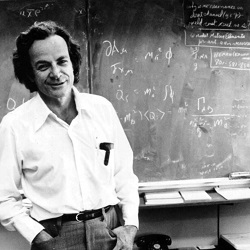
Richard Feynman
“There is one feature I notice that is generally missing in cargo cult science. It's a kind of scientific integrity, a principle of scientific thought that corresponds to a kind of utter honesty — a kind of leaning over backwards. For example, if you're doing an experiment, you should report everything that you think might make it invalid — not only what you think is right about it; other causes that could possibly explain your results; and things you thought of that you've eliminated by some other experiment, and how they worked — to make sure the other fellow can tell they have been eliminated. Details that could throw doubt on your interpretation must be given, if you know them. You must do the best you can — if you know anything at all wrong, or possibly wrong — to explain it. If you make a theory, for example, and advertise it, or put it out, then you must also put down all the facts that disagree with it, as well as those that agree with it. There is also a more subtle problem. When you have put a lot of ideas together to make an elaborate theory, you want to make sure, when explaining what it fits, that those things it fits are not just the things that gave you the idea for the theory; but that the finished theory makes something else come out right, in addition. In summary, the idea is to try to give all of the information to help others to judge the value of your contribution; not just the information that leads to judgement in one particular direction or another.”
While I certainly applaud and encourage Dayalbagh’s repeated efforts to have shabd yoga experimentation taken seriously, I think they must in turn contemplate seriously about how their particular view of higher states of consciousness (as revealed by their founder and in their holy writings) could be mistaken and how their own theological viewpoint could be changed. In this regard, I think they should follow the Dalai Lama’s lead concerning his openness to science disproving certain theological tenets in Tibetan Buddhism. As Carl Sagan, the noted astronomer and skeptic wrote concerning the Dalai Lama, “In theological discussions with religious leaders, I often ask what their response would be if a central dogma of their faith were disproved by scientific discipline. When I put this question to the Dalai Lama, he unhesitatingly replied as no traditionalist or fundamentalist religious leaders do: In such a case, he said, Tibetan Buddhism would have to alter. Even, I asked, if it’s a really central tenet, like reincarnation? Even then, he replied.”
David Christopher Lane, Ph.D., is a Professor of Philosophy at Mt. San Antonio College. Professor Lane received his Ph.D. and M.A. in Sociology from the University of California, San Diego, where he was a recipient of a Regents Fellowship. Additionally, he earned an M.A. in the History and Phenomenology of Religion from the Graduate Theological Union, Berkeley. Dr. Lane is the author of several books including The Radhasoami Tradition and Exposing Cults (New York: Garland Publishers, 1992 and 1994 respectively) and The Making of a Spiritual Movement (1979, 1983, 1993). He is the founder of the Neural Surfer website and co-founder along with Dr. Stephen Runnebohm, former Dean of Mt. San Antonio College, of the MSAC Philosophy Group.
The following essay is my response to a series of questions posed by a reader of Brian Hines' blog, Church of the Churchless.
APPRECIATIVE READER WRITES:
But I think what you are saying is that you are indeed critiquing the theology not as a layman but as a scientist, as someone who’s put in the requisite work in terms of picking up the math and physics and existing theory (in short, in the capacity of the scientist). In your case, this would translate as someone who’s acquired the book-knowledge, the history of the faith, the details of the theology; and also, crucially, the meditation; and also, even more crucially, the actual inner “experiences”. Am I right?
DAVID LANE REPLIES:
I think each of us are (at some of our best moments) working scientists in the sense that we observe certain phenomena and try our best to figure out why it is so. We come up with all sorts of hypotheses and then if we are honest in our inquiry we test out our guesses against other ideas and the one that is (relatively) best at explaining the data we tend to accept, even if only tentatively. Thus when it comes to meditation and spirituality, each one of us has to engage in the experiment and then decide (avoiding as best as possible group think and theological tethering) how to interpret what arises, hopefully keeping open minded to alternative viewpoints.
APPRECIATIVE READER WRITES:
[Quick little on-the-side comment/request while on the matter of your “experiences : Would you be comfortable sharing those experiences in your own words? Actual personal experiences only, not what’s “supposed to be”? I’d be REALLY interested, fascinated, to be able to learn about that. I understand they ask you not to talk about this sort of thing, and if you’re not comfortable breaking that particular tenet of theirs, then it’s cool. Although I’m hoping you’ll say you find that particular tenet amongst the unreasonable and pointless diktats of RSSB, and that you will be able to relate to us something of what you’ve “seen within”.]
DAVID LANE REPLIES:
I think one of the underlying reasons that Sant Mat gurus have argued against revealing one’s inner experiences is because they can be so personal and particular. As for myself (and what I suspect is common or more universal and not merely due to individual peculiarities), I have noticed the following during shabd yoga meditation:
1) prolonged simran or repetition does help one to keep at the eye focus and that once this is sufficiently accomplished the extremities of the body have a very pleasant (at times almost exhilarating) feeling of numbness. In the article The Science of Going Within we described the process and theorized that it may have a biochemical basis similar to sleep paralysis.
“According to adepts and serious students of shabd yoga, one of the first signs that the meditation technique is working is the distinct feeling of numbness in the lower extremities. This is coupled with a sense of conscious withdrawal where one oftentimes intuits that something profound is about to occur, such as entry into a new and luminous state of awareness. The intriguing question—at least from a neurobiological perspective—is to pinpoint biochemically what is happening during this first stage of meditation. It appears that the same chemicals that keep your body relatively still while asleep and dreaming (where one might be surfing, jumping, or flying…. with arms and legs moving about in all sorts of rotations) may also be activated in deeper stages of meditation. The fundamental difference being that in dreaming one is usually unconscious of such chemical interferences whereas in shabd yoga one consciously feels the onslaught of these chemicals becoming operative.In a breakthrough study, two Canadian neuroscientists, Patricia Brooks and and John Peever, located two neurotransmitters which inhibit bodily movement when dreaming. As reported in the Journal of Neuroscience's press release, “During REM sleep — the deep sleep where most recalled dreams occur — muscles that move the eyes and those involved in breathing continue to move, but the most of the body's other muscles are stopped, potentially to prevent injury. In a series of experiments, University of Toronto neuroscientists Patricia L. Brooks and John H. Peever, PhD, found that the neurotransmitters gamma-aminobutyric acid (GABA) and glycine caused REM sleep paralysis in rats by “switching off” the specialized cells in the brain that allow muscles to be active. This finding reversed earlier beliefs that glycine was a lone inhibitor of these motor neurons. “Interestingly, sleep paralysis, where one feels incapable of moving their body during sleep, which is on occasion accompanied by nightmares or visions, may offer a tantalizing clue to what may be transpiring during the first significant stages of shabd yoga meditation Sleep paralysis is a transcultural phenomenon and can be either a chronic condition where one's sleep patterns can be dramatically impacted or occur in only isolated and rare episodes. Sleep paralysis can range from one minute to an hour. A number of theories have been proposed to explain why it occurs, but it appears that such disruptive sleep patterns are directly correlated to a disjunction between R.E.M. and wakefulness where an erstwhile smooth transition between such states is somehow damaged or altered. Shabd yoga is a relatively simple technique, arguably dating back to the pre-Vedic period in India, which is designed to induce a conscious out-of-body experience that is facilitated by a three-fold method of constant repetition of certain words, listening to internal, subtle sounds, and focusing on inner light/lights. As Charan Singh, the late spiritual master at Radhasoami Satsang Beas, explains, “The electric current or battery charge you feel is the withdrawal of the spirit currents from the body. This will gradually change to numbness of the body and travel upward. Please do not become frightened over this withdrawal of he soul current from the body.” Shabd yogis in general, however, have not tried to correlate their inner journeys with a deeper neurobiological understanding since their practice has been intertwined for centuries with a gnostic-like theology where the body and the spirit are viewed as distinct entities. However, if shabd yoga meditation is indeed a neurobiological process then there should be telltale signs of such that can be quantified by accurately measuring the levels of neurotransmitters such as gamma-aminobutyric acid and glycine in the brain while one is feeling the sensation of conscious paralysis while meditating. Indeed, one wonders if there are not chemical ways of inducing the same effect in non-meditators and seeing whether or not they report similar experiences as their shabd yoga counterparts. Our hypothesis is that shabd yoga practitioners who experience the onslaught of numbness in their extremities (which shouldn't be confused with parasthesia—the sensation that one feels when one's foot goes to “sleep”) during deep meditation are experiencing a biochemical process that is similar to what happens when we are asleep and certain neurochemicals manifest to inhibit bodily movements. In other words, shabd yoga induces a conscious sleep paralysis of sorts. If this is correct, we should be able to ascertain whether or not gamma-aminobutyric acid and glycine levels are operative.”
2). The sound current or shabd is a real phenomenon since it appears that almost anyone can hear internal sounds within him or herself during moments of concentration. It also has variations of subtleness and intensity and when the meditation is going smoothly such sounds can have a deeply pulling effect, such that one can have sensations of being pulled out of the body and a rushing feeling. The larger twin questions, however, are: What is causing this sound? And, what does it ultimately mean?
Sant Mat and Radhasoami and Nad Yoga related groups have already decided on the ontological significance of shabd and have made it the cornerstone of their respective theologies and claim it is the manifestation of the Supreme Being. God’s calling card, so to say. If we take a more agnostic position (and avoid the religious overlays that are invariably intertwined with shabd experiences), then we can keep open to a multiplicity of explanations, some of which may be purely physiological in origination.
But uncovering a physical basis to the sound current shouldn’t be surprising since there is nothing demeaning when relating consciousness and its manifestations to material substances, especially when matter itself (given its hierarchical structure) is as mysterious as saying something is purely spiritual.
Yet, when a religious path has predicated its entire superstructure on a particular interpretation (as we see in shabd yoga circles), that same religion will tend to resist explanations that differ with its core dogma. This is why calling Radhasoami a science is fraught with difficulties, given its preset ideology.
This is also why reading and understanding Faqir Chand’s life and work can be so controversial and liberating. Faqir has a more open-ended approach to the subject, despite being appointed a guru in the tradition by Shiv Brat Lal. Faqir repeatedly stated that he could be wrong about his interpretations and asked other shabd yoga masters to correct him if that were the case. Moreover, Faqir provided a much more psychological understanding of the inner regions and radically exclaimed that all inner visions (regardless of their majesty) were entirely self-generated and a product of one’s own mind.
APPRECIATIVE READER WRITES:
What you’re saying (as I understand it—correct me if I’m wrong) is this: just as in science you have observations, basis which you build hypotheses: thus in this case you have experiences and insights, and basis those experiences and insights you’re building up a theology. So the theology is not “revealed”: what is “revealed” are the experiences and insights (the counterpart of science’s observations), while the theology is the attempted interpretation of those experiences (the hypotheses, in other words). Am I right? And basis your own experiences (as well as what you’ve read, Faqir Chand for instance), you’re questioning elements of the theology.
DAVID LANE REPLIES:
Yes, what you write here is spot-on. We seem predisposed to connect our inner experiences with a preset cartography such that we start to believe that they are one and the same. We have a projective arc, similar in import to what Freud had discovered with his patients who invariably “transferred” all sorts of motivations on his part, never recognizing them as their own. The difficulty is that when one has an extraordinary experience (as I did with speaking in tongues at the age of 15), there is often a deep desire to make sense of it. So we look around and depending on our culture we try to “fit” the numinous encounter within a given framework, such as I did when I was given the Bible as a roadmap for understanding glossolalia. Once this happens, we then entangle our inner experience with an outer theology, giving it more power than it might deserve. This became uber clear to me when I examined Kirpal Singh’s claim that he could give inner experiences to his disciples on the day of their initiation or during a special meditation sitting. As I explained in the Kirpal Statistic,
Self Projected Visions
“It turns out that almost everybody has the inherent ability to see inner light and hear inner sound. Moreover, almost everybody has the capacity to have an out-of-body experience and behold wondrous inner visions. You don't need to go to an Indian guru to have such experiences indeed, you don't need to go anywhere at all. In the early 1980s when I was teaching religious studies at a Catholic high school, I tried several meditation experiments with my students which convinced me that Kirpal Singh and other gurus like him were taking undue credit for their disciples' inner experiences. In my trial mediation sessions, I informed my students beforehand about the possibility of seeing inner lights and hearing inner sounds. Naturally, given the boring routine of secondary education, my students were intrigued. I informed them that I knew of an ancient yoga technique that would facilitate their inner voyages. I turned the lights off, instructed them briefly about closing their eyes gently and looking for sparks of light at the proverbial third eye. I told them that I would touch some students on the forehead lightly with my fingers. They meditated for some five minutes. I then proceeded to ask them about their experiences. [Kirpal Singh invariably did such a process directly after his initiation ceremonies; he also kept a running tally of how many saw stars and so on-something which I have called the 'Kirpal Statistic'.] To my amazement, since I felt that Kirpal Singh and others were actually transmitting spiritual power, the majority of my students reported seeing light. A few students even claimed to have visions of personages in the middle of the light. Others reported hearing subtle sounds and the like. I repeated the experiment on four other classes that day. I have also in the past ten years conducted the same experiment on my college students (both undergraduate and graduate). The result, though differing in terms of absolute numbers, is remarkably the same. The majority see and hear something. It doesn't take a neuropsychologist or a sociologist trained in statistics to realize that Kirpal Singh and others were simply tapping into an already built reservoir of meditational possibilities. Religious devotees seem overly eager to give up responsibility for their own neurological happenings, believing instead that it takes a 'Master' to draw their attention 'within.' This may or may not be the case (and I am not implying that gurus don't have anything good to offer), but one thing is certain: Kirpal's claims, and others like his, cannot be divorced (as they often are in Sant Mat related groups ) from an initiates own cultural and psychological field of interplay. It is that interplay, that acceptance as fact of a guru's method and the disciple's own inherent capacity neurological or mystical for inner experiences, which fuels the claims of would-be masters. It seems wise to me, in light of Near-Death Experiences and the plethora of other meditation accounts, to inspect how we see and hear during our inner voyages of light and sound. Then we may be able to understand why such experiences can occur to almost anybody, anywhere, anytime. It may also help us contextualize and appraise the claims of gurus like Kirpal Singh, who insist on taking credit for their disciples' wondrous visions. If, as I have suggested, that anybody can act as a conduit for such other-worldly experiences, then Kirpal and gurus like him should be judged on some other criteria, since their claims for uniqueness and exclusiveness are anything but unique and exclusive. The 'Kirpal Statistic' is exactly that: the probable outcome that the majority of meditators, provided the necessary instructions in Shabd or Nad yoga practice, will see and hear something.”
APPRECIATIVE READER WRITES:
Gurinder Singh steadfastly refusing to directly engage with crucial questions, that too appears distinctly fishy! What you say about large numbers and too little time is true I suppose, but surely answering crucial questions squarely is one of the chief functions of the Guru/Sheikh? (Yes, I know about the “inner guidance” theory. I’ll take that with a pinch of salt, unless someone can say that they themselves have received such inner guidance from the Guru. Have you, David?) Although I suppose there is always the Faqir Chand interpretation of even that inner guidance (should such guidance actually have been forthcoming), so that the “inner Guru” is seen as no more than a mental projection, or something like that. (Yes, I’ve read a bit on Faqir Chand’s experiences and views, after finding out about him from Brian’s blog. Especially that part where his followers say they saw him and were guided and/or helped by him, but Faqir Chand himself did nothing nor was aware of anything of this kind.) In which case clearing people’s genuine doubts (that is to say, teaching) would become one of the prime duties of the Guru, right? Which would make Gurinder Singh’s shying away repeatedly from tough questions look even more suspicious! And why would someone keep quiet about this? The only answer that suggests itself is: to perpetuate the myth about themselves. That’s plain dishonest and underhand, isn’t it? What is your own hypothesis on all this, David? What would you say is the role of the Guru, then? You seem to agree with Faqir Chand: in which case, why do we even need a Guru? (I mean Guru as defined by RSSB; there are others that define a Guru merely as a teacher, which is a wholly separate and acceptable definition.) He isn’t GIHF; he isn’t some kind of supernatural conduit ; so all he is a teacher, right? Can’t you have four of them at the same time, then, or forty? Or none?
DAVID LANE REPLIES:
You raise some very elemental and important questions here. Let me see if I can tackle the Faqir Chand issue first. It has been my experience that Beas related gurus (and those related to Dayalbagh, Soamibagh, and Peepalmandi) have distanced themselves from Faqir’s more sweeping revelations, particularly what the outer guru knows and doesn’t know about the inner state of their disciples.
I remember the strange reaction I got from the Dera administration (specifically Professor K.S. Narang, who was Chairman of Publications and later Chairman of the Dera Board) back in the Winter of 1981 about me wanting to publish Faqir Chand’s autobiography, which Faqir had kindly dictated in Urdu and had translated at my request. Faqir had only died just three months prior (September 11, 1981) and I was keen to finalize a printed version of the book for larger distribution. Prior to visiting the Dera that session I had sent a proof copy of The Unknowing Sage (the title I gave to Faqir’s autobiography) and a copy of my M.A. thesis, Radhasoami Mat (which was a genealogical description of how Radhasoami developed since the death of its founder, Shiv Dayal Singh).
I can still vividly recall meeting with Professor Narang in his administrative office at the Dera and how he tried to convince me not to publish Faqir’s narrative or my M.A. thesis. It struck me as quite strange since just prior the same administration had asked for several copies of my work on Eckankar so that they could distribute it to their Western representatives. Something didn’t settle right for me at that time. Narang’s words (which apparently came directly from Charan Singh) were that I would be doing “no service to Sant Mat.” I protested and explained that Faqir’s experiences were unique and of great benefit to those embarked on spiritual quest since he was so frank and honest in his descriptions. Instead of engaging me with what Faqir had realized in his life, Narang tried to cast dispersions on Faqir’s character. I was taken aback by this tactic since it appeared to me (even at the time) that the Dera should be more magnanimous about a mystic who had just died even if they may have disagreed with his findings. My gut feeling was that Faqir Chand’s revelations about how little the guru knows hit a sore spot among the Dera hierarchy since it contradicted the status quo. I say this precisely because even if the Beas gurus were much more knowing than Faqir (and were the “Perfect Masters” their literature describes), they would understand that Faqir’s revelations would help explain “lesser” gurus and how their respective disciples get all sorts of miraculous visions, even if they had no power whatsoever. But Beas didn’t see it this way; instead they saw it as a challenge. This too would be fine with me if Beas would openly and clearly explain (with evidence and not merely anecdotes) how exactly Faqir Chand was mistaken. Instead, when I pushed this issue the only responses I got were elliptical and couched in mitigating language that could be taken in several different ways.
I distinctly remember being at the Beas train station as I was getting ready to depart and having a sinking feeling in my stomach that the Dera was not being as straightforward as they should be. Something felt amiss, at least to me.
I went ahead and published the Unknowing Sage and even published an edited section of it for the Laughing Man Magazine in the United States a few months later in 1982, which was widely distributed. I also resisted the Dera’s attempt to have me curtail my researches into early Radhasoami history even though I knew they were touchy (insecure?) about their early connections (and dissociations) from the Agra satsang. When it came to my Ph.D. dissertation at UCSD, I got a letter from Professor Narang requesting that I should not publish such material.
Again, I compared and contrasted this with how the Dera welcomed my Eckankar research (which was much more controversial) with how sensitive they were about delving into early Radhasoami succession history. It should be stated that the Dera has been much less forthcoming than almost any other satsang about releasing pertinent information about their development. Even though I was not initiated at the time (and working as Professor Juergensmeyer’s Research Assistant for the express purpose of developing the most comprehensive guru genealogical history to date), the Dera officials balked when I asked them pointed questions about their relationship with the Taran Tarn satsang (founded by Baba Bagga Singh) and its then present leader Sri Pratap Singh. [Sidenote: Pratap Singh was succeeded by his son, Deva Singh.] Whenever I wrote letters to Professor Narang or others at the Dera trying to unearth certain key historical facts I was only given the scantiest of facts.
It is a matter of historical record that the Dera has been somewhat duplicitous in its reconstruction of early Radhasoami history. For instance, a close comparison of the first English translation of Partap Singh’s letters to Sawan Singh and Bibi Rukko after Jaimal Singh’s death (published five decades ago) with the second and unabridged translation (printed thirty years later) shows a concerted effort early on to mislead readers on certain core issues, including the status given to Jaimal Singh and the directives concerning initiation.
Beas’ bowdlerizing of history to its own favor is unmistakable and, I am sure, is common with almost all other religious movements as well. But this doesn’t then mean that we should turn a blind eye to such manipulations. I say all this primarily because it seems to me that Beas’ reaction to Faqir Chand is one of an organizational concern since his revelations casts a pale shadow on the theological hype that is spliced throughout their most popular texts. Faqir Chand claims (and there is no reason to doubt his memory on this, given how forthcoming he has been on other matters) that he went to Sawan Singh early in his tenure to be relieved of his duty as a guru since he knew that if he told the unvarnished truth it would cause a controversy. He states that Sawan not only backed his ministry but even admitted that he couldn’t be as honest as Faqir given the constrictions of his large and growing organization.
So, yes, I do think that Gurinder Singh and Beas want to have their cake and eat it too. At one end we hear that Gurinder can respond in a very human (and unknowing) fashion and at the other continue to publish books where it is repeatedly claimed that the gurus at Beas are Perfect or are God in Human Form. Whereas Agra gurus have been “orthodox” or fundamentalist in its doctrines (“Radhasoami Mat is the highest religion of all) and Beas masters more “paradoxical” (depending on the audience), Faqir Chand (based as he was in Hoshiarpur) has been heretical and his teachings considered a radical heterodoxy. It is little wonder, therefore, that Faqir’s revelations have been met at best with unconvincing refutations and at worst with uncomfortable silence.
Faqir Chand was very upfront about the dishonesty he saw in Sant Mat gurus and he was not in the least shy in calling them out on it (even by name). As Faqir himself argued, “My physical form appears in visions to many of my satsangis and helps them to tide over some of their difficulties. I receive numerous reports of this effect from the satsangis concerned, orally and by letters. In my heart of hearts I know for certain that I do not know where and when these visions arise and help them miraculously; nor do I produce them. Then, how does it happen? What is the explanation for this? I believe that the intensified faith of these devout persons becomes creative and produces these results. Many so-called gurus mis-appropriate the credit for similar happenings, which take place in their disciples, whose own true faith should be held responsible for those results. By the lack of moral courage and honesty on the part of pseudo gurus, credulous disciples are kept in the dark and fleeced under fake pretenses. I alert the faithful, but simple-minded satsangis, to beware of such sneaks and their false claims.” (cited in the new book, The ProjectiveArc: Guru Visions and Theological Tethering).
Theological Tethering
I think the guru can be extremely helpful in the spiritual quest provided that he or she is a transparency to our own innermost yearnings and not as a “catcher’s mitt.” Undoubtedly bhakti is a powerful force and very helpful in meditation. But there is a paradoxical Catch-22 in this dyad. The more one values one’s master, the greater one’s expectations become about that person. So when a disciple thinks his guru is God it can act as a tremendous force in focusing one’s mind during meditation, not to mention outer darshan during satsang. Such bhakti does indeed work as a sort of spiritual aphrodisiac, even if the guru in question has no power whatsoever. But despite the obvious fact the disciple is doing all the heavy lifting in the relationship (since he is doing the projecting), he or she must actually believe that the guru is the one with supreme power. Thus, if the devotee finds out (like Dorothy in the Wizard of Oz) that the Master is merely human it is really quite difficult to get as energized as before. Ignorance of a guru’s lack of power is indeed a pathway to a certain form of bliss. This is akin to what happens when one is mesmerized by a famous person (a movie actor, a singer, a model) and then sees them in person for the first time. If they are really enamored with the star they get an indescribable rush when coming into contact with them. But if they see through the “star making machinery” (to quote Joni Mitchell) that luminous rush dissipates.
Perhaps this is why the guru game works in the beginning, provided that the disciple can overwhelmingly convince him or herself that the person initiating them is indeed God in Human Form. Otherwise, if they pull the curtain too soon like Toto and see only a balloonist from Kansas (or, in our case, an Indian man with a nicely tied turban), then all that projected energy goes away. Now, this doesn’t always have to be the case, but it does seem to be such with the majority who find out that their so-called Perfect Master doesn’t live up to the literature’s hyped billing.
Perhaps this Catch-22 is why Beas and other related gurus are reticent about following Faqir Chand’s lead because it would cause many disciples to forego the path. Simply put, if you think your Guru is God you are much more willing to put in hours of meditation and hours of seva. If, however, you think your guru is merely human (and without requisite magical abilities, since it is your own faith and devotion creating the internal fireworks) then the urge to perform extraordinary devotions may slacken, if not devolve altogether.
Of course, the guru interplay doesn’t have to be this way. If the teacher can serve as a transparency to one’s self, who consistently forces the disciple to look within and not to some external icon or to serve the needs of an organization, then perhaps having such a guide can be liberating.
To be sure, Sant Mat gurus do talk this way (the real path is within you) but far too often the student gets enveloped into the needs of the institution that entraps one into its unique theological net. All of this is quite understandable and Max Weber has written at length about the routinizing of charisma and how a small group inevitably turns bureaucratic the larger it becomes.
If you look at the vast numbers now following Gurinder Singh, it is little wonder that he must exercise tremendous restrictions in order to keep his organization under control and still thrive.
One must acknowledge that Gurinder is in a very difficult position and how he keeps the whole satsang afloat is impressive indeed. But this, in turn, doesn’t mean that one has to agree with his approach or his views on differing subjects. I, for one, can appreciate that on one end of the spectrum, he wishes to act as the Spiritual C.E.O. and expand the satsang and its centers worldwide. But what may be imperative from an organizational standpoint may not dovetail with what certain individuals seek and desire from a spiritual path.
As to your question about how many gurus one can have, I think it all depends on how we view the teacher in question. Certainly, in life we have innumerable guides but when it comes to forming tight relationships with others we tend to have very few close partners since it requires so much time and energy, not to mention that most dreaded of words . . . commitment. I think quite frankly it is an individual affair and depends almost entirely on one’s own perceived needs and desires at the time.
APPRECIATIVE READER WRITES:
Brian’s written a blog post where he links the primacy of the Guru in RSSB to a cultural trope more than anything else. That there is such a cultural trope is very true; but do you yourself agree that the primacy of Guru is no more than just that? What does your own experience say? Do we really a need a Guru (with capital G) at all (as opposed to just a teacher)? [I’m looking for personal answers, basis personal experience, not pro forma dogma. But I don’t think you’d proffer pro forma dogma anyway, so perhaps that qualification was unnecessary.]
DAVID LANE REPLIES:
Faqir Chand had a very interesting take on this whole Guru business and the need for one. In his first few letters to me (given how young I was), he suggested that such yearnings are due to some deficiency in our early life and those who are better acclimatized to their surroundings and circumstances tend not to get obsessive about such spiritual pursuits. So to answer your question, I think no one needs a guru at all, except (and the emphasis is rich with irony) if one believes that he or she needs one. Silly analogy, but no one really needs a “living” teacher to learn how to surf unless, of course, one thinks it is necessary. It is our needs, our desires, which fuels and sustains the Master/disciple paradigm. This doesn’t mean that gurus are not helpful (just like surf instructors they can be), but they can also be detrimental as well. One doesn’t have to look any further than to John-Roger Hinkins, Sathya Sai Baba, and Thakar Singh to underline this point. In other words, I don’t buy the theological dogma that the transcendental being of the multiverse (if there is such a one) has somehow closed the pearly gates to all and sundry unless they got initiated by Babaiamtheonlyone in the hill station of Simla.
APPRECIATIVE READER WRITES:
Finally : What do you think of Gurinder Singh, then? You don’t think he’s GIHF, that much is clear from your comment. So what is he then, spiritual adept, or charlatan? Or something in between?
DAVID LANE REPLIES: I have many different thoughts about Gurinder Singh. Let me start off positively and say what has impressed me. 1. Having met Gurinder Singh in a fairly long personal interview in Austin, Texas, and seeing him upfront in Chicago, Palm Springs, and New Delhi, I have found him to be quite intelligent and very sharp. 2. I think Gurinder’s architectural tastes are quite refined and he has approved some exquisite building designs. 3. Gurinder has inspired thousands of his followers to be sevadars and perform tireless tasks in constructing large properties and organizing satsang events in countries across the globe. I have been treated with the utmost kindness by these volunteer helpers and much credit must be given to Gurinder for guiding such a large congregation. 4. Gurinder has resisted being photographed and has discouraged publicity about himself and Radhasoami Satsang Beas. He has also strengthened the requirements for initiation, insisting that neophytes make absolutely sure they are ready to follow such a path. This is altogether commendable. 5. Because Gurinder has traveled extensively he has made it easier for interested seekers to see him and ask questions. Now, on the opposite end of the spectrum, I have had reservations about Gurinder Singh from almost day one. But as I have said on several occasions, this may be due to my own myopia. For whatever reasons (and I could spell them out in detail, but I have done that too many times already), I just don’t feel entirely comfortable with Gurinder Singh, whereas with Charan Singh I felt entirely at home. Somehow I am a square peg to Gurinder’s circle. I truly wish it were otherwise. I did deeply enjoy going to satsang in Delhi and even have fond memories of Gurinder’s “Pope mobile” darshan. I also love satsangis in general as they are an exceptionally nice and kind group of people. But maybe we all get to a stage where we need to focus more on the internal quest and less on the external machinations of one. Charan Singh captured this well when he said that he wished for us to give up this game of the form and turn our love towards the formless. I do know that I meditate more now than ever and that I appreciate the hard work that sevadars do to make one’s experience at satsang a comfortable one. Emotionally I am still very much attached, even if theologically I am an unrepentant heretic. I want to thank you Appreciative Reader for your finely tuned questions and for giving me the opportunity of thinking anew about these important issues. Having just visited India in November and going to Agra where Radhasoami was first founded has flooded me with memories of what it was like when Charan Singh was still alive. I have absolutely no regrets about getting initiated in 1978 even if I am not anyone’s ideal of a satsangi. In conclusion, let me say some words about why I admire what Brian Hines has accomplished with his blog and why I think it is vitally important that his critical voice be heard and not prematurely silenced. Brian Hines has been extremely open about his spiritual life and he has shown tremendous courage in revealing what he has accomplished (and not accomplished) doing shabd yoga meditation. Too many readers in the past (with an orthodox bent of mind, no doubt) have lambasted Brian alleging that he didn’t follow the path properly or that he should lessen his criticisms of Radhasoami. I don’t agree with this for a nano second. Brian Hines’ blog is satsang in the purest sense of that term. He is trying to tell the truth in the best way he knows how. Jagat Singh is famously quoted as saying that 90 percent of spirituality is clear thinking. The best way to develop those skills of “vichar” and “vivek” is to take one’s rusty brain and have it cleaned and sharpened by one who is willing to think differently than you. This doesn’t mean that one agrees with everything that is written (I don’t even agree with all that I write sometimes), but one honors and appreciates when one takes the time to systematically explain his or her philosophy. Brian Hines has done me (and I believe countless others) a great service and I think that needs to be acknowledged. It is truly ironic that when he was asked to discontinue giving “official” satsangs sanctioned by Beas, Brian was liberated in the process and upped his game and gave even more profound ones. Charan Singh said on many occasions that critics are our best friends. I think there is much truth in that. Charan also gave a very wise piece of advice to me and others when we were young (and it has stuck with me all these years) He wrote that even if you spend your whole life researching and questioning the path, it is not time wasted but time gained. I think Radhasoami Satsang Beas is better served by its critics than those keeping silent because of blind allegiance.
Edited by David Lane Publishers: MSAC Philosophy
Group, 1100 N. Grand Avenue Walnut, California 91789 Phone: 909 594-5611
(4593) With appreciation to Professor Mark Juergensmeyer.
Excerpt (with permission) from
The Unknowing Sage: The Life and Work of Baba Faqir Chand
From the Prologue
Abstract - Describes a radical Indian guru
in the Sant tradition who argued that masters and gurus were deceiving their
disciples by making them believe that the Master knows when he appears in their
visions and meditation. Faqir argues that they do not know; rather, such visions
are the outcome of one's inherent capacity for higher structural (or
neurological) adaptation.
Edited by David C. Lane
Prologue
THE FAQIR CHAND LIBRARY SERIES
Faqir Chand [1886 to 1981] was a remarkable
Indian sage who spent over seventy-five years practicing an ancient meditation
technique, popularly known today as surat shabd yoga, which attempts to induce a
consciously controlled near-death experience. Mastery of this practice,
according to adepts of the tradition, enables one to experience regions of light
and sound beyond the normal waking state, providing glimpses into higher realms
of consciousness.
Near the end of World War One, Faqir Chand was recognized by his own
guru Shiv Brat Lal and others in the movement to be an advanced shabd yoga
mystic. According to Faqir's own account, he could almost daily leave his body
at will and experience exalted states of awareness. Nevertheless, Faqir Chand
was not satisfied with these attainments and sought for something higher and
more permanent. Eventually Faqir realized that no matter how subtle or blissful
a meditation experience may be, it did not in and of itself constitute the
ultimate in spiritual realization. Rather, the ultimate truth was that no
experience could capture or contain the transcendental mystery of Being. In the
highest stages of development man does not develop a keen sense of omniscience,
but a radical and irrevocable understanding of unknowingness. In sum, one
realizes that he or she is nothing but a mere bubble in a sea of existence which
is infinite in all directions. As such, the bubble simply surrenders its entire
being to that Power which is, in truth, living it.
Thus Faqir Chand became quite outspoken about how gurus, masters,
prophets, and mystics, posing as all-knowing beings, have deceived millions of
followers by duping them into believing that they have omnipresence and
omnipotence when in fact they have neither. What enlightened sages possess,
rather, is access experientially to a higher spectrum of awareness, which, in
turn, reveals not final or absolute truth, but a growing awareness of how truly
mysterious life really is. As Shiv Dayal Singh, the founder of Radhasoami,
poetically put it: "Wonder, Wonder, Wonder; Wonder hath assumed a form."
Coupled with Faqir's tacit realization of unknowingness, he also exposed
for the first time in the Sant tradition how visions of religious personages are
the products of one's own inner development. For instance, when one undergoes a
near-death experience and beholds a Jesus or a Nanak or an Angel in the middle
of the light at the end of a long, dark tunnel, it is not the esteemed figure
who is himself orchestrating the encounter. Rather it is the neophyte who is
projecting the sacred personage on to the light from his/her own biological and
cultural history. The light may well indeed be a transcultural phenomenon, part
and parcel of a higher order of awareness or merely a neurological event, but
the interpretation of who resides in that light (Is it Jesus? Is it Nanak? Is it
my uncle Joe?) is entirely a personal affair, shaded by the nuances of an
individual's sojourn for tens of years on a planet we call Earth.
Faqir is perhaps best known for his frank admissions of ignorance
surrounding his miraculous appearances to disciples during times of need. He
unilaterally confessed that he was never aware of appearing to his devotees. Nor
did Faqir Chand claim that he had understood the secret of Reality. As he said
on many occasions, echoing the words of such greats as Lao Tzu, Socrates, and
Nicholas of Cusa: "How can I make any claims about attaining the Ultimate. The
truth is that I know nothing." Hence, Faqir Chand raised the slogan of "Be-Man,"
arguing that to become a human being, endowed with discrimination and
compassion, is a great thing in itself. To be spiritual, Faqir would assert,
necessitates that one become a true man (or woman) first.
The Mt. San Antonio Philosophy Group, while not advocating any one
position in philosophy or religion, established the Faqir Chand Library Series
in honor of vichar, "clear thinking." As the late Sardar Bahadur Jagat Singh, a
contemporary of Faqir's, once stated, "Clear thinking is 90% of spirituality."
Future volumes in the series will include works in both science and religion
which promote the Chandian spirit of honest and frank criticism. This volume,
The Unknowing Sage, represents the first comprehensive study of Baba Faqir
Chand's life and work in English.
Introduction
THE UNKNOWING SAGE
After meeting personally with Baba Faqir Chand, it became exceedingly
apparent to myself and Professor Mark Juergensmeyer (who visited Manavta Mandir
in late August of 1978) [See Juergensmeyer's book,
Radhasoami Reality (Princeton University Press, 1991)]
that the old sage was something of an anomaly amongst Indian gurus. For,
although Faqir Chand had a rather large and devoted following (numbering in the
thousands), he absolutely disclaimed himself of any miracles attributed to his
spiritual work, saying quite frankly that they were products of either the
devotee's previous karma or intense faith. Indeed, it was this very insight
which led Faqir to his own enlightenment.
When Faqir Chand began to initiate disciples into surat shabd yoga, at
the request of his master Shiv Brat Lal, a most curious thing happened. His
devotees began reporting that Faqir's radiant form appeared inside their
meditations. Others related miracles that were caused by Faqir's prashad
(blessed food), letters, or advice. However, all during this time Faqir claims
that he had absolutely no knowledge or awareness of his form appearing to
distant provinces or performing miracles to the sick and dying. As Faqir himself
wrote,
"People say that my Form manifests to them and helps them in
solving their worldly as well as mental problems, but I do not go anywhere, nor
do I know about such miraculous instances." [Faqir
Chand, The Essence Of The Truth (Hoshiarpur: Faqir Charitable Library
Trust, n.d.1976?)]
It was at this point when Faqir
asked himself, "What about the visions that appear to me? Are they a creation of
my own mind, and does my guru also not know about his appearances to me?" Only
then, according to Faqir, did he realize the truth: "All manifestations,
visions, and forms that are seen within are mental (illusory)
creations." [Faqir Chand, The Secret of Secrets
(Hoshiarpur: Faqir Charitable Library Trust, 1975)]
After
his realization, Faqir began preaching his belief that all saints, from Buddha,
Christ, to even his own master Shiv Brat Lal are ignorant about the miracles or
inner experiences attributed to them. In a paper given to the American Academy
of Religion in March 1981, I used the term "The Unknowing Hierophany" to
describe what Faqir Chand believes; that is, a "Divine" vehicle within the
temporal world that is unaware of its spiritual manifestations. [A revised form of this original paper was published under the title
"The Hierarchical Structure of Religious Visions," in The Journal Of
Transpersonal Psychology (Volume 15, Number 1)]
Though
Faqir is probably the most outspoken, other great religious leaders, saints and
mystics have expounded on this same unknowingness. However, it is not seen by
most (especially devotees) as an explanation of their subservience to the Great
Mystery, but rather as a statement designed to exhibit the saint's humility, or
as a tacit attempt for concealing his real mission and purpose.
Jesus, for instance, is reported in the Gospel of Mark as asking the
crowd that was following him, "Who touched me?" After this, a woman who had
suffered from a flow of blood for twelve years came up to Jesus and told him
about her plan for a Divine cure. By a brief touch a miracle happened, as she
was cured from hemorrhaging.
At this Jesus said, "Daughter, your faith has made you well." [Saint Mark, translated and edited by D.E. Nineham (Harmondsworth:
Penguin, 1976)]
The famed sage, Ramana Maharshi, when asked about Jesus' power to
perform miracles, substantiates what Faqir Chand had taught for over forty
years:
"Was Jesus aware at the time that he was curing men of their
diseases? He could not have been conscious of his powers. Such manifestations
are as real as your own reality. In other words, when you identify yourself with
the body as in jagrat, you see gross objects; when in subtle body or in mental
plane as in svapna, you see objects equally subtle; in absence of identification
as in sushputi, you see nothing. The objects seen bear relation to the state of
the seer. The same applies to visions of God." [Talks
With Sri Ramana Maharshi, Volume I, II, and III. (Tiruvannamalai: Sri
Ramanasramam, 1972), pages 17 and 355]
Along with this
"unknowingness" there is also the internal, ever-present supreme knowledge which
saints and sages have described as the hallmark of enlightenment. Jesus said,
"The Father and I are one." The Sufi martyr, Mansur al-Hallaj, shouted before
his execution, "ana'l-Haqq" (I am the Truth). Sarmad, the Jewish-Indian saint,
exclaimed, "I am King of Kings." And Meister Eckhart, in slightly different
language wrote, "The eye with which God sees me is the same eye which I perceive
Him."
These quotations illustrate that mysticism is concerned with spiritual
knowledge: the relationship of the soul with God, and not with any secondary
psychic abilities which may arise as a result of intense spiritual discipline.
However, this kind of knowledge cannot be equated with logical,
objective learning. The former is the realization of one's eternal nature, a
transcendental experience of oneness. The latter is concerned with dualistic
thinking, knowing about things--that which is based upon an illusory division of
the world into two separate components: the subject and the object. Thus, when
saints talk about the ultimate knowledge, they are referring to the Ground of
Being, that which is the condition for all subsequent conditions. Consequently,
an enlightened master may not know anything about academic subjects such as
quantum mechanics, anthropology, or critical history.
As Ken Wilber astutely comments, "I have yet to see a guru run a
four-minute mile with his `perfect body' or explain Einstein's special theory of
relativity with his `perfect mind'. . . Perfection lies only in conscious
transcendence, not in concrete manifestation." [Spiritual Choices (New York: Paragon House Publishers, 1987),
page 258]
Even though Faqir Chand was not conscious of his
miraculous powers or his healing gifts (nor, evidently, are most other gurus),
does it necessarily hold that all masters are likewise ignorant about their
visionary manifestations? Moreover, is it true that all religious visions are
individual creations, determined by the faith and concentration of zealous
devotees? At first glance, the answer would appear to be "yes," because many
internal visions are not of factual and historical human entities, but of
amalgamated characters, mythic beings, and fictional heroines--some whose life
stories may be entirely based upon the writer's own creative mind. For
example, Paul Twitchell made up the literary figure, Rebazar Tarzs, claiming
that the Tibetan monk was over 500 hundred years old and resided in a remote
region in the Himalayan mountains. Although Rebazar Tarzs does not, in fact,
exist, devoted followers of Paul Twitchell's religious movement, Eckankar, claim
to have extraordinary visions of him. What is transpiring is fairly obvious:
when one ascends to a different level of awareness (like in O.B.E.'s or
N.D.E.'s) they interpret the inner light according to their own particular
cultural background. Sikhs see Guru Nanak, not Moses; Catholics see the Virgin
Mary, not Buddha; and Eckists see Rebazar Tarzs, not the store clerk at 7/11.
For more on this phenomenon, see my chapter, Gakko Came From Venus: The
Invention Of A Religious Tradition, in Exposing Cults (New York &
London: Garland Publishing, 1993).
However, on closer inspection it becomes apparent that some masters
claim to know about their subtle interactions with disciples and that certain
visions may not be merely due to extreme faith or concentration. This psychic
awareness, as it were though, apparently arises spontaneously and is not the
product of any sustained conscious manipulation.
A classic example of a fully conscious bilocation experience comes
surprisingly enough from Ramana Maharshi, a sage who did not show even the
slightest interest in psychic powers or abilities. Recounts Arthur Osborne,
Ramana's biographer:
"About a year after his meeting with Sri Bhagavan, Ganapati
Sastri experienced a remarkable outflow of his Grace. While he was sitting in
meditation in the temple of Ganapati at Tiruvothiyur he felt distracted and
longed intensely for the presence and guidance of Sri Bhagavan. At that moment
Sri Bhagavan entered the temple. Ganapati Sastri prostrated himself before him
and, as he was about to rise, he felt Sri Bhagavan's hand upon his head and a
terrifically vital force coursing through his body from the touch; so that he
also received Grace by touch from the Master."
Speaking about
this incident in later years, Sri Bhagavan said,
"One day, some years ago, I was lying down and awake when I
distinctly felt my body rise higher and higher. I could see the physical objects
below growing smaller and smaller until they disappeared and all around me was a
limitless expanse of dazzling light. "After some time I felt the body
slowly descend and the physical objects below began to appear. I was so fully
aware of this incident that I finally concluded that it must be by such means
that Siddhas (Sages with powers) travel over vast distances in a short time and
appear and disappear in such a mysterious manner. While the body thus descended
to the ground it occurred to me that I was at Tiruvothiyur though I had never
seen the place before. I found myself on a highroad and walked along it. At some
distance from the roadside was a temple of Ganapati and I entered it."Published by the MSAC Philosophy Group Mount San Antonio
College 1100 N. Grand Avenue Walnut, California 91789 Phone: 909
594-5611 (4593)