From Wikipedia, the free encyclopedia/Blogger Ref http://www.p2pfoundation.net/Multi-Dimensional_Science
The story of the blind men and an elephant originated in the Indian subcontinent from where it has widely diffused. It is a story of a group of blind men (or men in the dark) who touch an elephant to learn what it is like. Each one feels a different part, but only one part, such as the side or the tusk. They then compare notes and learn that they are in complete disagreement.
It is a parable that has crossed between many religious traditions and is part of Jain, Buddhist, Sufi, Hindu and Bahá’í lore. The tale later became well known in Europe, with 19th century American poet John Godfrey Saxe creating his own version as a poem.[1] The story has been published in many books for adults and children, and interpreted in a variety of ways.
The stories differ primarily in how the elephant's body parts are described, how violent the conflict becomes and how (or if) the conflict among the men and their perspectives is resolved.
In some versions, they stop talking, start listening and collaborate to "see" the full elephant. When a sighted man walks by and sees the entire elephant all at once, the blind men also learn they are all blind. While one's subjective experience is true, it may not be the totality of truth. If the sighted man was deaf, he would not hear the elephant bellow.
It has been used to illustrate a range of truths and fallacies; broadly, the parable implies that one's subjective experience can be true, but that such experience is inherently limited by its failure to account for other truths or a totality of truth. At various times the parable has provided insight into the relativism, opaqueness or inexpressible nature of truth, the behavior of experts in fields where there is a deficit or inaccessibility of information, the need for communication, and respect for different perspectives.
A king explains to them:
Two of the many references to this parable are found in Tattvarthaslokavatika of Vidyanandi (9th century) and Syādvādamanjari of Ācārya Mallisena (13th century). Mallisena uses the parable to argue that immature people deny various aspects of truth; deluded by the aspects they do understand, they deny the aspects they don't understand. "Due to extreme delusion produced on account of a partial viewpoint, the immature deny one aspect and try to establish another. This is the maxim of the blind (men) and the elephant."[4] Mallisena also cites the parable when noting the importance of considering all viewpoints in obtaining a full picture of reality. "It is impossible to properly understand an entity consisting of infinite properties without the method of modal description consisting of all viewpoints, since it will otherwise lead to a situation of seizing mere sprouts (i.e., a superficial, inadequate cognition), on the maxim of the blind (men) and the elephant."[5]
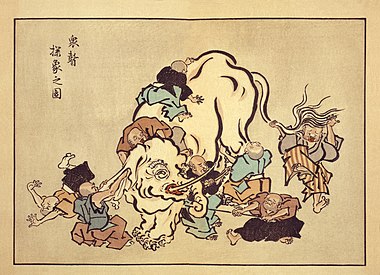 The Buddha twice uses the simile of blind men led astray. In the Canki Sutta he describes a row of blind men holding on to each other as an example of those who follow an old text that has passed down from generation to generation.[6] In the Udana (68–69)[7] he uses the elephant parable to describe sectarian quarrels. A king has the blind men of the capital brought to the palace, where an elephant is brought in and they are asked to describe it.
The men cannot agree with one another and come to blows over the question of what it is like and their dispute delights the king. The Buddha ends the story by comparing the blind men to preachers and scholars who are blind and ignorant and hold to their own views: "Just so are these preachers and scholars holding various views blind and unseeing.... In their ignorance they are by nature quarrelsome, wrangling, and disputatious, each maintaining reality is thus and thus." The Buddha then speaks the following verse:
Rumi, the 13th Century Persian poet and teacher of Sufism, included it in his Masnavi. In his retelling, "The Elephant in the Dark", some Hindus bring an elephant to be exhibited in a dark room. A number of men touch and feel the elephant in the dark and, depending upon where they touch it, they believe the elephant to be like a water spout (trunk), a fan (ear), a pillar (leg) and a throne (back). Rumi uses this story as an example of the limits of individual perception:
The poem begins:
Moral:
The fable is one of a number of tales that cast light on the response of hearers or readers to the story itself. Idries Shah has commented on this element of self-reference in the many interpretations of the story, and its function as a teaching story:
The story enjoys a continuing appeal, as shown by the number of illustrated children's books of the fable; there is one for instance by Paul Galdone and another, Seven Blind Mice, by Ed Young (1992).
In the title cartoon of one of his books, cartoonist Sam Gross postulated that one of the blind men, encountering a pile of the elephant's fewmets, concluded that "An elephant is soft and mushy."
An elephant joke inverts the story in the following way:
It is a parable that has crossed between many religious traditions and is part of Jain, Buddhist, Sufi, Hindu and Bahá’í lore. The tale later became well known in Europe, with 19th century American poet John Godfrey Saxe creating his own version as a poem.[1] The story has been published in many books for adults and children, and interpreted in a variety of ways.

Contents
[hide]The story[edit]
In various versions of the tale, a group of blind men (or men in the dark) touch an elephant to learn what it is like. Each one feels a different part, but only one part, such as the side or the tusk. They then compare notes and learn that they are in complete disagreement.The stories differ primarily in how the elephant's body parts are described, how violent the conflict becomes and how (or if) the conflict among the men and their perspectives is resolved.
In some versions, they stop talking, start listening and collaborate to "see" the full elephant. When a sighted man walks by and sees the entire elephant all at once, the blind men also learn they are all blind. While one's subjective experience is true, it may not be the totality of truth. If the sighted man was deaf, he would not hear the elephant bellow.
It has been used to illustrate a range of truths and fallacies; broadly, the parable implies that one's subjective experience can be true, but that such experience is inherently limited by its failure to account for other truths or a totality of truth. At various times the parable has provided insight into the relativism, opaqueness or inexpressible nature of truth, the behavior of experts in fields where there is a deficit or inaccessibility of information, the need for communication, and respect for different perspectives.
Jain[edit]
A Jain version of the story says that six blind men were asked to determine what an elephant looked like by feeling different parts of the elephant's body. The blind man who feels a leg says the elephant is like a pillar; the one who feels the tail says the elephant is like a rope; the one who feels the trunk says the elephant is like a tree branch; the one who feels the ear says the elephant is like a hand fan; the one who feels the belly says the elephant is like a wall; and the one who feels the tusk says the elephant is like a solid pipe.A king explains to them:
All of you are right. The reason every one of you is telling it differently is because each one of you touched the different part of the elephant. So, actually the elephant has all the features you mentioned.[2]The ancient Jain texts often explain the concepts of anekāntvāda and syādvāda with the parable of the blind men and an elephant (Andhgajanyāyah), which addresses the manifold nature of truth.[3] This parable resolves the conflict, and is used to illustrate the principle of living in harmony with people who have different belief systems, and that truth can be stated in different ways (in Jain beliefs often said to be seven versions). This is known as the Syadvada, Anekantvada, or the theory of Manifold Predications.[2]
Two of the many references to this parable are found in Tattvarthaslokavatika of Vidyanandi (9th century) and Syādvādamanjari of Ācārya Mallisena (13th century). Mallisena uses the parable to argue that immature people deny various aspects of truth; deluded by the aspects they do understand, they deny the aspects they don't understand. "Due to extreme delusion produced on account of a partial viewpoint, the immature deny one aspect and try to establish another. This is the maxim of the blind (men) and the elephant."[4] Mallisena also cites the parable when noting the importance of considering all viewpoints in obtaining a full picture of reality. "It is impossible to properly understand an entity consisting of infinite properties without the method of modal description consisting of all viewpoints, since it will otherwise lead to a situation of seizing mere sprouts (i.e., a superficial, inadequate cognition), on the maxim of the blind (men) and the elephant."[5]
Buddhist[edit]

When the blind men had each felt a part of the elephant, the king went to each of them and said to each: 'Well, blind man, have you seen the elephant? Tell me, what sort of thing is an elephant?'The men assert the elephant is either like a pot (the blind man who felt the elephant's head), a winnowing basket (ear), a plowshare (tusk), a plow (trunk), a granary (body), a pillar (foot), a mortar (back), a pestle (tail) or a brush (tip of the tail).
The men cannot agree with one another and come to blows over the question of what it is like and their dispute delights the king. The Buddha ends the story by comparing the blind men to preachers and scholars who are blind and ignorant and hold to their own views: "Just so are these preachers and scholars holding various views blind and unseeing.... In their ignorance they are by nature quarrelsome, wrangling, and disputatious, each maintaining reality is thus and thus." The Buddha then speaks the following verse:
O how they cling and wrangle, some who claim
For preacher and monk the honored name!
For, quarreling, each to his view they cling.
Such folk see only one side of a thing.[8]
Sufi Muslim[edit]
The Persian Sufi poet Sanai of Ghazni (currently, Afghanistan) presented this teaching story in his The Walled Garden of Truth.[9]Rumi, the 13th Century Persian poet and teacher of Sufism, included it in his Masnavi. In his retelling, "The Elephant in the Dark", some Hindus bring an elephant to be exhibited in a dark room. A number of men touch and feel the elephant in the dark and, depending upon where they touch it, they believe the elephant to be like a water spout (trunk), a fan (ear), a pillar (leg) and a throne (back). Rumi uses this story as an example of the limits of individual perception:
The sensual eye is just like the palm of the hand. The palm has not the means of covering the whole of the beast.[10]Rumi does not present a resolution to the conflict in his version, but states:
The eye of the Sea is one thing and the foam another. Let the foam go, and gaze with the eye of the Sea. Day and night foam-flecks are flung from the sea: oh amazing! You behold the foam but not the Sea. We are like boats dashing together; our eyes are darkened, yet we are in clear water.[10]Rumi ends his poem by stating "If each had a candle and they went in together the differences would disappear." [11]
Hindu[edit]
Ramakrishna Paramahamsa used this parable to discourage dogmatism:[12]A number of blind men came to an elephant. Somebody told them that it was an elephant. The blind men asked, ‘What is the elephant like?’ and they began to touch its body. One of them said: 'It is like a pillar.' This blind man had only touched its leg. Another man said, ‘The elephant is like a husking basket.’ This person had only touched its ears. Similarly, he who touched its trunk or its belly talked of it differently. In the same way, he who has seen the Lord in a particular way limits the Lord to that alone and thinks that He is nothing else.
John Godfrey Saxe[edit]
One of the most famous versions of the 19th century was the poem "The Blind Men and the Elephant" by John Godfrey Saxe (1816–1887).
They conclude that the elephant is like a wall, snake, spear, tree, fan or rope, depending upon where they touch. They have a heated debate that does not come to physical violence. But in Saxe's version, the conflict is never resolved.It was six men of Indostan
To learning much inclined,
Who went to see the Elephant
(Though all of them were blind),
That each by observation
Might satisfy his mind[13]
Moral:
Natalie Merchant sang this poem in full on her Leave Your Sleep album (Disc 1, track 13).So oft in theologic wars,
The disputants, I ween,
Rail on in utter ignorance
Of what each other mean,
And prate about an Elephant
Not one of them has seen!
Modern treatments[edit]
The story is seen as a metaphor in many disciplines, being pressed into service as an analogy in fields well beyond the traditional. In physics, it has been seen as an analogy for the wave–particle duality.[14] In biology, the way the blind men hold onto different parts of the elephant has been seen as a good analogy for the Polyclonal B cell response.[15]The fable is one of a number of tales that cast light on the response of hearers or readers to the story itself. Idries Shah has commented on this element of self-reference in the many interpretations of the story, and its function as a teaching story:
...people address themselves to this story in one or more [...] interpretations. They then accept or reject them. Now they can feel happy; they have arrived at an opinion about the matter. According to their conditioning they produce the answer. Now look at their answers. Some will say that this is a fascinating and touching allegory of the presence of God. Others will say that it is showing people how stupid mankind can be. Some say it is anti-scholastic. Others that it is just a tale copied by Rumi from Sanai – and so on.[16]Shah adapted the tale in his book The Dermis Probe. This version begins with a conference of scientists, from different fields of expertise, presenting their conflicting conclusions on the material upon which a camera is focused. As the camera slowly zooms out it gradually becomes clear that the material under examination is the hide of an African elephant. The words 'The Parts Are Greater Than The Whole' then appear on the screen. This retelling formed the script for a short four-minute film by the animator Richard Williams. The film was chosen as an Outstanding Film of the Year and was exhibited at the London and New York film festivals.[17]
The story enjoys a continuing appeal, as shown by the number of illustrated children's books of the fable; there is one for instance by Paul Galdone and another, Seven Blind Mice, by Ed Young (1992).
In the title cartoon of one of his books, cartoonist Sam Gross postulated that one of the blind men, encountering a pile of the elephant's fewmets, concluded that "An elephant is soft and mushy."
An elephant joke inverts the story in the following way:
Six blind elephants were discussing what men were like. After arguing they decided to find one and determine what it was like by direct experience. The first blind elephant felt the man and declared, 'Men are flat.' After the other blind elephants felt the man, they agreed.Moral:
"We have to remember that what we observe is not nature in itself, but nature exposed to our method of questioning." - Werner Heisenberg
See also[edit]

- Anekantavada
- Dispersed knowledge
- Flatland: A Romance of Many Dimensions, an 1884 satirical novella
- Hasty generalization
- Rashomon effect
- Syncretism
- The blind leading the blind
- Unreliable narrator
References[edit]
- Jump up ^ Martin Gardner (1 September 1995). Famous Poems from Bygone Days. Courier Dover Publications. p. 124. ISBN 978-0-486-28623-5. Retrieved 2012-08-25.
- ^ Jump up to: a b "Elephant and the blind men". Jain Stories. JainWorld.com. Retrieved 2006-08-29.
- Jump up ^ Hughes, Marilynn (2005). The voice of Prophets. Volume 2 of 12. Morrisville, North Carolina: Lulu.com. pp. 590–591. ISBN 1-4116-5121-9.
- Jump up ^ Mallisena, Syādvādamanjari, 14:103–104. Dhruva, A.B. (1933) pp. 9–10.
- Jump up ^ Mallisena, Syādvādamanjari, 19:75–77. Dhruva, A.B. (1933) pp. 23–25.
- Jump up ^ Accesstoinsight.org
- Jump up ^ Katinkahesselink.net
- Jump up ^ Wang, Randy. "The Blind Men and the Elephant". Retrieved 2006-08-29.
- Jump up ^ Included in Idries Shah, Tales of the Dervishes ISBN 0-900860-47-2 Octagon Press 1993.
- ^ Jump up to: a b Arberry, A.J. (2004-05-09). "71 – The Elephant in the dark, on the reconciliation of contrarieties". Rumi – Tales from Masnavi. Retrieved 2006-08-29.
- Jump up ^ For an adaptation of Rumi's poem, see this song version by David Wilcox here.
- Jump up ^ Gupta, Mahendranath (11 March 1883). "Chapter V – Vaishnavism and sectarianism – harmony of religions". Kathamrita. Vol. II. ISBN 81-88343-01-3.
- Jump up ^ Saxe, John Godfrey. "
 The Blind Men and the Elephant". The poems of John Godfrey Saxe. Wikisource. [scan]
 - Jump up ^ For example, Quantum theory by David Bohm, p. 26. Retrieved 2010-03-03.
- Jump up ^ See for instance The lymph node in HIV pathogenesis by Michael M. Lederman and Leonid Margolis, Seminars in Immunology, Volume 20, Issue 3, June 2008, pp. 187–195
- Jump up ^ Shah, Idries. "The Teaching Story: Observations on the Folklore of Our "Modern" Thought". Retrieved 2010-03-05.
- Jump up ^ Octagon Press page for The Dermis Probe, with preview of story

External links[edit]
 | Wikimedia Commons has media related to Blind men and an elephant. |
- Jalal al-Din Muhammad Rumi. " Book III". Masnavi I Ma'navi. Trans. Edward Henry Whinfield. Wikisource.
- Story of the Blind Men and the Elephant from www.spiritual-education.org[dead link]
- All of Saxe's Poems including original printing of The Blindman and the Elephant[dead link] Free to read and full text search.
- Buddhist Version as found in Jainism and Buddhism. Udana hosted by the University of Princeton
- Jalal ad-Din Muhammad Rumi's version as translated by A.J. Arberry
- Jainist Version hosted by Jainworld
- John Godfrey Saxe's version hosted at Rice University[dead link]
Categories:
- Elephants in Indian culture
- Fictional elephants
- Fables
- Oral tradition
- Indian literature
- Indian folklore
- Indian short stories
- Parables
- Sufi literature
- Persian literature
- Wisdom literature
- Pali Buddhist texts
- Storytelling
- Epistemology
- Perception
- Relativism
- Inductive fallacies
- Informal fallacies
- Belief
- Reality
- Illusions
- Blindness
- Metaphors referring to elephants


