The more "exotic" interpretations of Quantum Mechanics have well-known relevance to parapsychology, and mysticism.
Quantum mechanics (QM – also known as
quantum physics, or
quantum theory) is a branch of
physics which deals with physical phenomena at
nanoscopic scales where the
action is on the order of the
Planck constant. It departs from
classical mechanics primarily at the
quantum realm of
atomic and
subatomic length scales. Quantum mechanics provides a mathematical description of much of the dual
particle-like and
wave-like behavior and interactions of
energy and
matter. Quantum mechanics provides a substantially useful framework for many features of the modern
periodic table of elements including the behavior of atoms during
chemical bonding and has played a significant role in the development of many modern technologies.
In advanced topics of quantum mechanics, some of these behaviors are
macroscopic (see
macroscopic quantum phenomena) and emerge at only extreme (i.e., very low or very high) energies or
temperatures (such as in the use of
superconducting magnets). For example, the
angular momentum of an electron bound to an
atom or
molecule is quantized. In contrast, the angular momentum of an unbound electron is not quantized. In the context of quantum mechanics, the
wave–particle duality of energy and matter and the
uncertainty principle provide a unified view of the behavior of
photons,
electrons, and other atomic-scale objects.
The
mathematical formulations of quantum mechanics are abstract. A mathematical function, the
wavefunction, provides information about the
probability amplitude of position, momentum, and other physical properties of a particle. Mathematical manipulations of the wavefunction usually involve
bra–ket notation which requires an understanding of
complex numbers and
linear functionals. The wavefunction formulation treats the particle as a
quantum harmonic oscillator, and the mathematics is akin to that describing
acoustic resonance. Many of the results of quantum mechanics are not easily visualized in terms of
classical mechanics. For instance, in a quantum mechanical model the lowest energy state of a system, the
ground state, is non-zero as opposed to a more "traditional" ground state with zero
kinetic energy (all particles at rest). Instead of a traditional static, unchanging zero energy state, quantum mechanics allows for far more dynamic, chaotic possibilities, according to
John Wheeler.
The earliest versions of quantum mechanics were formulated in the first decade of the 20th century. About this time, the
atomic theory and the
corpuscular theory of light (as updated by
Einstein) first came to be widely accepted as scientific fact; these latter theories can be viewed as quantum theories of
matter and
electromagnetic radiation, respectively.
Early quantum theory was significantly reformulated in the mid-1920s by
Werner Heisenberg,
Max Born and
Pascual Jordan, (
matrix mechanics);
Louis de Broglie and
Erwin Schrödinger (
wave mechanics); and
Wolfgang Pauli and
Satyendra Nath Bose (statistics of subatomic particles). Moreover, the
Copenhagen interpretation of
Niels Bohr became widely accepted. By 1930, quantum mechanics had been further unified and formalized by the work of
David Hilbert,
Paul Dirac and
John von Neumann[1] with a greater emphasis placed on
measurement in quantum mechanics, the statistical nature of our knowledge of reality, and
philosophical speculation about the role of the observer. Quantum mechanics has since permeated throughout many aspects of 20th-century physics and other disciplines including
quantum chemistry,
quantum electronics,
quantum optics, and
quantum information science. Much 19th-century physics has been re-evaluated as the "classical limit" of quantum mechanics and its more advanced developments in terms of
quantum field theory,
string theory, and speculative
quantum gravity theories.
The name
quantum mechanics derives from the observation that some physical quantities can change only in
discrete amounts (Latin
quanta), and not in a continuous (
cf. analog) way.
History[edit]
Scientific inquiry into the wave nature of light began in the 17th and 18th centuries when scientists such as
Robert Hooke,
Christiaan Huygens and
Leonhard Euler proposed a wave theory of light based on experimental observations.
[2] In 1803,
Thomas Young, an English
polymath, performed the famous
double-slit experiment that he later described in a paper entitled "On the nature of light and colours". This experiment played a major role in the general acceptance of the
wave theory of light.
In 1838, with the discovery of
cathode rays by
Michael Faraday, these studies were followed by the 1859 statement of the
black-body radiation problem by
Gustav Kirchhoff, the 1877 suggestion by
Ludwig Boltzmann that the energy states of a physical system can be discrete, and the 1900 quantum hypothesis of
Max Planck.
[3] Planck's hypothesis that energy is radiated and absorbed in discrete "quanta" (or "energy elements") precisely matched the observed patterns of black-body radiation.
In 1896,
Wilhelm Wien empirically determined a distribution law of black-body radiation,
[4] known as
Wien's law in his honor. Ludwig Boltzmann independently arrived at this result by considerations of
Maxwell's equations. However, it was valid only at high frequencies, and underestimated the radiance at low frequencies. Later,
Max Planck corrected this model using Boltzmann statistical interpretation of thermodynamics and proposed what is now called
Planck's law, which led to the development of quantum mechanics.
Among the first to study quantum phenomena in nature were
Arthur Compton,
C.V. Raman,
Pieter Zeeman, each of whom has a quantum effect named after him.
Robert A. Millikan studied the
Photoelectric effect experimentally and
Albert Einstein developed a theory for it. At the same time
Niels Bohr developed his theory of the atomic structure which was later confirmed by the experiments of
Henry Moseley. In 1913,
Peter Debye extended Niels Bohr's theory of atomic structure, introducing
elliptical orbits, a concept also introduced by
Arnold Sommerfeld.
[5] This phase is known as
Old quantum theory.
According to Planck, each energy element,
E, is proportional to its
frequency,
ν:


Planck is considered the father of the Quantum Theory
where
h is
Planck's constant. Planck (cautiously) insisted that this was simply an aspect of the
processes of absorption and emission of radiation and had nothing to do with the
physical reality of the radiation itself.
[6] In fact, he considered his
quantum hypothesis a mathematical trick to get the right answer rather than a sizeable discovery.
[citation needed] However, in 1905
Albert Einstein interpreted Planck's quantum hypothesis
realistically and used it to explain the
photoelectric effect in which shining light on certain materials can eject electrons from the material.
The foundations of quantum mechanics were established during the first half of the 20th century by
Max Planck,
Niels Bohr,
Werner Heisenberg,
Louis de Broglie,
Arthur Compton,
Albert Einstein,
Erwin Schrödinger,
Max Born,
John von Neumann,
Paul Dirac,
Enrico Fermi,
Wolfgang Pauli,
Max von Laue,
Freeman Dyson,
David Hilbert,
Wilhelm Wien,
Satyendra Nath Bose,
Arnold Sommerfeld and
others. In the mid-1920s, developments in quantum mechanics led to its becoming the standard formulation for atomic physics. In the summer of 1925, Bohr and Heisenberg published results that closed the
"Old Quantum Theory". Out of deference to their particle-like behavior in certain processes and measurements, light quanta came to be called
photons (1926). From Einstein's simple postulation was born a flurry of debating, theorizing, and testing. Thus the entire field of
quantum physics emerged, leading to its wider acceptance at the Fifth
Solvay Conference in 1927.
The other
exemplar that led to quantum mechanics was the study of
electromagnetic waves, such as visible and ultraviolet light. When it was found in 1900 by Max Planck that the energy of waves could be described as consisting of small packets or "quanta", Albert Einstein further developed this idea to show that an electromagnetic wave such as light could also be described as a particle (later called the
photon) with a discrete quantum of energy that was dependent on its frequency.
[7] Einstein was able to use the photon theory of light to explain the photoelectric effect for which he won the 1921 Nobel Prize in Physics. This led to a
theory of unity between
subatomic particles and electromagnetic waves in which particles and waves are neither simply particle nor wave but have certain properties of each. This originated the concept of
wave–particle duality.
While quantum mechanics traditionally described the world of the very small, it is also needed to explain certain recently investigated
macroscopic systems such as
superconductors,
superfluids, and large organic molecules.
[8]
The word
quantum derives from the
Latin, meaning "how great" or "how much".
[9] In quantum mechanics, it refers to a discrete unit that quantum theory assigns to certain
physical quantities, such as the
energy of an
atom at rest (see Figure 1). The discovery that particles are discrete packets of energy with wave-like properties led to the branch of physics dealing with atomic and sub-atomic systems which is today called quantum mechanics. It underlies the
mathematical framework of many fields of
physics and
chemistry, including
condensed matter physics,
solid-state physics,
atomic physics,
molecular physics,
computational physics,
computational chemistry,
quantum chemistry,
particle physics,
nuclear chemistry, and
nuclear physics.
[10] Some fundamental aspects of the theory are still actively studied.
[11]
Quantum mechanics is essential to understanding the behavior of systems at
atomic length scales and smaller. If the physical nature of an atom was solely described by
classical mechanics electrons would not "orbit" the nucleus since orbiting electrons emit radiation (due to
circular motion) and would eventually collide with the nucleus due to this loss of energy. This framework was unable to explain the stability of atoms. Instead, electrons remain in an uncertain, non-deterministic, "smeared",
probabilistic, wave–particle
orbital about the nucleus, defying the traditional assumptions of
classical mechanics and
electromagnetism.
[12]
Quantum mechanics was initially developed to provide a better explanation and description of the atom, especially the differences in the
spectra of light emitted by different
isotopes of the same
element, as well as subatomic particles. In short, the quantum-mechanical atomic model has succeeded spectacularly in the realm where classical mechanics and electromagnetism falter.
Broadly speaking, quantum mechanics incorporates four classes of phenomena for which classical physics cannot account:
Mathematical formulations[edit]
In the mathematically rigorous formulation of quantum mechanics developed by
Paul Dirac,
[13] David Hilbert,
[14] John von Neumann,
[15] and
Hermann Weyl[16] the possible states of a quantum mechanical system are represented by
unit vectors (called "state vectors"). Formally, these reside in a
complex separable Hilbert space—variously called the "
state space" or the "associated Hilbert space" of the system—that is well defined up to a complex number of norm 1 (the phase factor). In other words, the possible states are points in the
projective space of a Hilbert space, usually called the
complex projective space. The exact nature of this Hilbert space is dependent on the system—for example, the state space for position and momentum states is the space of
square-integrable functions, while the state space for the spin of a single proton is just the product of two complex planes. Each observable is represented by a maximally
Hermitian (precisely: by a
self-adjoint) linear
operator acting on the state space. Each
eigenstate of an observable corresponds to an
eigenvector of the operator, and the associated
eigenvalue corresponds to the value of the observable in that eigenstate. If the operator's spectrum is discrete, the observable can attain only those discrete eigenvalues.
In the formalism of quantum mechanics, the state of a system at a given time is described by a
complex wave function, also referred to as state vector in a complex
vector space.
[17] This abstract mathematical object allows for the calculation of
probabilities of outcomes of concrete experiments. For example, it allows one to compute the probability of finding an electron in a particular region around the nucleus at a particular time. Contrary to classical mechanics, one can never make simultaneous predictions of
conjugate variables, such as position and momentum, with accuracy. For instance, electrons may be considered (to a certain probability) to be located somewhere within a given region of space, but with their exact positions unknown. Contours of constant probability, often referred to as "clouds", may be drawn around the nucleus of an atom to conceptualize where the electron might be located with the most probability. Heisenberg's
uncertainty principle quantifies the inability to precisely locate the particle given its conjugate momentum.
[18]
According to one interpretation, as the result of a measurement the wave function containing the probability information for a system collapses from a given initial state to a particular eigenstate. The possible results of a measurement are the eigenvalues of the operator representing the observable—which explains the choice of
Hermitian operators, for which all the eigenvalues are real. The probability distribution of an observable in a given state can be found by computing the
spectral decomposition of the corresponding operator. Heisenberg's
uncertainty principle is represented by the statement that the operators corresponding to certain observables do not
commute.
The
probabilistic nature of quantum mechanics thus stems from the act of measurement. This is one of the most difficult aspects of quantum systems to understand. It was the central topic in the famous
Bohr-Einstein debates, in which the two scientists attempted to clarify these fundamental principles by way of
thought experiments. In the decades after the formulation of quantum mechanics, the question of what constitutes a "measurement" has been extensively studied. Newer
interpretations of quantum mechanics have been formulated that do away with the concept of "wavefunction collapse" (see, for example, the
relative state interpretation). The basic idea is that when a quantum system interacts with a measuring apparatus, their respective wavefunctions become
entangled, so that the original quantum system ceases to exist as an independent entity. For details, see the article on
measurement in quantum mechanics.
[19]
Generally, quantum mechanics does not assign definite values. Instead, it makes a prediction using a
probability distribution; that is, it describes the probability of obtaining the possible outcomes from measuring an observable. Often these results are skewed by many causes, such as dense probability clouds. Probability clouds are approximate, but better than
the Bohr model, whereby electron location is given by a
probability function, the
wave function eigenvalue, such that the probability is the squared modulus of the complex amplitude, or quantum state nuclear attraction.
[20][21] Naturally, these probabilities will depend on the quantum state at the "instant" of the measurement. Hence, uncertainty is involved in the value. There are, however, certain states that are associated with a definite value of a particular observable. These are known as
eigenstates of the observable ("eigen" can be translated from
German as meaning "inherent" or "characteristic").
[22]
In the everyday world, it is natural and intuitive to think of everything (every observable) as being in an eigenstate. Everything appears to have a definite position, a definite momentum, a definite energy, and a definite time of occurrence. However, quantum mechanics does not pinpoint the exact values of a particle's position and momentum (since they are
conjugate pairs) or its energy and time (since they too are conjugate pairs); rather, it provides only a range of probabilities in which that particle might be given its momentum and momentum probability. Therefore, it is helpful to use different words to describe states having
uncertain values and states having
definite values (eigenstates). Usually, a system will not be in an
eigenstate of the observable (particle) we are interested in. However, if one measures the observable, the wavefunction will instantaneously be an eigenstate (or "generalized" eigenstate) of that observable. This process is known as
wavefunction collapse, a controversial and much-debated process
[23] that involves expanding the system under study to include the measurement device. If one knows the corresponding wave function at the instant before the measurement, one will be able to compute the probability of the wavefunction collapsing into each of the possible eigenstates. For example, the free particle in the previous example will usually have a wavefunction that is a
wave packet centered around some mean position
x0 (neither an eigenstate of position nor of momentum). When one measures the position of the particle, it is impossible to predict with certainty the result.
[19] It is probable, but not certain, that it will be near
x0, where the amplitude of the wave function is large. After the measurement is performed, having obtained some result
x, the wave function collapses into a position eigenstate centered at
x.
[24]
The time evolution of a quantum state is described by the
Schrödinger equation, in which the
Hamiltonian (the
operator corresponding to the
total energy of the system) generates the time evolution. The
time evolution of wave functions is
deterministic in the sense that - given a wavefunction at an
initial time - it makes a definite prediction of what the wavefunction will be at any
later time.
[25]
During a
measurement, on the other hand, the change of the initial wavefunction into another, later wavefunction is not deterministic, it is unpredictable (i.e.,
random). A time-evolution simulation can be seen here.
[26][27]
Wave functions change as time progresses. The
Schrödinger equation describes how wavefunctions change in time, playing a role similar to
Newton's second law in
classical mechanics. The Schrödinger equation, applied to the aforementioned example of the free particle, predicts that the center of a wave packet will move through space at a constant velocity (like a classical particle with no forces acting on it). However, the wave packet will also spread out as time progresses, which means that the position becomes more uncertain with time. This also has the effect of turning a position eigenstate (which can be thought of as an infinitely sharp wave packet) into a broadened wave packet that no longer represents a (definite, certain) position eigenstate.
[28]
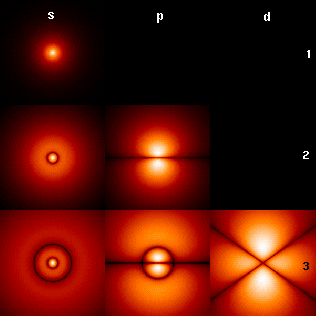
Fig. 1:
Probability densities corresponding to the wavefunctions of an electron in a hydrogen atom possessing definite energy levels (increasing from the top of the image to the bottom:
n = 1, 2, 3, ...) and angular momenta (increasing across from left to right:
s,
p,
d, ...). Brighter areas correspond to higher probability density in a position measurement. Such wavefunctions are directly comparable to
Chladni's figures of
acoustic modes of vibration in
classical physics, and are modes of oscillation as well, possessing a sharp
energy and, thus, a definite
frequency. The
angular momentum and energy are
quantized, and take
only discrete values like those shown (as is the case for
resonant frequencies in acoustics)
Some wave functions produce probability distributions that are constant, or independent of time—such as when in a
stationary state of constant energy, time vanishes in the absolute square of the wave function. Many systems that are treated dynamically in classical mechanics are described by such "static" wave functions. For example, a single
electron in an unexcited
atom is pictured classically as a particle moving in a circular trajectory around the
atomic nucleus, whereas in quantum mechanics it is described by a static,
spherically symmetric wavefunction surrounding the nucleus (
Fig. 1) (note, however, that only the lowest angular momentum states, labeled
s, are spherically symmetric).
[29]
The Schrödinger equation acts on the
entire probability amplitude, not merely its absolute value. Whereas the absolute value of the probability amplitude encodes information about probabilities, its
phase encodes information about the
interference between quantum states. This gives rise to the "wave-like" behavior of quantum states. As it turns out, analytic solutions of the Schrödinger equation are available for only
a very small number of relatively simple model Hamiltonians, of which the
quantum harmonic oscillator, the
particle in a box, the
hydrogen molecular ion, and the
hydrogen atom are the most important representatives. Even the
helium atom—which contains just one more electron than does the hydrogen atom—has defied all attempts at a fully analytic treatment.
There exist several techniques for generating approximate solutions, however. In the important method known as
perturbation theory, one uses the analytic result for a simple quantum mechanical model to generate a result for a more complicated model that is related to the simpler model by (for one example) the addition of a weak
potential energy. Another method is the "semi-classical equation of motion" approach, which applies to systems for which quantum mechanics produces only weak (small) deviations from classical behavior. These deviations can then be computed based on the classical motion. This approach is particularly important in the field of
quantum chaos.
Mathematically equivalent formulations of quantum mechanics[edit]
There are numerous mathematically equivalent formulations of quantum mechanics. One of the oldest and most commonly used formulations is the "
transformation theory" proposed by
Paul Dirac, which unifies and generalizes the two earliest formulations of quantum mechanics -
matrix mechanics (invented by
Werner Heisenberg)
[30] and
wave mechanics (invented by
Erwin Schrödinger).
[31]
Especially since
Werner Heisenberg was awarded the
Nobel Prize in Physics in 1932 for the creation of quantum mechanics, the role of
Max Born in the development of QM was overlooked until the 1954 Nobel award. The role is noted in a 2005 biography of Born, which recounts his role in the matrix formulation of quantum mechanics, and the use of probability amplitudes. Heisenberg himself acknowledges having learned matrices from Born, as published in a 1940
festschrift honoring
Max Planck.
[32] In the matrix formulation, the
instantaneous state of a quantum system encodes the probabilities of its measurable properties, or "
observables". Examples of observables include
energy,
position,
momentum, and
angular momentum. Observables can be either
continuous (e.g., the position of a particle) or
discrete (e.g., the energy of an electron bound to a hydrogen atom).
[33] An alternative formulation of quantum mechanics is
Feynman's
path integral formulation, in which a quantum-mechanical amplitude is considered as a sum over all possible histories between the initial and final states. This is the quantum-mechanical counterpart of the
action principle in classical mechanics.
Interactions with other scientific theories[edit]
The rules of quantum mechanics are fundamental. They assert that the state space of a system is a
Hilbert space, and that observables of that system are
Hermitian operators acting on that space—although they do not tell us which Hilbert space or which operators. These can be chosen appropriately in order to obtain a quantitative description of a quantum system. An important guide for making these choices is the
correspondence principle, which states that the predictions of quantum mechanics reduce to those of classical mechanics when a system moves to higher energies or—equivalently—larger quantum numbers, i.e. whereas a single particle exhibits a degree of randomness, in systems incorporating millions of particles averaging takes over and, at the high energy limit, the statistical probability of random behaviour approaches zero. In other words, classical mechanics is simply a quantum mechanics of large systems. This "high energy" limit is known as the
classical or
correspondence limit. One can even start from an established classical model of a particular system, then attempt to guess the underlying quantum model that would give rise to the classical model in the correspondence limit.
When quantum mechanics was originally formulated, it was applied to models whose correspondence limit was
non-relativistic classical mechanics. For instance, the well-known model of the
quantum harmonic oscillator uses an explicitly non-relativistic expression for the
kinetic energy of the oscillator, and is thus a quantum version of the
classical harmonic oscillator.
Early attempts to merge quantum mechanics with
special relativity involved the replacement of the Schrödinger equation with a covariant equation such as the
Klein–Gordon equation or the
Dirac equation. While these theories were successful in explaining many experimental results, they had certain unsatisfactory qualities stemming from their neglect of the relativistic creation and annihilation of particles. A fully relativistic quantum theory required the development of
quantum field theory, which applies quantization to a field (rather than a fixed set of particles). The first complete quantum field theory,
quantum electrodynamics, provides a fully quantum description of the
electromagnetic interaction. The full apparatus of quantum field theory is often unnecessary for describing electrodynamic systems. A simpler approach, one that has been employed since the inception of quantum mechanics, is to treat
charged particles as quantum mechanical objects being acted on by a classical
electromagnetic field. For example, the elementary quantum model of the
hydrogen atom describes the
electric field of the hydrogen atom using a classical
 Coulomb potential
. This "semi-classical" approach fails if quantum fluctuations in the electromagnetic field play an important role, such as in the emission of
photons by
charged particles.
Quantum field theories for the
strong nuclear force and the
weak nuclear force have also been developed. The quantum field theory of the strong nuclear force is called
quantum chromodynamics, and describes the interactions of subnuclear particles such as
quarks and
gluons. The weak nuclear force and the
electromagnetic force were unified, in their quantized forms, into a single quantum field theory (known as
electroweak theory), by the physicists
Abdus Salam,
Sheldon Glashow and
Steven Weinberg. These three men shared the Nobel Prize in Physics in 1979 for this work.
[34]
It has proven difficult to construct quantum models of
gravity, the remaining
fundamental force. Semi-classical approximations are workable, and have led to predictions such as
Hawking radiation. However, the formulation of a complete theory of
quantum gravity is hindered by apparent incompatibilities between
general relativity (the most accurate theory of gravity currently known) and some of the fundamental assumptions of quantum theory. The resolution of these incompatibilities is an area of active research, and theories such as
string theory are among the possible candidates for a future theory of quantum gravity.
Classical mechanics has also been extended into the
complex domain, with complex classical mechanics exhibiting behaviors similar to quantum mechanics.
[35]
Quantum mechanics and classical physics[edit]
Predictions of quantum mechanics have been verified experimentally to an extremely high degree of accuracy.
[36] According to the
correspondence principle between classical and quantum mechanics, all objects obey the laws of quantum mechanics, and classical mechanics is just an approximation for large systems of objects (or a statistical quantum mechanics of a large collection of particles).
[37] The laws of classical mechanics thus follow from the laws of quantum mechanics as a statistical average at the limit of large systems or large
quantum numbers.
[38] However,
chaotic systems do not have good quantum numbers, and
quantum chaos studies the relationship between classical and quantum descriptions in these systems.
Quantum coherence is an essential difference between classical and quantum theories as illustrated by the
Einstein–Podolsky–Rosen (EPR) paradox — an attempt to disprove quantum mechanics by an appeal to
local realism.
[39] Quantum interference involves adding together
probability amplitudes, whereas classical "waves" infer that there is an adding together of
intensities. For microscopic bodies, the extension of the system is much smaller than the
coherence length, which gives rise to long-range entanglement and other nonlocal phenomena characteristic of quantum systems.
[40] Quantum coherence is not typically evident at macroscopic scales, though an exception to this rule may occur at extremely low temperatures (i.e. approaching
absolute zero) at which quantum behavior may manifest itself macroscopically.
[41] This is in accordance with the following observations:
- Many macroscopic properties of a classical system are a direct consequence of the quantum behavior of its parts. For example, the stability of bulk matter (consisting of atoms and molecules which would quickly collapse under electric forces alone), the rigidity of solids, and the mechanical, thermal, chemical, optical and magnetic properties of matter are all results of the interaction of electric charges under the rules of quantum mechanics.[42]
- While the seemingly "exotic" behavior of matter posited by quantum mechanics and relativity theory become more apparent when dealing with particles of extremely small size or velocities approaching the speed of light, the laws of classical, often considered "Newtonian", physics remain accurate in predicting the behavior of the vast majority of "large" objects (on the order of the size of large molecules or bigger) at velocities much smaller than the velocity of light.[43]
Relativity and quantum mechanics[edit]
Even with the defining postulates of both Einstein's theory of general relativity and quantum theory being indisputably supported by rigorous and repeated
empirical evidence and while they do not directly contradict each other theoretically (at least with regard to their primary claims), they have proven extremely difficult to incorporate into one consistent, cohesive model.
[44]
Einstein himself is well known for rejecting some of the claims of quantum mechanics. While clearly contributing to the field, he did not accept many of the more "philosophical consequences and interpretations" of quantum mechanics, such as the lack of deterministic
causality. He is famously quoted as saying, in response to this aspect, "My God does not play with dice". He also had difficulty with the assertion that a single
subatomic particle can occupy numerous areas of space at one time. However, he was also the first to notice some of the apparently exotic consequences of
entanglement, and used them to formulate the
Einstein–Podolsky–Rosen paradox in the hope of showing that quantum mechanics had unacceptable implications if taken as a complete description of physical reality. This was 1935, but in 1964 it was shown by John Bell (see
Bell inequality) that - although Einstein was correct in identifying seemingly paradoxical implications of
quantum mechanical nonlocality - these implications could be experimentally tested. Alain Aspect's initial experiments in 1982, and many subsequent experiments since, have definitively verified quantum entanglement.
According to the paper of J. Bell and the
Copenhagen interpretation—the common interpretation of quantum mechanics by physicists since 1927 - and contrary to Einstein's ideas, quantum mechanics was
not, at the same time a "realistic" theory and a "
local" theory.
The
Einstein–Podolsky–Rosen paradox shows in any case that there exist experiments by which one can measure the state of one particle and instantaneously change the state of its entangled partner - although the two particles can be an arbitrary distance apart. However, this effect does not violate
causality, since no transfer of information happens. Quantum entanglement forms the basis of
quantum cryptography, which is used in high-security commercial applications in banking and government.
Gravity is negligible in many areas of particle physics, so that unification between general relativity and quantum mechanics is not an urgent issue in those particular applications. However, the lack of a correct theory of
quantum gravity is an important issue in
cosmology and the search by physicists for an elegant "
Theory of Everything" (TOE). Consequently, resolving the inconsistencies between both theories has been a major goal of 20th and 21st century physics. Many prominent physicists, including
Stephen Hawking, have labored for many years in the attempt to discover a theory underlying
everything. This TOE would combine not only the different models of subatomic physics, but also derive the four
fundamental forces of nature - the
strong force,
electromagnetism, the
weak force, and
gravity - from a single force or phenomenon. While Stephen Hawking was initially a believer in the Theory of Everything, after considering
Gödel's Incompleteness Theorem, he has concluded that one is not obtainable, and has stated so publicly in his lecture "Gödel and the End of Physics" (2002).
[45]
Attempts at a unified field theory[edit]
The quest to unify the
fundamental forces through quantum mechanics is still ongoing.
Quantum electrodynamics (or "quantum electromagnetism"), which is currently (in the perturbative regime at least) the most accurately tested physical theory,
[46][unreliable source](blog) has been successfully merged with the weak nuclear force into the
electroweak force and work is currently being done to merge the electroweak and strong force into the
electrostrong force. Current predictions state that at around 10
14 GeV the three aforementioned forces are fused into a single unified field,
[47] Beyond this "grand unification", it is speculated that it may be possible to merge gravity with the other three gauge symmetries, expected to occur at roughly 10
19 GeV. However — and while special relativity is parsimoniously incorporated into quantum electrodynamics — the expanded
general relativity, currently the best theory describing the gravitation force, has not been fully incorporated into quantum theory. One of the leading authorities continuing the search for a coherent TOE is
Edward Witten, a theoretical physicist who formulated the groundbreaking
M-theory, which is an attempt at describing the supersymmetrical based
string theory. M-theory posits that our apparent 4-dimensional
spacetime is, in reality, actually an 11-dimensional spacetime containing 10 spatial dimensions and 1 time dimension, although 7 of the spatial dimensions are - at lower energies - completely "compactified" (or infinitely curved) and not readily amenable to measurement or probing.
Another popular theory is
Loop quantum gravity (LQG), a theory that describes the quantum properties of gravity. It is also a theory of
quantum space and
quantum time, because in general relativity the geometry of spacetime is a manifestation of
gravity. LQG is an attempt to merge and adapt standard quantum mechanics and standard
general relativity. The main output of the theory is a physical picture of space where space is granular. The granularity is a direct consequence of the quantization. It has the same nature of the granularity of the photons in the quantum theory of electromagnetism or the discrete levels of the energy of the atoms. But here it is space itself which is discrete. More precisely, space can be viewed as an extremely fine fabric or network "woven" of finite loops. These networks of loops are called
spin networks. The evolution of a spin network over time, is called a spin foam. The predicted size of this structure is the
Planck length, which is approximately 1.616×10
−35 m. According to theory, there is no meaning to length shorter than this (cf.
Planck scale energy). Therefore LQG predicts that not just matter, but also space itself, has an atomic structure. Loop quantum Gravity was first proposed by
Carlo Rovelli.
Philosophical implications[edit]
Since its inception, the many
counter-intuitive aspects and results of quantum mechanics have provoked strong
philosophical debates and many
interpretations. Even fundamental issues, such as
Max Born's basic
rules concerning
probability amplitudes and
probability distributions took decades to be appreciated by society and many leading scientists.
Richard Feynman once said, "I think I can safely say that nobody understands quantum mechanics."
[48] According to
Steven Weinberg, "There is now in my opinion no entirely satisfactory interpretation of quantum mechanics."
[49]
The
Copenhagen interpretation - due largely to the Danish theoretical physicist
Niels Bohr - remains the quantum mechanical formalism that is currently most widely accepted amongst physicists, some 75 years after its enunciation. According to this interpretation, the probabilistic nature of quantum mechanics is not a
temporary feature which will eventually be replaced by a deterministic theory, but instead must be considered a
final renunciation of the classical idea of "causality". It is also believed therein that any well-defined application of the quantum mechanical formalism must always make reference to the experimental arrangement, due to the
complementarity nature of evidence obtained under different experimental situations.
Albert Einstein, himself one of the founders of quantum theory,
disliked this loss of determinism in measurement. Einstein held that there should be a
local hidden variable theory underlying quantum mechanics and, consequently, that the present theory was incomplete. He produced a series of objections to the theory, the most famous of which has become known as the
Einstein–Podolsky–Rosen paradox.
John Bell showed that this "EPR" paradox led to
experimentally testable differences between quantum mechanics and local realistic theories.
Experiments have been performed confirming the accuracy of quantum mechanics, thereby demonstrating that the physical world cannot be described by any local realistic theory.
[50] The
Bohr-Einstein debates provide a vibrant critique of the Copenhagen Interpretation from an
epistemological point of view.
The
Everett many-worlds interpretation, formulated in 1956, holds that
all the possibilities described by quantum theory
simultaneously occur in a
multiverse composed of mostly independent parallel universes.
[51] This is not accomplished by introducing some "new axiom" to quantum mechanics, but on the contrary, by
removing the axiom of the collapse of the wave packet.
All of the possible consistent states of the measured system and the measuring apparatus (including the observer) are present in a
real physical - not just formally mathematical, as in other interpretations -
quantum superposition. Such a superposition of consistent state combinations of different systems is called an
entangled state. While the multiverse is deterministic, we perceive non-deterministic behavior governed by probabilities, because we can observe only the universe (i.e., the consistent state contribution to the aforementioned superposition) that we, as observers, inhabit. Everett's interpretation is perfectly consistent with
John Bell's experiments and makes them intuitively understandable. However, according to the theory of
quantum decoherence, these "parallel universes" will never be accessible to us. The inaccessibility can be understood as follows: once a measurement is done, the measured system becomes
entangled with
both the physicist who measured it
and a huge number of other particles, some of which are
photons flying away at the
speed of light towards the other end of the universe. In order to prove that the wave function did not collapse, one would have to bring
all these particles back and measure them again, together with the system that was originally measured. Not only is this completely impractical, but even if one
could theoretically do this, it would have to destroy any evidence that the original measurement took place (to include the physicist's memory!); in light of these
Bell tests, Cramer (1986) formulated his
transactional interpretation.
[52] Relational quantum mechanics appeared in the late 1990s as the modern derivative of the
Copenhagen Interpretation.
Applications[edit]
Quantum mechanics had enormous
[53] success in explaining many of the features of our world. Quantum mechanics is often the only tool available that can reveal the individual behaviors of the subatomic particles that make up all forms of
matter (
electrons,
protons,
neutrons,
photons, and others). Quantum mechanics has strongly influenced
string theories, candidates for a
Theory of Everything (see
reductionism).
Quantum mechanics is also critically important for understanding how individual atoms combine covalently to form
molecules. The application of quantum mechanics to
chemistry is known as
quantum chemistry. Relativistic quantum mechanics can, in principle, mathematically describe most of chemistry. Quantum mechanics can also provide quantitative insight into
ionic and
covalent bonding processes by explicitly showing which molecules are energetically favorable to which others, and the magnitudes of the energies involved.
[54] Furthermore, most of the calculations performed in modern
computational chemistry rely on quantum mechanics.

A working mechanism of a resonant tunneling diode device, based on the phenomenon of quantum tunneling through potential barriers
A great deal of modern technological inventions operate at a scale where quantum effects are significant. Examples include the
laser, the
transistor (and thus the
microchip), the
electron microscope, and
magnetic resonance imaging (MRI). The study of
semiconductors led to the invention of the
diode and the
transistor, which are indispensable parts of modern
electronics systems and devices.
Researchers are currently seeking robust methods of directly manipulating quantum states. Efforts are being made to more fully develop
quantum cryptography, which will theoretically allow guaranteed secure transmission of
information. A more distant goal is the development of
quantum computers, which are expected to perform certain computational tasks exponentially faster than classical
computers. Another active research topic is
quantum teleportation, which deals with techniques to transmit quantum information over arbitrary distances.
Quantum tunneling is vital to the operation of many devices - even in the simple
light switch, as otherwise the electrons in the
electric current could not penetrate the potential barrier made up of a layer of oxide.
Flash memory chips found in
USB drives use quantum tunneling to erase their memory cells.
While quantum mechanics primarily applies to the atomic regimes of matter and energy, some systems exhibit
quantum mechanical effects on a large scale -
superfluidity, the frictionless flow of a liquid at temperatures near
absolute zero, is one well-known example. Quantum theory also provides accurate descriptions for many previously unexplained phenomena, such as
black-body radiation and the stability of
the orbitals of electrons in atoms. It has also given insight into the workings of many different
biological systems, including
smell receptors and
protein structures.
[55] Recent work on
photosynthesis has provided evidence that quantum correlations play an essential role in this basic fundamental process of the
plant kingdom.
[56] Even so,
classical physics can often provide good approximations to results otherwise obtained by quantum physics, typically in circumstances with large numbers of particles or large quantum numbers.
Examples[edit]
Free particle[edit]
For example, consider a
free particle. In quantum mechanics, there is
wave–particle duality, so the properties of the particle can be described as the properties of a wave. Therefore, its
quantum state can be represented as a
wave of arbitrary shape and extending over space as a
wave function. The position and momentum of the particle are
observables. The
Uncertainty Principle states that both the position and the momentum cannot simultaneously be measured with complete precision. However, one
can measure the position (alone) of a moving free particle, creating an eigenstate of position with a wavefunction that is very large (a
Dirac delta) at a particular position
x, and zero everywhere else. If one performs a position measurement on such a wavefunction, the resultant
x will be obtained with 100% probability (i.e., with full certainty, or complete precision). This is called an eigenstate of position—or, stated in mathematical terms, a
generalized position eigenstate (eigendistribution). If the particle is in an eigenstate of position, then its momentum is completely unknown. On the other hand, if the particle is in an eigenstate of momentum, then its position is completely unknown.
[57] In an eigenstate of momentum having a
plane wave form, it can be shown that the
wavelength is equal to
h/p, where
h is
Planck's constant and
p is the momentum of the
eigenstate.
[58]

3D confined electron wave functions for each eigenstate in a Quantum Dot. Here, rectangular and triangular-shaped quantum dots are shown. Energy states in rectangular dots are more ‘s-type’ and ‘p-type’. However, in a triangular dot, the wave functions are mixed due to confinement symmetry.
Step potential[edit]

Scattering at a finite potential step of height
V0, shown in green. The amplitudes and direction of left- and right-moving waves are indicated. Yellow is the incident wave, blue are reflected and transmitted waves, red does not occur.
E >
V0 for this figure.
The potential in this case is given by:

The solutions are superpositions of left- and right-moving waves:


where the
wave vectors are related to the energy via
 , and
, and
with coefficients A and B determined from the
boundary conditions and by imposing a continuous
derivative on the solution.
Each term of the solution can be interpreted as an incident, reflected, or transmitted component of the wave, allowing the calculation of transmission and reflection coefficients. Notably, in contrast to classical mechanics, incident particles with energies greater than the potential step are partially reflected.
Rectangular potential barrier[edit]
This is a model for the
quantum tunneling effect which plays an important role in the performance of modern technologies such as
flash memory and
scanning tunneling microscopy. Quantum tunneling is central to physical phenomena involved in
superlattices.
Particle in a box[edit]

1-dimensional potential energy box (or infinite potential well)
The particle in a one-dimensional potential energy box is the most mathematically simple example where restraints lead to the quantization of energy levels. The box is defined as having zero potential energy everywhere
inside a certain region, and infinite potential energy everywhere
outside that region. For the one-dimensional case in the

direction, the time-independent Schrödinger equation may be written
[59]

With the differential operator defined by

the previous equation is evocative of the
classic kinetic energy analogue,

with state

in this case having energy

coincident with the kinetic energy of the particle.
The general solutions of the Schrödinger equation for the particle in a box are

or, from
Euler's formula,

The infinite potential walls of the box determine the values of
C,
D, and
k at
x = 0 and
x = L where
ψ must be zero. Thus, at
x = 0,

and
D = 0. At
x = L,

in which
C cannot be zero as this would conflict with the Born interpretation. Therefore, since
sin(kL) = 0,
kL must be an integer multiple of π,

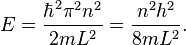
The quantization of energy levels follows from this constraint on
k, since
Finite potential well[edit]
A finite potential well is the generalization of the infinite potential well problem to potential wells having finite depth.
The finite potential well problem is mathematically more complicated than the infinite particle-in-a-box problem as the wavefunction is not pinned to zero at the walls of the well. Instead, the wavefunction must satisfy more complicated mathematical boundary conditions as it is nonzero in regions outside the well.
Harmonic oscillator[edit]
As in the classical case, the potential for the quantum harmonic oscillator is given by

This problem can either be treated by directly solving the Schrödinger, which is not trivial, or by using the more elegant "ladder method" first proposed by Paul Dirac. The
eigenstates are given by

where
Hn are the
Hermite polynomials,

and the corresponding energy levels are
 .
.
This is another example illustrating the quantization of energy for bound states.
See also[edit]
- Jump up ^ van Hove, Leon (1958). "Von Neumann's contributions to quantum mechanics" (PDF). Bulletin of the American Mathematical Society 64: Part2:95–99.
- Jump up ^ Max Born & Emil Wolf, Principles of Optics, 1999, Cambridge University Press
- Jump up ^ Mehra, J.; Rechenberg, H. (1982). The historical development of quantum theory. New York: Springer-Verlag. ISBN 0387906428.
- Jump up ^ Kragh, Helge (2002). Quantum Generations: A History of Physics in the Twentieth Century. Princeton University Press. p. 58. ISBN 0-691-09552-3. , Extract of page 58
- Jump up ^ http://www.ias.ac.in/resonance/December2010/p1056-1059.pdf
- Jump up ^ Kuhn, T. S. (1978). Black-body theory and the quantum discontinuity 1894-1912. Oxford: Clarendon Press. ISBN 0195023838.
- Jump up ^ Einstein, A. (1905). "Über einen die Erzeugung und Verwandlung des Lichtes betreffenden heuristischen Gesichtspunkt" [On a heuristic point of view concerning the production and transformation of light]. Annalen der Physik 17 (6): 132–148. Bibcode:1905AnP...322..132E. doi:10.1002/andp.19053220607. Reprinted in The collected papers of Albert Einstein, John Stachel, editor, Princeton University Press, 1989, Vol. 2, pp. 149-166, in German; see also Einstein's early work on the quantum hypothesis, ibid. pp. 134-148.
- Jump up ^ "Quantum interference of large organic molecules". Nature.com. Retrieved April 20, 2013.
- Jump up ^ "Quantum - Definition and More from the Free Merriam-Webster Dictionary". Merriam-webster.com. Retrieved 2012-08-18.
- Jump up ^ http://mooni.fccj.org/~ethall/quantum/quant.htm
- Jump up ^ Compare the list of conferences presented here
- Jump up ^ Oocities.com at the Wayback Machine (archived October 26, 2009)
- Jump up ^ P.A.M. Dirac, The Principles of Quantum Mechanics, Clarendon Press, Oxford, 1930.
- Jump up ^ D. Hilbert Lectures on Quantum Theory, 1915–1927
- Jump up ^ J. von Neumann, Mathematische Grundlagen der Quantenmechanik, Springer, Berlin, 1932 (English translation: Mathematical Foundations of Quantum Mechanics, Princeton University Press, 1955).
- Jump up ^ H.Weyl "The Theory of Groups and Quantum Mechanics", 1931 (original title: "Gruppentheorie und Quantenmechanik").
- Jump up ^ Greiner, Walter; Müller, Berndt (1994). Quantum Mechanics Symmetries, Second edition. Springer-Verlag. p. 52. ISBN 3-540-58080-8. , Chapter 1, p. 52
- Jump up ^ "Heisenberg - Quantum Mechanics, 1925–1927: The Uncertainty Relations". Aip.org. Retrieved 2012-08-18.
- ^ Jump up to: a b Greenstein, George; Zajonc, Arthur (2006). The Quantum Challenge: Modern Research on the Foundations of Quantum Mechanics, Second edition. Jones and Bartlett Publishers, Inc. p. 215. ISBN 0-7637-2470-X. , Chapter 8, p. 215
- Jump up ^ "[Abstract] Visualization of Uncertain Particle Movement". Actapress.com. Retrieved 2012-08-18.
- Jump up ^ Hirshleifer, Jack (2001). The Dark Side of the Force: Economic Foundations of Conflict Theory. Campbridge University Press. p. 265. ISBN 0-521-80412-4. , Chapter , p.
- Jump up ^ Dict.cc
De.pons.eu
- Jump up ^ "Topics: Wave-Function Collapse". Phy.olemiss.edu. 2012-07-27. Retrieved 2012-08-18.
- Jump up ^ "Collapse of the wave-function". Farside.ph.utexas.edu. Retrieved 2012-08-18.
- Jump up ^ "Determinism and Naive Realism : philosophy". Reddit.com. 2009-06-01. Retrieved 2012-08-18.
- Jump up ^ Michael Trott. "Time-Evolution of a Wavepacket in a Square Well — Wolfram Demonstrations Project". Demonstrations.wolfram.com. Retrieved 2010-10-15.
- Jump up ^ Michael Trott. "Time Evolution of a Wavepacket In a Square Well". Demonstrations.wolfram.com. Retrieved 2010-10-15.
- Jump up ^ Mathews, Piravonu Mathews; Venkatesan, K. (1976). A Textbook of Quantum Mechanics. Tata McGraw-Hill. p. 36. ISBN 0-07-096510-2. , Chapter 2, p. 36
- Jump up ^ "Wave Functions and the Schrödinger Equation" (PDF). Retrieved 2010-10-15. [dead link]
- Jump up ^ "Quantum Physics: Werner Heisenberg Uncertainty Principle of Quantum Mechanics. Werner Heisenberg Biography". Spaceandmotion.com. 1976-02-01. Retrieved 2012-08-18.
- Jump up ^ http://th-www.if.uj.edu.pl/acta/vol19/pdf/v19p0683.pdf
- Jump up ^ Nancy Thorndike Greenspan, "The End of the Certain World: The Life and Science of Max Born" (Basic Books, 2005), pp. 124-8 and 285-6.
- Jump up ^ http://ocw.usu.edu/physics/classical-mechanics/pdf_lectures/06.pdf
- Jump up ^ "The Nobel Prize in Physics 1979". Nobel Foundation. Retrieved 2010-02-16.
- Jump up ^ Carl M. Bender, Daniel W. Hook, Karta Kooner (2009-12-31). "Complex Elliptic Pendulum". arXiv:1001.0131 [hep-th].
- Jump up ^ See, for example, Precision tests of QED. The relativistic refinement of quantum mechanics known as quantum electrodynamics (QED) has been shown to agree with experiment to within 1 part in 108 for some atomic properties.
- Jump up ^ Tipler, Paul; Llewellyn, Ralph (2008). Modern Physics (5 ed.). W. H. Freeman and Company. pp. 160–161. ISBN 978-0-7167-7550-8.
- Jump up ^ "Quantum mechanics course iwhatisquantummechanics". Scribd.com. 2008-09-14. Retrieved 2012-08-18.
- Jump up ^ A. Einstein, B. Podolsky, and N. Rosen, Can quantum-mechanical description of physical reality be considered complete? Phys. Rev. 47 777 (1935). [1]
- Jump up ^ "Between classical and quantum�" (PDF). Retrieved 2012-08-19.
- Jump up ^ (see macroscopic quantum phenomena, Bose–Einstein condensate, and Quantum machine)
- Jump up ^ "Atomic Properties". Academic.brooklyn.cuny.edu. Retrieved 2012-08-18.
- Jump up ^ http://assets.cambridge.org/97805218/29526/excerpt/9780521829526_excerpt.pdf
- Jump up ^ "There is as yet no logically consistent and complete relativistic quantum field theory.", p. 4. — V. B. Berestetskii, E. M. Lifshitz, L P Pitaevskii (1971). J. B. Sykes, J. S. Bell (translators). Relativistic Quantum Theory 4, part I. Course of Theoretical Physics (Landau and Lifshitz) ISBN 0-08-016025-5
- Jump up ^ Stephen Hawking; Gödel and the end of physics
- Jump up ^ "Life on the lattice: The most accurate theory we have". Latticeqcd.blogspot.com. 2005-06-03. Retrieved 2010-10-15.
- Jump up ^ Parker, B. (1993). Overcoming some of the problems. pp. 259–279.
- Jump up ^ The Character of Physical Law (1965) Ch. 6; also quoted in The New Quantum Universe (2003), by Tony Hey and Patrick Walters
- Jump up ^ Weinberg, S. "Collapse of the State Vector", Phys. Rev. A 85, 062116 (2012).
- Jump up ^ "Action at a Distance in Quantum Mechanics (Stanford Encyclopedia of Philosophy)". Plato.stanford.edu. 2007-01-26. Retrieved 2012-08-18.
- Jump up ^ "Everett's Relative-State Formulation of Quantum Mechanics (Stanford Encyclopedia of Philosophy)". Plato.stanford.edu. Retrieved 2012-08-18.
- Jump up ^ The Transactional Interpretation of Quantum Mechanics by John Cramer. Reviews of Modern Physics 58, 647-688, July (1986)
- Jump up ^ See, for example, the Feynman Lectures on Physics for some of the technological applications which use quantum mechanics, e.g., transistors (vol III, pp. 14-11 ff), integrated circuits, which are follow-on technology in solid-state physics (vol II, pp. 8-6), and lasers (vol III, pp. 9-13).
- Jump up ^ Introduction to Quantum Mechanics with Applications to Chemistry - Linus Pauling, E. Bright Wilson. Books.google.com. 1985-03-01. ISBN 9780486648712. Retrieved 2012-08-18.
- Jump up ^ Anderson, Mark (2009-01-13). "Is Quantum Mechanics Controlling Your Thoughts? | Subatomic Particles". DISCOVER Magazine. Retrieved 2012-08-18.
- Jump up ^ "Quantum mechanics boosts photosynthesis". physicsworld.com. Retrieved 2010-10-23.
- Jump up ^ Davies, P. C. W.; Betts, David S. (1984). Quantum Mechanics, Second edition. Chapman and Hall. p. 79. ISBN 0-7487-4446-0. , Chapter 6, p. 79
- Jump up ^ Baofu, Peter (2007-12-31). The Future of Complexity: Conceiving a Better Way to Understand Order and Chaos. Books.google.com. ISBN 9789812708991. Retrieved 2012-08-18.
- Jump up ^ Derivation of particle in a box, chemistry.tidalswan.com
References[edit]
The following titles, all by working physicists, attempt to communicate quantum theory to lay people, using a minimum of technical apparatus.
- Chester, Marvin (1987) Primer of Quantum Mechanics. John Wiley. ISBN 0-486-42878-8
- Cox, Brian; Forshaw, Jeff (2011). The Quantum Universe: Everything That Can Happen Does Happen:. Allen Lane. ISBN 1-84614-432-9.
- Richard Feynman, 1985. QED: The Strange Theory of Light and Matter, Princeton University Press. ISBN 0-691-08388-6. Four elementary lectures on quantum electrodynamics and quantum field theory, yet containing many insights for the expert.
- Ghirardi, GianCarlo, 2004. Sneaking a Look at God's Cards, Gerald Malsbary, trans. Princeton Univ. Press. The most technical of the works cited here. Passages using algebra, trigonometry, and bra–ket notation can be passed over on a first reading.
- N. David Mermin, 1990, "Spooky actions at a distance: mysteries of the QT" in his Boojums all the way through. Cambridge University Press: 110-76.
- Victor Stenger, 2000. Timeless Reality: Symmetry, Simplicity, and Multiple Universes. Buffalo NY: Prometheus Books. Chpts. 5-8. Includes cosmological and philosophical considerations.
More technical:
- Bryce DeWitt, R. Neill Graham, eds., 1973. The Many-Worlds Interpretation of Quantum Mechanics, Princeton Series in Physics, Princeton University Press. ISBN 0-691-08131-X
- Dirac, P. A. M. (1930). The Principles of Quantum Mechanics. ISBN 0-19-852011-5. The beginning chapters make up a very clear and comprehensible introduction.
- Hugh Everett, 1957, "Relative State Formulation of Quantum Mechanics", Reviews of Modern Physics 29: 454-62.
- Feynman, Richard P.; Leighton, Robert B.; Sands, Matthew (1965). The Feynman Lectures on Physics 1–3. Addison-Wesley. ISBN 0-7382-0008-5.
- Griffiths, David J. (2004). Introduction to Quantum Mechanics (2nd ed.). Prentice Hall. ISBN 0-13-111892-7. OCLC 40251748. A standard undergraduate text.
- Max Jammer, 1966. The Conceptual Development of Quantum Mechanics. McGraw Hill.
- Hagen Kleinert, 2004. Path Integrals in Quantum Mechanics, Statistics, Polymer Physics, and Financial Markets, 3rd ed. Singapore: World Scientific. Draft of 4th edition.
- Gunther Ludwig, 1968. Wave Mechanics. London: Pergamon Press. ISBN 0-08-203204-1
- George Mackey (2004). The mathematical foundations of quantum mechanics. Dover Publications. ISBN 0-486-43517-2.
- Albert Messiah, 1966. Quantum Mechanics (Vol. I), English translation from French by G. M. Temmer. North Holland, John Wiley & Sons. Cf. chpt. IV, section III.
- Omnès, Roland (1999). Understanding Quantum Mechanics. Princeton University Press. ISBN 0-691-00435-8. OCLC 39849482.
- Scerri, Eric R., 2006. The Periodic Table: Its Story and Its Significance. Oxford University Press. Considers the extent to which chemistry and the periodic system have been reduced to quantum mechanics. ISBN 0-19-530573-6
- Transnational College of Lex (1996). What is Quantum Mechanics? A Physics Adventure. Language Research Foundation, Boston. ISBN 0-9643504-1-6. OCLC 34661512.
- von Neumann, John (1955). Mathematical Foundations of Quantum Mechanics. Princeton University Press. ISBN 0-691-02893-1.
- Hermann Weyl, 1950. The Theory of Groups and Quantum Mechanics, Dover Publications.
- D. Greenberger, K. Hentschel, F. Weinert, eds., 2009. Compendium of quantum physics, Concepts, experiments, history and philosophy, Springer-Verlag, Berlin, Heidelberg.
Further reading[edit]
- Bernstein, Jeremy (2009). Quantum Leaps. Cambridge, Massachusetts: Belknap Press of Harvard University Press. ISBN 978-0-674-03541-6.
- Bohm, David (1989). Quantum Theory. Dover Publications. ISBN 0-486-65969-0.
- Eisberg, Robert; Resnick, Robert (1985). Quantum Physics of Atoms, Molecules, Solids, Nuclei, and Particles (2nd ed.). Wiley. ISBN 0-471-87373-X.
- Liboff, Richard L. (2002). Introductory Quantum Mechanics. Addison-Wesley. ISBN 0-8053-8714-5.
- Merzbacher, Eugen (1998). Quantum Mechanics. Wiley, John & Sons, Inc. ISBN 0-471-88702-1.
- Sakurai, J. J. (1994). Modern Quantum Mechanics. Addison Wesley. ISBN 0-201-53929-2.
- Shankar, R. (1994). Principles of Quantum Mechanics. Springer. ISBN 0-306-44790-8.
External links[edit]
- Course material
- FAQs
- Media
- Philosophy


.jpg)


