
Möbius strips, which have only one surface and one edge, are a kind of object studied in topology.
Topology (from the
Greek τόπος, “place”, and λόγος, “study”) is a major area of
mathematics concerned with the most basic properties of space, such as
connectedness. More precisely, topology studies properties that are preserved under
continuous deformations, including stretching and bending, but not tearing or gluing. The exact mathematical definition is given below. Topology developed as a field of study out of
geometry and
set theory, through analysis of such concepts as space, dimension, and transformation.
Ideas that are now classified as topological were expressed as early as 1736. Toward the end of the 19th century, a distinct discipline developed, which was referred to in Latin as the
geometria situs (“geometry of place”) or
analysis situs (Greek-Latin for “picking apart of place”). This later acquired the modern name of topology. By the middle of the 20th century, topology had become an important area of study within mathematics.
Topology has many subfields.
Point-set topology establishes the foundational aspects of topology and investigates concepts inherent to topological spaces (basic examples include
compactness and
connectedness).
Algebraic topology tries to measure degrees of connectivity using algebraic constructs such as
homology and
homotopy groups.
Geometric topology primarily studies
manifolds and their embeddings (placements) in other manifolds. A particularly active area in geometric topology is
low dimensional topology, which studies manifold of 4 or fewer dimensions. This includes
knot theory, the study of
mathematical knots.
See also:
topology glossary for definitions of some of the terms used in topology and
topological space for a more technical treatment of the subject.
[edit] History
Topology began with the investigation of certain questions in geometry.
Leonhard Euler's 1736 paper on the
Seven Bridges of Königsberg[1] is regarded as one of the first academic treatises in modern topology.
The term "Topologie" was introduced in German in 1847 by
Johann Benedict Listing in
Vorstudien zur Topologie,
[2] who had used the word for ten years in correspondence before its first appearance in print. "Topology," its English form, was first used in 1883 in Listing's obituary in the journal
Nature[3] to distinguish "qualitative geometry from the ordinary geometry in which quantitative relations chiefly are treated". The term
topologist in the sense of a specialist in topology was used in 1905 in the magazine
Spectator.
[citation needed] However, none of these uses corresponds exactly to the modern definition of topology.
Modern topology depends strongly on the ideas of
set theory, developed by
Georg Cantor in the later part of the 19th century. Cantor, in addition to establishing the basic ideas of set theory, considered point sets in
Euclidean space as part of his study of
Fourier series.
Henri Poincaré published
Analysis Situs in 1895,
[4] introducing the concepts of
homotopy and
homology, which are now considered part of
algebraic topology.
Maurice Fréchet, unifying the work on function spaces of Cantor,
Volterra,
Arzelà,
Hadamard,
Ascoli, and others, introduced the
metric space in 1906.
[5] A metric space is now considered a special case of a general topological space. In 1914,
Felix Hausdorff coined the term "topological space" and gave the definition for what is now called a
Hausdorff space.
[6] In current usage, a topological space is a slight generalization of Hausdorff spaces, given in 1922 by
Kazimierz Kuratowski.
[citation needed]
For further developments, see
point-set topology and
algebraic topology.
[edit] Elementary introduction
Topology, as a branch of mathematics, can be formally defined as "the study of qualitative properties of certain objects (called
topological spaces) that are
invariant under a certain kind of transformation (called a
continuous map), especially those properties that are invariant under a certain kind of equivalence (called
homeomorphism)." To put it more simply, topology is the study of continuity and connectivity.
The term
topology is also used to refer to a structure imposed upon a set
X, a structure that essentially 'characterizes' the set
X as a
topological space by taking proper care of properties such as
convergence,
connectedness and
continuity, upon transformation.
Topological spaces show up naturally in almost every branch of mathematics. This has made topology one of the great unifying ideas of mathematics.
The motivating insight behind topology is that some geometric problems depend not on the exact shape of the objects involved, but rather on the way they are put together. For example, the square and the circle have many properties in common: they are both one dimensional objects (from a topological point of view) and both separate the plane into two parts, the part inside and the part outside.
One of the first papers in topology was the demonstration, by
Leonhard Euler, that it was impossible to find a route through the town of Königsberg (now
Kaliningrad) that would cross each of its seven bridges exactly once. This result did not depend on the lengths of the bridges, nor on their distance from one another, but only on connectivity properties: which bridges are connected to which islands or riverbanks. This problem, the
Seven Bridges of Königsberg, is now a famous problem in introductory mathematics, and led to the branch of mathematics known as
graph theory.
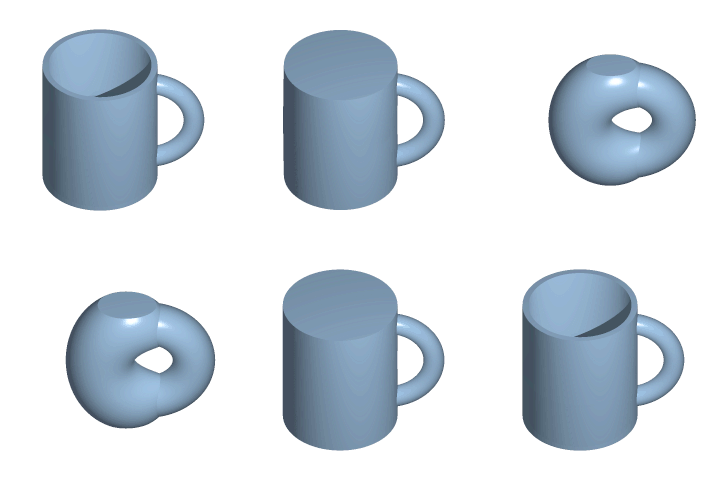
A continuous deformation (a type of
homeomorphism) of a mug into a doughnut (
torus) and back.
Similarly, the
hairy ball theorem of algebraic topology says that "one cannot comb the hair flat on a hairy ball without creating a
cowlick." This fact is immediately convincing to most people, even though they might not recognize the more formal statement of the theorem, that there is no nonvanishing continuous
tangent vector field on the
sphere. As with the
Bridges of Königsberg, the result does not depend on the exact shape of the sphere; it applies to pear shapes and in fact any kind of smooth blob, as long as it has no holes.
To deal with these problems that do not rely on the exact shape of the objects, one must be clear about just what properties these problems
do rely on. From this need arises the notion of homeomorphism. The impossibility of crossing each bridge just once applies to any arrangement of bridges homeomorphic to those in Königsberg, and the hairy ball theorem applies to any space homeomorphic to a sphere.
Intuitively two spaces are homeomorphic if one can be deformed into the other without cutting or gluing. A traditional joke is that a topologist can't distinguish a coffee mug from a doughnut, since a sufficiently pliable doughnut could be reshaped to the form of a coffee cup by creating a dimple and progressively enlarging it, while shrinking the hole into a handle. A precise definition of homeomorphic, involving a continuous function with a continuous inverse, is necessarily more technical.
Homeomorphism can be considered the most basic
topological equivalence. Another is
homotopy equivalence. This is harder to describe without getting technical, but the essential notion is that two objects are homotopy equivalent if they both result from "squishing" some larger object.
| Equivalence classes of the English alphabet: |
|---|
| Homeomorphism | Homotopy equivalence |
|---|
 |  |
An introductory
exercise is to classify the uppercase letters of the
English alphabet according to homeomorphism and homotopy equivalence. The result depends partially on the font used. The figures use a
sans-serif font named
Myriad. Notice that homotopy equivalence is a rougher relationship than homeomorphism; a homotopy equivalence class can contain several of the homeomorphism classes. The simple case of homotopy equivalence described above can be used here to show two letters are homotopy equivalent. For example, O fits inside P and the tail of the P can be squished to the "hole" part.
Thus, the homeomorphism classes are: one hole two tails, two holes no tail, no holes, one hole no tail, no holes three tails, a bar with four tails (the "bar" on the
K is almost too short to see), one hole one tail, and no holes four tails.
The homotopy classes are larger, because the tails can be squished down to a point. The homotopy classes are: one hole, two holes, and no holes.
To be sure we have classified the letters correctly, we not only need to show that two letters in the same class are equivalent, but that two letters in different classes are not equivalent. In the case of homeomorphism, this can be done by suitably selecting points and showing their removal disconnects the letters differently. For example, X and Y are not homeomorphic because removing the center point of the X leaves four pieces; whatever point in Y corresponds to this point, its removal can leave at most three pieces. The case of homotopy equivalence is harder and requires a more elaborate argument showing an algebraic invariant, such as the
fundamental group, is different on the supposedly differing classes.
Letter topology has some practical relevance in
stencil typography. The font
Braggadocio, for instance, has stencils that are made of one connected piece of material.
[edit] Mathematical definition
Let
X be a set and let
τ be a family of subsets of
X. Then
τ is called a
topology on X if:
- Both the empty set and X are elements of τ
- Any union of elements of τ is an element of τ
- Any intersection of finitely many elements of τ is an element of τ
If
τ is a topology on
X, then the pair (
X,
τ) is called a
topological space. The notation
Xτ may be used to denote a set
X endowed with the particular topology
τ.
The members of
τ are called
open sets in
X. A subset of
X is said to be
closed if its complement is in
τ (i.e., its complement is open). A subset of
X may be open, closed, both (
clopen set), or neither. The empty set and
X itself are always clopen.
A
function or map from one topological space to another is called
continuous if the inverse image of any open set is open. If the function maps the
real numbers to the real numbers (both spaces with the Standard Topology), then this definition of continuous is equivalent to the definition of continuous in
calculus. If a continuous function is
one-to-one and
onto, and if the inverse of the function is also continuous, then the function is called a
homeomorphism and the domain of the function is said to be homeomorphic to the range. Another way of saying this is that the function has a natural extension to the topology. If two spaces are homeomorphic, they have identical topological properties, and are considered topologically the same. The cube and the sphere are homeomorphic, as are the coffee cup and the doughnut. But the circle is not homeomorphic to the doughnut.
[edit] Topology topics
[edit] Some theorems in general topology
General topology also has some surprising connections to other areas of mathematics. For example:
See also some counter-intuitive theorems, e.g. the
Banach–Tarski one.
[edit] Some useful notions from algebraic topology
See also
list of algebraic topology topics.
[edit] Generalizations
Occasionally, one needs to use the tools of topology but a "set of points" is not available. In
pointless topology one considers instead the
lattice of open sets as the basic notion of the theory, while
Grothendieck topologies are certain structures defined on arbitrary
categories that allow the definition of
sheaves on those categories, and with that the definition of quite general cohomology theories.
[edit] See also
[edit] References
- ^ Euler, Leonhard, Solutio problematis ad geometriam situs pertinentis
- ^ Listing, Johann Benedict, "Vorstudien zur Topologie", Vandenhoeck und Ruprecht, Göttingen, p. 67, 1848
- ^ Tait, Peter Guthrie, "Johann Benedict Listing (obituary)", Nature *27*, 1 February 1883, pp. 316–317
- ^ Poincaré, Henri, "Analysis situs", Journal de l'École Polytechnique ser 2, 1 (1895) pp. 1–123
- ^ Fréchet, Maurice, "Sur quelques points du calcul fonctionnel", PhD dissertation, 1906
- ^ Hausdorff, Felix, "Grundzüge der Mengenlehre", Leipzig: Veit. In (Hausdorff Werke, II (2002), 91–576)
[edit] Further reading
- Rysxard Engelking, General Topology, Heldermann Verlag, Sigma Series in Pure Mathematics, December 1989, ISBN-10: 3885380064.
- Waclaw Sierpinski, General Topology, Dover Publications, 2000, ISBN-10: 0486411486
- Pickover, Clifford A. (2006). The Möbius Strip: Dr. August Möbius's Marvelous Band in Mathematics, Games, Literature, Art, Technology, and Cosmology. Thunder's Mouth Press (Provides a popular introduction to topology and geometry). ISBN 1-56025-826-8.
[edit] External links
- Hazewinkel, Michiel, ed. (2001), "Topology, general", Encyclopedia of Mathematics, Springer, ISBN 978-1-55608-010-4, http://www.encyclopediaofmath.org/index.php?title=p/t093200
- Elementary Topology: A First Course Viro, Ivanov, Netsvetaev, Kharlamov
- Topology at the Open Directory Project
- The Topological Zoo at The Geometry Center
- Topology Atlas
- Topology Course Lecture Notes Aisling McCluskey and Brian McMaster, Topology Atlas
- Topology Glossary
- Moscow 1935: Topology moving towards America, a historical essay by Hassler Whitney.
[show]
Topics in Topology
|
|---|
|
| Fields |
|
|---|
|
| Key concepts |
|
|---|
|
| Lists and glossaries |
|
|---|
|


 As summarised by Frank Barr, the torus is"a self-referential "time-structure" with numerous unique properties (Young, 1976) such as:
 The 3,10 Torus Knot, Ring, Sphere Tetrahelix and Hand - a poster and explanatory text originally published in TORUS, the Journal of the Meru Foundation, Vol. 2 #2.


