Showing posts with label bohm. Show all posts

Wednesday, 17 June 2015

Bohm's Alternative to Quantum Mechanics

Blogger Ref http://www.p2pfoundation.net/Multi-Dimensional_Science


 David Albert Scientific American May 94
Last Words of a Quantum Heretic John Horgan New Scientist 29 Feb 93
The keystone of Bohr's interpretation was the concept of complementarily, which held that wave-particle duality is a paradox that cannot be resolved. Bohr also ruled out the possibility that the probabilistic behaviour of quantum systems was actually the result of underlying deterministic mechanisms called hidden variables. Reality was unknowable because it was intrinsically indefinite, Bohr insisted.

Particles are always particles
In trying to explain Bohr's approach, Bohm became dissatisfied with it. "The whole idea of science so far has been to say that underlying the phenomenon is some reality which explains things," he explained. "It was not that Bohr denied reality, but he said quantum mechanics implied there was nothing more that could be said about it." Such a view, Bohm decided, reduced quantum mechanics to "a system of formulas that we use to make predictions or to control things technologically. I said, that's not enough. I don't think I would be very interested in science if that were afl there was." In 1952 Bohm defied Bohr's prohibition against hidden-variable explanations in a classic two-part paper in Physical Review entitled "A suggested interpretation of the quantum theory in terms of 'hidden' variables". He proposed that particles are indeed particles-and at afl times, not just when they are observed. Their behaviour is determined by an unusual field or wave consisting both of classical versions of forces such as electromagnetism and an entirely new force-which Bohm called the quantum potential-that is responsible for nonclassical effects. The positions of particles in tum serve as the hidden variables determining the nature of the pilot wave. Bohm's interpretation was causal, or deterministic. Particles always had a distinct position and velocity, but any effort to measure these properties precisely would destroy information about them by physically altering the pilot wave. Bohm gave the uncertainty principle a purely physical rather than metaphysical meaning. Bohr had interpreted the uncertainty pn'nciple, Bohm explained, as meaning "not that there is uncertainty, but that there is an inherent ambiguity" in a quantum sv'tem. Bohm sent out preprints of the paper and was quickly informed that his interpretation was an old one, proposed 25 years earlier by Louis de Broglie. De Broglie had abandoned the pilot-wave concept after Wolfgang Pauli pointed out that, when applied to systems involving more than one particle, it led to "some very strange behaviour" This strange behaviour referred to by Pauli, Bohm realised, was nonlocality. Actually, nonlocality was a feature intrinsic to all quantum theories, not just Bohm's. Einstein had demonstrated this fact back in 1935 in an effort to show that quantum mechanics must be flawed. Working together with Boris Podolsky and Nathan Rosen at Princeton, Einstein proposed a thought experiment involving rwo particles that spring from a common source and fly in opposite directions. According to the standard model of quantum mechanics, neither particle has a definite position or momentum before it is measured; but by measuring the momentum of one particle, the physicist instantaneously forces the other particle to assume a fixed position-even if it is on the other side of the Galaxy. Deriding this effect as "spooky action at a distance", Einstein argued that it violated both common sense and the theory of relativity, which prohibits the propagation of effects faster than the speed of light-I quantum mechanics must be an incomplete theory. Perhaps because he had always had a holistic view of reality, Bohm was not disturbed by nonlocality. "I must have tacitly been feeling all along that quantum mechanics was nonlocal," he said. In Quantum Theory, Bohm even suggested an experiment that could demonstrate nonlocaliry more clearly and easily than the one proposed by Einstein, Podoisky and Rosen. Bohm called for measuring not the momentum and position of rwo particles from a common source but rather their spin. Bohm's spin experiment became the basis for a brilliant mathematical proof bv Bell in 1964 showing that no local hidden-variable theory could replicate the predictions of quantum mechanics. In 1982, a group led bN, the French physicist Alain Aspect at the University of Paris-South, carried out Bohm's experiment, demonstrating once and for all that quantum mechanics does indeed require spooky action. (The reason that nonlocality does not violate the theory of relativity is that one cannot exploit it to transmit infon-nation faster than light or instantaneously.) Bohm said he never had any doubts about the outcome of the experiment: 'it would have been a terrific surprise to find out otherwise." Ironically, Bell's theorem and the Aspect experiment were widely thought to rule out all hidden-variable theories, including Bohm's. It was Bell who pointed out years later that Bohm's theory, since it was nonlocal, was not ruled out by his theorem. According to Bohm's model, nonlocality was mediated through the pilot wave: any localised physical act, such as the measurement of a particle, would instantaneously alter the shape of the entire pilot wave, affecting all particles under its influence. Bohm continued to develop the pilot-wave theory through the 1980s with the help of collaborators such as Hiley. In its latest version, the Bohmian pilot wave is quite distinct from the one posited by de Broglie. De Broglie conceived of the pilot wave as a kind of mechanical force which pushed particles this way and that through the transmission of energy. Bohm's pilot wave is more subtle: it guides particles not through its amplitude but through its form-much as the form rather than the amplitude of a flight-controller's radio transmission controls a plane's behaviour. The wave's abuity to influence particles therefore does not diminish with distance, as classical waves do. In the last decade, Bohm also became absorbed in another perennial puzzle: why quantum effects are generally lim ited to very small-scale phenomena. Two recent efforts to explain this mystery left him unimpressed. One of these, proposed by Gian Carlo Ghirardi of the University of Trieste and others, holds that as a quantum entity propagates through space, its multiple, possible states converge into a single state that behaves in a classical way. Roger Penrose of the University of Oxford presented another possibility in his book The Emperor's New Mind: quantum effects disappear in systems containing so much mass that gravity-which is usually negligible at subatomic scales-becomes a factor. Bohm favoured what he felt was a much simpler explanation: heat. Various lines of evidence-notably the fact that superconductivity, which relies on quantum effects, occurs only at very low temperatures-suggest that thermal energy swamps quantum effects. To completely resolve the issue of the limits of quantum effects, Bohm contended that: "It would be required to connect thermodynamics and quantum mechanics in a deep ftindamental way rather than the present superficial way, which is that you start with quantum mechanics and then apply statistics. It may be that thermal properties are just as essential as quantum properties, or there's something deeper than both." To arrive at such a theory, physicists might need to jettison some basic assumptions about the organisation of nature. "Fundamental notions like order and structure condition our thinking unconsciously, and new kinds of theories depend on new kinds of order," he said. During the Enlightenment, he noted, thinkers such as Rene Descartes and Isaac Newton replaced the ancients' concept of order with a mechanistic view. Although the advent of relativity and other theories has brought about modifications in this order, Bohm said, "the basic idea is still the same: a mechanical order described by coordinates". Bohm himself began formulating what he called the implicate order several decades ago. His ideas were inspired in part by a simple experiment he saw on television, in which a drop of ink was squeezed onto a cylinder of glycerine. When the cylinder rotated, the ink diffused through the glycerine in an apparently irreversible fashion; its order seemed to have disintegrated. But when the direction of rotation was reversed, the ink gathered into a drop again. Bohm made this simple experiment into a metaphor for au of reality. Underlying the apparently chaotic realm of physical appearances-the explicate order-there is always a deeper, implicate order that is often hidden. Applying this concept to the quantum realm, Bohm proposed that the implicate order is the quantum potential, a field consisting of an infinite number of fluctuating waves. The overlapping of these waves generates what appear to us as particles: these constitute the explicate order. Even such seemingly fundamental conceprs as space and time may be merely explicate manifestations of some "nonlocal, deeper implicate order', according to Bohm. Bohm hoped the implicate order could even point the way to a resolution of that perennial conundrum of philosophy, the mind-matter problem. His belief was based on hints and rough analogies rather than on any concrete evidence. For example, he compared the way a pilot wave guides a particle to the way thought guides Ehe movements of a dancer. "The movement of the body is coming from thought, and the movement of the eleciron Ls coming from something very subtle, this wave. So there are similarities, which should make it possible to relate them."

Krishnamurti and David Bohm discuss the observer and the observed.
Despite his own enormous ambition as a truth seeker, Bohm rejected the possibility that scientists can ever bring their enterprise to an end by reducing all of nature to a single ftindamental phenomenon (such as infinitesimal particles called superstrings). "At each level we have something which is taken as appearance and something else is taken as the essence which explains the appearance. But there's no end to this. What underlies it all is unknown and cannot be grasped by thought." Indeed, scientists' belief that they are on the verge of a final theory may prevent them from seeking deeper truths. "It's like fish," Bohm elaborated. "If you have fish in a tank and you put a glass barrier in there, the fish learn to keep away from it. Then if you take the barrier away the fish never cross the barrier." Scientists who are frustrated at the thought that ultimate truths are unat tainable should consider the altemative. "They are going to be very frustrated if they get the final answer and then have nothing to do except be technicians," Bohm said. Science, Bohm believed, is sure to evolve in totally unexpected ways. He expressed the hope, for example, that future scientists wdl be less dependent on mathematics for modelling reality and will draw on new sources of metaphor and analogy. "We have an assumption now thaes getting stronger and stronger that mathematics is the only way to deal with reality," Bohm said. "Because it's worked so weLl for a while we've assumed that it has to be that way." Indeed, like some other scientific visionaries, Bohm expected that science and art would someday merge. "This division of art and science is temporary," he said. "It didn't exist in the past, and there's no reason why it should go on in the future." Just as art consists not simply of works of art but of an "attitude, the artistic spirit", so does science consist not in the accumulation of knowledge but in the creation of fresh modes of perception. 'The ability to perceive or think differently is more important than the knowledge gained." No matter how history treats Bohm's specific ideas, this, surely, wOl be one of his greatest legacies: his ability to make the rest of us perceive and think differently.
John Horgan

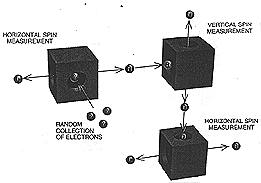
Spin behaviour is disrupted in a sequence ofthree measurementsElectrons are measured one at a time for their hrizontal spins (left), then for their vertical spins (right) and again for their horizontal spins (bottom). The vertical box disrupts the spin of half those electrons, so that half emerge from the second horizontal box with right spin and half with left.

Spin equivalent of two-slit interference: Two-path spin detection experiment depicts the unusual spin behaviour of electrons. On the left diagram right-spinning electrons are reflected back from an up down detector and recohered. The subsequent horizontal detector confirms they are all right spinning. However if one of the paths (top) are obstructed, then only 50% of the electrons subsequently measure as right spinning. This is because those which make it to the end definitely were down spinning and hence had had a disrupting measurement made of their vertical spin.
Bohm's theory can fully account for the outcomes of the experiments with the contraption-the experiment seemed to imply that electrons can be in states in which there fails to be any fact about where they are. in the case of an initially right-spinning electron fed into the apparatus, Bohm's theory entails that the electron wdl take either the up or the down route, period. Which of those two routes it takes wiu be fully determined by the particle's initial conditions, more specifically by its initial wave flmction and its initial position. Of course, certain details of those conditions wiu prove ixnpossible, as a matter of law, to ascertain by measurement. But the crucial point here is that whichever route the electron happens to take, its wave ftmction wiu split UP and take both. It wfll do so in accoidance with the linear differential equations of motion So, in the event that the electron jn question takes, say, the UP route, it wm nonetheless be reunited at the black box with the part of fts wave function that took the down route. How the down-route part of the wave function ends up pushing the electron around once the two are reunited wgl depend on the physical conditions encountered along the down path. To put ft a bit more suggestively, once the two parts of the electroifs wave fimction are reunited, the part that took the route that the electron itself did not take can inform the electron of what things were like along the way. For example, if a wall is inserted in the down route, the down component of the wave function will be missing at the exit of the black box. This absence in itself can constitute decisive information. Thus, the motion that such an electron executes, even if it took the up path through the apparatus, can depend quite dramaticaUy on whether or not such a wall was inserted. Moreover, Bohin's theory entails that the 'empty' part of the wave functionthe part that travels along the route the electron itself does not take-is completely undetectable. One of the consequences of the second equation in the box below is that only the part of any given particle's wave ftmction that is tly occupied by the particle itself can have any effect on the motions of other particles. So the empty part of the wave function-notwithstanding the fact that it is really, physically, thereis completely incapable of leaving any obsle trace of itself on detectors or anything else.
Hence, Bohm's theory accounts for all the unfathomable-looking behaviors of electrons discussed earlier every bit as well as the standard interpretation does. Moreover, and this point is important, ft is free of any of the metaphysical perplexties associated with quantum-mechanical -perposition.

Left: A graphical depiction of the quantum potential.
Right: Trajectories of an electron in a double slit experiment.
Bohm's theory-in Its entirety consists of three elements.
The first is a deterministic law (namely, Schödinger's equation) that describes how the wave functions of physical systems evolve over time. lt is:
where i is the imaginary number , h is Planck's constant, V is the wave function, H is a mathematical object called the Hamiltonian operator, N is the number of particles in the system, xl...X3N represent the spatial coordinates of those particles, and t is the time. Loosely speaking, the Hamiltonian operator describes the energy in the system.
The second element is a deterministic law of the motions of the particles:
where X1 ... X3N represent the actual coordinate values of the particles, dXj(t)/dt is the rate of change of X, at time t, and j represents the components of the standard quantum-mechanical probability current. The subscript i ranges from 1 to 3N.
The third element Is a statistical rule analogous to one used In classical statistical mechanics. It stipulates precisely how one goes about 'averaging over' one's Inevitable Ignorance of the exact states of physical systems. It runs as follows. Assume one is given the wave function of a certain system but no information about the positions of its particles. To calculate the motions of those particles in the future, what one ought to suppose is that the probability that those particles are currently located at some position (X1 ... X3N) is equal to . If information about the positions of the particles becomes available (as during a measurement), the rule indicates that that information ought to be used to 'update' the probabilities through a mathematical procedure called straightforward conditionalization. That is literally all there is to Bohm's theory. Whatever else we know about it derives strictly from these three elements.

Wednesday, 5 September 2012

Does Objective Reality Exist? Ref Talbot/The Holographic Universe.


Blogger Reference Link http://www.p2pfoundation.net/Multi-Dimensional_Science


note: because important websites are frequently "here today but gone tomorrow", the following was
archived from  http://www.rense.com/general69/holoff.htm  on March 10, 2006.  This is NOT
an attempt to divert readers from the aforementioned website.  Indeed, the reader should only
read this back-up copy if it cannot be found at the original author's site.


The Holographic Universe
Does Objective Reality Exist?
by Michael Talbot
3-12-2006


In 1982, a remarkable event took place.  At the University of Paris, a research team led by physicist
Alain Aspect performed what may turn out to be one of the most important experiments of the 20
th Century.  You did not hear about it on the evening news.  In fact, unless you are in the habit of reading
scientific journals, you probably have never even heard Aspect's name though there are some who
believe his discovery may change the face of Science.

Aspect and his team discovered that under certain circumstances subatomic particles such as
electrons are able to instantaneously communicate with each other regardless of the distance separating
them. It doesn't matter whether they are 10 feet or 10 billion miles apart.

Somehow, each particle always seems to know what the other is doing.  The problem with this feat is
that it violates Einstein's long-held tenet that no communication can travel faster than the speed-of-light. 
Since traveling faster than the speed -of-light is tantamount to breaking the time barrier, this daunting
prospect has caused some physicists to try to come up with elaborate ways to explain away Aspect's
findings.  But it has inspired others to offer even more radical explanations.

University of London physicist David Bohm, for example, believes Aspect's findings imply that
objective reality does not exist.  That despite its apparent solidity, the Universe is at heart a phantasm --
a gigantic and splendidly detailed hologram.

To understand why Bohm makes this startling assertion, one must first understand a little about
holograms.  A hologram is a 3-dimensional photograph made with the aid of a laser.
To make a hologram, the object to be photographed is first bathed in the light of a laser beam.  Then
a second laser beam is bounced off the reflected light of the first and the resulting interference pattern
(the area where the 2 laser beams commingle) is captured on film.

When the film is developed, it looks like a meaningless swirl of light and dark lines.  But as soon as
the developed film is illuminated by another laser beam, a 3-dimensional image of the original object
appears.

The 3-dimensionality of such images is not the only remarkable characteristic of holograms.  If a
hologram of a rose is cut in half and then illuminated by a laser, each half will still be found to contain
the entire image of the rose.2

Indeed, even if the halves are divided again, each snippet of film will always be found to contain a
smaller-but-intact version of the original image.  Unlike normal photographs, every part of a hologram
contains all the information possessed by the whole.
The "whole in every part" nature of a hologram provides us with an entirely new way of
understanding organization and order.  For most of its history, Western science has labored under the
bias that the best way to understand a physical phenomenon -- whether a frog or an atom -- is to dissect
it and study its respective parts.
A hologram teaches us that some things in the Universe may not lend themselves to this approach. 
If we try to take apart something constructed holographically, we will not get the pieces of which it is
made.  We will only get smaller wholes.
This insight suggested to Bohm another way of understanding Aspect's discovery.  Bohm believes
the reason subatomic particles are able to remain in contact with one another regardless of the distance
separating them is not because they are sending some sort of mysterious signal back-and-forth, but
because their separateness is an illusion.  He argues that at some deeper level of reality such particles
are not individual entities, but are actually extensions of the same fundamental something.
To enable people to better visualize what he means, Bohm offers the following illustration.
Imagine an aquarium containing a fish.  Imagine also that you are unable to see the aquarium
directly.  Your knowledge about it and what it contains comes from 2 television cameras -- one directed
at the aquarium's front and the other directed at its side.

As you stare at the 2 television monitors, you might assume that the fish on each of the screens are
separate entities.  After all, because the cameras are set at different angles, each of the images will be
slightly different.  But as you continue to watch the 2 fish, you will eventually become aware that there
is a certain relationship between them.
When one turns, the other also makes a slightly different but corresponding turn.  When one faces
the front, the other always faces toward the side.  If you remain unaware of the full scope of the
situation, you might even conclude that the fish must be instantaneously communicating with one
another.  But this is clearly not the case.

This, says Bohm, is precisely what is going on between the subatomic particles in Aspect's
experiment.

According to Bohm, the apparent faster-than-light connection between subatomic particles is really
telling us that there is a deeper level of reality we are not privy to -- a more complex dimension beyond
our own that is analogous to the aquarium.  And, he adds, we view objects such as subatomic particles as
separate from one another because we are seeing only a portion of their reality.

Such particles are not separate "parts", but facets of a deeper and more underlying unity that is
ultimately as holographic and indivisible as the previously mentioned rose. And since everything in
physical reality is comprised of these "eidolons", the Universe is itself a projection -- a hologram.
In addition to its phantom-like nature, such a Universe would possess other rather startling features. 
If the apparent separateness of subatomic particles is illusory, it means that at a deeper level of reality all
things in the Universe are infinitely interconnected.3

The electrons in a carbon atom in the human brain are connected to the subatomic particles that
comprise every salmon that swims, every heart that beats, and every star that shimmers in the sky.
Everything interpenetrates everything.  And although human nature may seek to categorize,
pigeonhole, and subdivide the various phenomena of the Universe, all apportionments are of necessity
artificial.  And all of Nature is ultimately a seamless web.

In a holographic universe, even time and space could no longer be viewed as fundamentals.  Because
concepts such as location break down in a universe in which nothing is truly separate from anything
else, time and 3-dimensional space -- like the images of the fish on the TV monitors -- would also have
to be viewed as projections of this deeper order.

At its deeper level reality is a sort of super-hologram in which the Past, Present, and Future all exist
simultaneously.  This suggests that given the proper tools it might even be possible to someday reach
into the super-holographic level of reality and pluck out scenes from the long-forgotten Past.
What else the super-hologram contains is an open-ended question.  Allowing  -- for the sake of
argument -- that the super-hologram is the matrix that has given birth to everything in our Universe, at
the very least it contains every subatomic particle that has been or will be  -- every configuration of
matter and energy that is possible from snowflakes to quasars to blue whales to gamma rays.  It must be
seen as a sort of cosmic storehouse of "All That Is",

Although Bohm concedes that we have no way of knowing what else might lie hidden in the superhologram, he does venture to say that we have no reason to assume it does not contain more.  Or as he
puts it, perhaps the super-holographic level of reality is a "mere stage" beyond which lies "an infinity of
further development".

Bohm is not the only researcher who has found evidence that the universe is a hologram.  Working
independently in the field of brain research, Stanford neurophysiologist Karl Pribram has also become
persuaded of the holographic nature of reality.

Pribram was drawn to the holographic model by the puzzle of how and where memories are stored in
the brain.  For decades, numerous studies have shown that rather than being confined to a specific
location, memories are dispersed throughout the brain.

In a series of landmark experiments in the 1920s, brain scientist Karl Lashley found that no matter
what portion of a rat's brain he removed, he was unable to eradicate its memory of how to perform
complex tasks that it had learned prior to surgery.  The only problem was that no one was able to come
up with a mechanism that might explain this curious "whole in every part" nature of memory storage.
Then in the 1960s, Pribram encountered the concept of holography and realized that he had found
the explanation brain scientists had been looking for.  Pribram believes memories are encoded not in
neurons or small groupings of neurons, but in patterns of nerve impulses that crisscross the entire brain
in the same way that patterns of laser light interference crisscross the entire area of a piece of film
containing a holographic image.  In other words, Pribram believes the brain itself is a hologram.
Pribram's theory also explains how the human brain can store so many memories in so little space.  It
has been estimated that the human brain has the capacity to memorize something on the order of 10
billion bits of information during the average human lifetime (or roughly the same amount of
information contained in 5 sets of the Encyclopaedia Britannica).4

Similarly, it has been discovered that in addition  to their other capabilities, holograms possess an
astounding capacity for information storage.  Simply by changing the angle at which the 2 lasers strike a
piece of photographic film, it is possible to record many different images on the same surface.  It  has
been demonstrated that 1 cubic centimeter of film can hold as many as 10 billion bits of information.
Our uncanny ability to quickly retrieve whatever information we need from the enormous store of
our memories becomes more understandable if the brain functions according to holographic principles. 
If a friend asks you to tell him what comes to mind when he says the word "zebra", you do not have to
clumsily sort back through some gigantic and cerebral alphabetic file to arrive at an answer.  Instead,
associations like "striped", "horse-like", and "animal native to Africa" all pop into your head instantly.
Indeed, one of the most amazing things about the human thinking process is that every piece of
information seems instantly cross-correlated with every other piece of information -- another feature
intrinsic to the hologram.  Because every portion of a hologram is infinitely interconnected with ever
other portion, it is perhaps Nature's supreme example of a cross-correlated system.

The storage of memory is not the only neurophysiological puzzle that becomes more tractable in
light of Pribram's holographic model of the brain.  Another is how the brain is able to translate the
avalanche of frequencies it receives via the senses (light frequencies, sound frequencies, and so on) into
the concrete world of our perceptions.  Encoding and decoding frequencies is precisely what a hologram
does best.  Just as a hologram functions as a sort of lens  -- a translating device able to convert an
apparently meaningless  blur of frequencies into a coherent image  -- Pribram believes the brain also
comprises a lens and uses holographic principles to mathematically convert the frequencies it receives
through the senses into the inner world of our perceptions.
An impressive body of evidence suggests that the brain uses holographic principles to perform its
operations.  Pribram's theory, in fact, has gained increasing support among neurophysiologists.
Argentinian-Italian researcher Hugo Zucarelli recently extended the holographic model into the
world of acoustic phenomena.  Puzzled by the fact that humans can locate the source of sounds without
moving their heads (even if they only possess hearing in one ear), Zucarelli discovered that holographic
principles can explain this ability.

Zucarelli has also developed the technology of holophonic sound -- a recording technique able to
reproduce acoustic situations with an almost uncanny realism.

Pribram's belief that our brains mathematically construct "hard" reality by relying on input from a
frequency domain has also received a good deal of experimental support.

It has been found that each of our senses is sensitive to a much broader range of frequencies than
was previously suspected.
Researchers have discovered, for instance, that our visual systems are sensitive to sound frequencies;
that our sense of smell is in part dependent on what are now called "cosmic frequencies"; and that even
the cells in our bodies are sensitive to a broad range of frequencies.  Such findings suggest that it is only
in the holographic domain of consciousness that such frequencies are sorted out and divided up into
conventional perceptions.
But the most mind-boggling aspect of Pribram's holographic model of the brain is what happens
when it is put together with Bohm's theory.  For if the concreteness of the World is but a secondary 5
reality and what is "there" is actually a holographic blur of frequencies  -- and if the brain is also a
hologram and only selects some of the frequencies out of this blur and mathematically transforms them
into sensory perceptions -- what becomes of objective reality?
Put quite simply, it ceases to exist.  As the religions of the East have long upheld, the material world
is Maya (an illusion).  And although we may think we are physical beings moving through a physical
World, this too is an illusion.
We are really "receivers" floating through a kaleidoscopic sea of frequency.  And what we extract
from this sea and transmogrify into physical reality is but one channel from many extracted out of the
super-hologram.

This striking new picture of reality -- the synthesis of Bohm and Pribram's views -- has come to be
called the holographic paradigm.  And although many scientists have greeted it with skepticism, it has
galvanized others.  A small-but-growing group of researchers believe it may be the most accurate model
of reality science has arrived at thus far.  More than that, some believe it may solve some mysteries that
have never before been explainable by Science and even establish the paranormal as a part of Nature.
Numerous researchers -- including Bohm and Pribram -- have noted that many para-psychological
phenomena become much more understandable in terms of the holographic paradigm.
In a universe in which individual brains are actually indivisible portions of the greater hologram and
everything is infinitely interconnected, telepathy may merely be the accessing of the holographic level.
It is obviously much easier to understand how information can travel from the mind of individual 'A'
to that of individual 'B' at a far distance point.  And it helps to understand a number of unsolved puzzles
in psychology.  In particular, Grof feels the holographic paradigm offers a model for understanding
many of the baffling phenomena experienced by individuals during altered states of consciousness.
i

Reviving the Ancient Polymath Spirit to Meet Modern Challenges We can embrace interdisciplinary learning for innovative problem-solving. Posted January 16, 2025 | Reviewed by Gary Drevitch

  by   Nigel R. Bairstow Ph.D. Disconnection Dynamics Psychology Today Key points Ancient Arab polymaths excelled by integrating diverse kno...