From Wikipedia, the free encyclopedia Blogger ref http://www.p2pfoundation.net/Multi-Dimensional_Science

Marian apparitions sometimes are reported to recur at the same site over an extended period of time. In the majority of Marian apparitions only one person or a few people report having witnessed the apparition. Exceptions to this include Zeitoun, Fatima and Assiut where thousands claimed to have seen her over a period of time.
Contents
[hide]- 1 Apparitions and appearances
- 2 Catholic belief
- 3 Impact of apparitions
- 4 Historical feasts
- 5 Approved apparitions
- 6 Apparitions with no or undocumented approval
- 7 Apparitions not approved by church authorities
- 8 See also
- 9 Further reading
- 10 Gallery of apparition-based Marian churches
- 11 References
- 12 External links
Apparitions and appearances[edit]

A photostatic copy of a page from Ilustração Portuguesa, October 29, 1917, showing the crowd looking at the miracle of the sun during the Fátima apparitions (attributed to the Blessed Virgin Mary)
In some apparitions such as Our Lady of Lourdes an actual vision is reported, resembling that of a person being present. In some of these reports the viewers do not initially report that they saw the Virgin Mary, but that they saw "a Lady" and had conversation with her. In these cases the viewers report experiences that resemble the visual and verbal interaction with a person present at the site. In most cases, there are no clear indications as to the auditory nature of the experience, i.e. whether the viewers heard the voices via airwaves or an "interior" or subjective sense of communication. The 1973 messages of Our Lady of Akita were to Sister Agnes Katsuko Sasagawa who went deaf before 1973 and remained deaf until 1982 when she was cured during Sunday Mass as foretold in her messages.
In some apparitions an image is reported absent any verbal interaction. An example is the reported apparitions at Our Lady of Assiut in which many people reported a bright image atop a building. Photographs at times suggest the silhouette of a statue of the Virgin Mary but the images are subject to varying interpretations, and critics suggest that they may just be due to various visual effects. However, such image-like appearances are hardly ever reported for visions of Jesus and Mary. In most cases these involve some form of reported communication.
And apparitions should be distinguished from interior locutions in which no visual contact is claimed. Interior locutions consist of inner voices. Interior locutions are generally not classified as apparitions.
Physical contact is hardly ever reported as part of Marian apparitions. In rare cases a physical artifact is reported in apparitions, such as the image of Our Lady of Guadalupe, which is reported to have been miraculously imprinted on the cloak of Saint Juan Diego.
Catholic belief[edit]

Eternal Father painting the Virgin of Guadalupe. Anonymous, 18th century, an example of Roman Catholic Marian art related to an apparition.
According to Father Salvatore M. Perrella of the Marianum Pontifical Institute in Rome, of the 295 reported apparitions studied by the Holy See through the centuries only 12 have been approved, the latest being the May 2008 approval of the 17th- and 18th-century apparitions of Our Lady of Laus.[3][4] Other apparitions continue to be approved at the local level, e.g. the December, 2010 local approval of the 19th-century apparitions of Our Lady of Good Help, the first recognized apparition in the United States.[5]
An authentic apparition is believed not to be a subjective experience, but a real and objective intervention of divine power. The purpose of such apparitions is to recall and emphasize some aspect of the Christian message. The church states that cures and other miraculous events are not the purpose of Marian apparitions, but exist primarily to validate and draw attention to the message.[6] Apparitions of Mary are held as evidence of her continuing active presence in the life of the church, through which she "cares for the brethren of her son who still journey on earth."[7]
Not all claims of visitations are dealt with favourably by the Roman Catholic Church. For example, claimed apparitions of Our Lady, under the title of "Our Lady of the Roses, Mary, Help of Mothers",[8] Jesus Christ and various saints at Bayside, New York have not been condoned or sanctioned in any way, nor those at the Necedah Shrine in Necedah, Wisconsin. The behavior of Ms Veronica Lueken and Mary Ann Van Hoof, who claimed these heavenly favors, was deemed not to compare favorably with the "quiet pragmatism" of St. Bernadette Soubirous — Church authorities are said to use Bernadette as a model by which to judge all who purport to have visitations. Indeed, both women seriously criticized the Roman Catholic Church hierarchy, allegedly even harshly, and Mrs. Van Hoof is said to have subsequently left Roman Catholicism for an independent local Old Catholic Church.
Possibly the best-known apparition sites are Lourdes and Fátima[9] Over sixty spontaneous healings, out of thousands reported at the Lourdes Spring, have been classified as "inexplicable" by the physicians of the Lourdes Bureau, a medical centre set up by the Church in association with local medical institutes to assess possible miracles. The Three Secrets of Fátima received a great deal of attention in the Catholic and secular press.
Criteria for evaluating apparitions[edit]
 |
| A series of articles on |
| Roman Catholic Mariology |
|---|
 |
| General articles |
| Devotions |
| Dogmas and doctrines |
| Expressions of devotion |
| Key Marian apparitions |
|
See also: Normae Congregationis
In 1978 the Sacred Congregation for the Doctrine of the Faith (formerly of the Holy Office) issued "Norms of the Congregation for Proceeding in Judging Alleged Apparitions and Revelations" containing the following provisions:[10]- The diocesan bishop can initiate a process on his own initiative or at the request of the faithful to investigate the facts of an alleged apparition. The bishop may refrain from looking into it if he chooses, especially if he thinks that not much will come of the event.
- The national conference of bishops may intervene if the local diocesan bishop refers it to him or if the event becomes important nationally or at least in more than one diocese.
- The Apostolic See (the Vatican) can also intervene at the request of the local bishop himself, at the request of a group of the faithful, or on its own initiative.
- Positive Criteria
- moral certainty (the certainty required to act morally in a situation of doubt) or at least great probability as to the existence of a private revelation at the end of a serious investigation into the case
- evaluation of the personal qualities of the person in question (mental balance, honesty, moral life, sincerity, obedience to Church authority, willingness to practice faith in the normal way, etc.)
- evaluation of the content of the revelations themselves (that they do not disagree with faith and morals of the Church, freedom from theological errors)
- the revelation results in healthy devotion and spiritual fruits in people's lives (greater prayer, greater conversion of heart, works of charity that result, etc.)
- Negative Criteria
- glaring errors in regard to the facts
- doctrinal errors attributed to God, the Blessed Virgin Mary, or to the Holy Spirit in how they appear
- any pursuit of financial gain in relation to the alleged event
- gravely immoral acts committed by the person or those associated with the person at the time of the event
- psychological disorders or tendencies on the part of the person or persons associated
Ultimately, a final judgment and determination needs to be given, giving or withholding approval of the event.
Local diocese approval[edit]
If the local bishop authorizes devotion inspired by an apparition to proceed based on an initial assessment, that permission does not constitute formal approval, which recognizes an event as being supernatural in origin. Such approval may follow years or even centuries later. A recent example of such a delay is the case of Our Lady of Laus, in which devotion was approved by the local diocese in 1665, but obtained formal recognition as a supernatural event only in 2008.[11][12][13]Moreover, Marian apparitions often involve complications at the local diocese, and a letter of approval or disapproval from a local bishop, does not automatically signal approval or denial. A recent example is the apparitions of Our Lady of Kibeho in the 1980s in Kibeho, Rwanda. In 1982 the teenagers who saw the visions reported truly gruesome sights and said that the Virgin Mary asked everyone to pray to prevent a terrible war. Some today regard the visions as an ominous foreshadowing of the Rwandan Genocide of 1994, and particularly in that specific location in 1995, where some teenagers died a decade after their vision. The apparitions were accepted by the local bishop (accused by many of complicity in the genocide himself), but have not been given final approval by the Congregation for the Doctrine of the Faith.[14][15][16][17]
Apparitions and statues[edit]
Marian apparitions are sometimes reported along with weeping statues of the Virgin Mary. However, to date only one single example of a combined weeping statue and apparition (namely Our Lady of Akita) has been approved by the Vatican and the rest have usually been dismissed as hoaxes.Impact of apparitions[edit]
.JPG)
Monument with a representation of an apparition of Our Lady to Benoîte Rencurel, the shepherdess visionary from Saint-Étienne-le-Laus, France.
- The conversion of millions of people to Roman Catholicism.
- The construction of some of the largest Roman Catholic Marian churches ever.
- The formation of the largest Marian Movements and Societies ever.
- The spread of Marian devotions (such as the rosary) to millions of people.
- The declaration of specific Marian dogmas and doctrines.
- Hundreds of millions of Marian pilgrimages.
Conversions and shrines[edit]
By all accounts, when Juan Diego, age 57, reported the apparition of Our Lady of Guadalupe on Tepeyac hill in Mexico in 1531, he did not receive a lot of attention in Rome, since the Church was busy with the challenges of the Protestant Reformation of 1521 to 1579 and perhaps very few Cardinals in Rome had ever heard the details of Mexico and its environs. Yet, just as a large number of people were leaving the Catholic Church in Europe as a result of the Reformation, Our Lady of Guadalupe was instrumental in adding almost 8 million people to the ranks of Catholics in the Americas between 1532 and 1538. The number of Catholics in South America has grown significantly over the centuries. Eventually with tens of millions of followers, Juan Diego had an effect on Mariology in the Americas and beyond, and was eventually declared venerable in 1987. Juan Diego was declared a saint in 2002. Furthermore, the Basilica of Our Lady of Guadalupe on Tepeyac hill in Mexico is now the third largest Catholic Church in the world, after Saint Peter's Basilica in Rome and the Basilica of the National Shrine of Our Lady of Aparecida in Brazil. Recent reported apparitions such as Medjugorje have also attracted a large following.
Societies and devotions[edit]
The Marian apparition of Our Lady of Fátima on a remote mountain top to three young Portuguese children in 1917 also seemed fanciful and the local administrator initially jailed the children and threatened that he would boil them one by one in a pot of oil. However, over the years the effect of Fátima has been undeniable. With over 25 million registered Catholic members, the Blue Army of Our Lady of Fátima (which was approved by Pope Pius XII in 1947) is the largest Marian Society in the world. And the message of Fátima has inspired the spread of other devotions. An example is Our Lady's Rosary Makers formed by Brother Sylvan Mattingly in 1949 with $25 to distribute free rosaries, based on his devotion to Fátima. Our Lady's Rosary Makers has since distributed hundreds of millions of free rosaries to Catholic missions worldwide.Pilgrimages[edit]
Marian apparitions are also responsible for tens of millions of Marian pilgrimages per year.[18] About 5 million pilgrims visit Lourdes every year and within France only Paris has more hotels than Lourdes. And about 10 million pilgrims visit Our Lady of Guadalupe each year, where each mass can accommodate up to 40,000 people.[19] Thus each decade, just Lourdes and Guadalupe amount to over one hundred million Catholic pilgrimages, based on Marian apparitions to two people on two remote hilltops.The Sanctuary of Our Lady of Fátima also attracts a large number of Roman Catholics, and every year pilgrims fill the country road that leads to the shrine with crowds that approach one million on May 13 and October 13, the significant dates of Fatima apparitions.[20] Overall, about four million pilgrims visit the basilica every year.[21]
In Canada, millions of Americans and Canadians have visited the national shrine of Our Lady of the Cape, in Cap-de-la-Madeleine, Quebec, where the first pilgrimages began in 1888.
Historical feasts[edit]
A number of feasts based on historical traditions involving apparitions are celebrated in the Roman Catholic Church. These apparitions do not technically fall in the Congregation for the Doctrine of the Faith approved category, since they generally predate the formation of the Congregation for the Doctrine of the Faith in 1542. They are recognized based on the papal declaration of the feast day rather than formal analysis by the Congregation for the Doctrine of the Faith.Our Lady of the Pillar[edit]
In the year AD 39, according to tradition, the Virgin Mary appeared to Saint James the Great, in Zaragoza, Spain. The vision is now called Our Lady of the Pillar and is the only reported Marian apparition before her Assumption. The Basilica of Our Lady of the Pillar was built in Zaragoza, Spain and a key piece of Roman Catholic Marian art, the statue of Our Lady of the Pillar, refers to this apparition.Our Lady of the Snow[edit]
Our Lady of the Snow is based on a legend that during the pontificate of Pope Liberius, during the night of August the 5th, snow fell on the summit of the Esquiline Hill in Rome. Based on a vision that night, a basilica was built in honour of Our Lady, on the spot that had been covered with snow.The church built there is now the basilica of Santa Maria Maggiore, and the feast was celebrated at that church for centuries on August 5 each year. However, there was no mention of this alleged miracle in historical records until a few hundred years later, not even by Pope Sixtus III in his dedicatory inscription, and it may be that the legend has no historical basis. However, in the 14th century the feast was extended to all the churches of Rome and finally it was made a universal feast by Pope Pius V.[22]
Our Lady of Walsingham[edit]
According to the tradition of Our Lady of Walsingham, the Virgin Mary appeared in a vision to Richeldis de Faverches, a devout Saxon noblewoman, in 1061 in Walsingham, England, instructing her to construct a shrine resembling the place of the Annunciation. The shrine passed into the care of the Canons Regular sometime between 1146 and 1174.Late in 1538, King Henry VIII’s soldiers sacked the priory at Walsingham, killed two monks and destroyed the shrine. In 1897 Pope Leo XIII re-established the restored 14th century Slipper Chapel as a Roman Catholic shrine. The Holy House had been rebuilt at the Catholic Church of the Annunciation at King's Lynn (Walsingham was part of this Catholic parish in 1897).
Today there are two shrines at Walsingham: the Roman Catholic shrine centered on the Slipper Chapel and the Holy House maintained by the Church of England. There are also two separate feast days: September 24 in the Roman Catholic Church and October 15 in the Anglican Communion.[23][24]
Our Lady of the Rosary[edit]
The apparition of Our Lady of the Rosary is by tradition attributed to Saint Dominic in 1208 in the church of Prouille, in France. According to the attribution, the Virgin Mary appeared to Saint Dominic and introduced him to the rosary.[25]Some sources suggest that Alan de Rupe (rather than Saint Dominic) was the major influence on the rosary in the 15th century, while other sources seek a middle ground to these two views.[26][27] For centuries, Dominicans became instrumental in spreading the rosary and emphasizing the Catholic belief in the power of the rosary.[28]
In 1571 Pope Pius V instituted "Our Lady of Victory" as an annual feast to commemorate the victory of Lepanto, the victory being attributed to Our Lady. In 1969, Pope Paul VI changed the name of the feast to Our Lady of the Rosary.[29]
Our Lady of Mount Carmel[edit]
The Blessed Virgin Mary is said to have appeared to Saint Simon Stock, who was Prior General of the Carmelite Order in the mid 13th century.[30] The earliest reference to the tradition of his Marian apparition, dating from the late 14th century, states that "St. Simon was an Englishman, a man of great holiness and devotion, who always in his prayers asked the Virgin to favor his Order with some singular privilege. The Virgin appeared to him holding the Brown Scapular in her hand saying, 'This is for you and yours a privilege; the one who dies in it will be saved.'"[31] A scapular is an apron-like garment that forms part of the Carmelite religious habit,[32] and in the original context the Blessed Virgin Mary's promise was an assurance that religious who persevered in their vocation would be saved; beginning in the latter half of the 16th century the small devotional scapular became very popular as a sacramental.[31]The historicity of Saint Simon Stock's vision is disputed,[33][34] and as a result today neither the liturgy for the Feast of Our Lady of Mount Carmel (which originally had no association with scapular devotion, but became strongly connected with Saint Simon Stock's vision in the 17th century[35]), nor that of Saint Simon Stock make any reference to the vision of Mary or the scapular.[36] The Brown Scapular itself remains warmly approved and recommended by the Catholic Church.[37] Various devotional sources[38] quote an interview with Lucia Santos in which she speaks about the Brown Scapular, saying "Our Lady wants all to wear the Scapular", especially when praying the Rosary, because "the Rosary and Scapular are inseparable".
Approved apparitions[edit]
A Roman Catholic approved Marian apparition is one that has been examined by the Congregation for the Doctrine of the Faith either based on the criteria listed above (or internal procedures in place before that) and has been granted approval either through the local Bishop based on the direction of the Congregation for the Doctrine of the Faith or received a direct approval from the Holy See.Although a local bishop may provide a preliminary assessment (and allow the devotion to proceed forward), formal approval can only be provided after detailed analysis by the Holy See. For instance, although the apparitions at Our Lady of Laus were recognized by the local diocese in 1665, they received approval from the Congregation for the Doctrine of the Faith centuries later, in 2008.
Apparitions favored by the Holy See usually:
- Become the site of major Roman Catholic Marian churches such as Lourdes, France or the Basilica of Our Lady of Guadalupe on Tepeyac hill in Mexico.
- Receive papal visits such as Popes Paul VI's, John Paul II's and Benedict XVI's visits to Fátima, Portugal, Knock Ireland and Beauraing, Belgium.
Some apparitions such as in Assiut, Egypt have been approved by the Coptic Church and can be called approved but not Roman Catholic approved.

Approved by the Roman Catholic Church[edit]
Our Lady of Guadalupe[edit]
The 1531 apparition of Our Lady of Guadalupe was reported by Saint Juan Diego. He said he saw an early morning vision of the Virgin Mary in which he was instructed to build an abbey on the Hill of Tepeyac in Mexico. The local prelate did not believe his account and asked for a miraculous sign, which was later provided as an icon of Our Lady of Guadalupe permanently imprinted on the saint’s cloak where he had gathered roses. Over the years, Our Lady of Guadalupe became a symbol of the Catholic faith in Mexico and the Mexican diaspora.[citation needed]Our Lady of Laus[edit]
The apparitions of Our Lady of Laus between 1664 and 1718 in Saint-Étienne-le-Laus, France to Benoîte Rencurel, a young shepherdess are the first Marian apparitions approved in the 21st century by the Roman Catholic Church.[11] The apparitions were recognized by the diocese of the Roman Catholic Church on September 18, 1665. They were approved by the Vatican on May 5, 2008. Currently, the site where the apparitions took place receives more than 120,000 pilgrims a year.Our Lady of the Miraculous Medal[edit]

The Miraculous Medal
Sister Justine Bisqueyburu is said to have also had an apparition in 1840 within the same chapel at Rue du Bac as Saint Catherine Labouré.[40] These visitations instituted the Green Scapular, which involves a very simple devotion to the Immaculate Heart of Mary and is associated with healing.[41] The Green Scapular has its own association[42] but has not been approved by the Holy See and does not have an associated confraternity.[43]
Our Lady of La Salette[edit]
The apparitions of Our Lady of La Salette were reported in La Salette in France in 1846 by two shepherd children, Mélanie Calvat and Maximin Giraud, followed by numerous accounts of miraculous healings. The Roman Catholic Church investigated the claims and found them credible.Our Lady of Lourdes[edit]
Main articles: Our Lady of Lourdes and Lourdes apparitions
In 1858 Saint Bernadette Soubirous was a 14-year-old shepherd girl who lived near the town of Lourdes in France. Bernadette Soubirous was out gathering firewood in the countryside. She reported a vision of a miraculous Lady who identified Herself as "the Immaculate Conception" in subsequent visions.""The Lady made a sign for me to approach; but I was seized with fear, and I did not dare, thinking that I was faced with an illusion. I rubbed my eyes, but in vain. I looked again, and I could still see the same Lady. Then I put my hand into my pocket, and took my rosary. I wanted to make the sign of the cross, but in vain; I could not raise my hand to my forehead, it kept on dropping" ... "The Lady took the rosary that she held in her hands and she made the sign of the cross". [44][45]In the third vision she was asked to return again and she had 18 visions overall. According to Saint Bernadette, the Lady held a string of Rosary beads and led Saint Bernadette to the discovery of a buried spring, also requesting that the local priests build a chapel at the site of the visions and lead holy processions there. Eventually, a number of chapels and churches were built at Lourdes as the Sanctuary of Our Lady of Lourdes—which is now a major Catholic pilgrimage site. One of these churches, the Basilica of St. Pius X can accommodate 25,000 people and was dedicated by the future Pope John XXIII when he was the Papal Nuncio to France.[citation needed]
Our Lady of Pontmain[edit]
The apparitions at Our Lady of Pontmain, France also called Our Lady of Hope were reported in 1871 by a number of young children.[46]Our Lady of Fátima[edit]

In 1925, eight years after the Fátima events, Sister Lúcia reported another set of apparitions, which became known as the Pontevedra apparitions.[51][52][53] Also Blessed Alexandrina of Balasar reported several apparitions of the Blessed Virgin Mary (following the Our Lady of Fátima request of World Consecration to the Immaculate Heart of Mary).[54]
Our Lady of Knock[edit]
Knock Shrine, in County Mayo, Ireland, is the site of a nineteenth-century apparition. On the wet Thursday evening of 21 August 1879, at about 8 o'clock, Our Lady, St. Joseph, and St. John the Evangelist appeared in a blaze of Heavenly light at the south gable of Knock Parish Church. Behind them and a little to the left of St. John was a plain altar. On the altar was a cross and a lamb with adoring angels. The appearance of St Joseph, St John and the Lamb make the apparition unique in church history. The Apparition was seen by fifteen people whose ages ranged from six years to seventy-five and included men, women and children.The witnesses described the Blessed Virgin Mary as being clothed in white robes with a brilliant crown on her head. Over the forehead where the crown fitted the brow, she wore a beautiful full-bloom golden rose. She was in an attitude of prayer with her eyes and hands raised towards Heaven. St. Joseph stood on Our Lady's right. He was turned towards her in an attitude of respect. His robes were also white. St. John was on Our Lady's left. He was dressed in white vestments and resembled a bishop, with a small mitre. He appeared to be preaching and he held an open book in his left hand.
The witnesses watched the Apparition in pouring rain for two hours, reciting the Rosary. Although they themselves were saturated not a single drop of rain fell on the gable or vision.

The altar sculptures at Shrine of Our Lady of Knock, based on the description of the apparition.
Our Lady of Beauraing[edit]

Our Lady of Banneux[edit]

Beco reported eight visions of the Blessed Virgin Mary between January 15 and March 2, 1933. She reported seeing a Lady in White who declared herself the Virgin of the Poor and told her: "Believe in me and I will believe in you". In one vision, the Lady reportedly asked Mariette to drink from a small spring and later said that the spring was for healing. Over time the site drew pilgrims. Today, the small spring yields about 2,000 gallons of water a day with many reports of miraculous healings.[61]
Approved by a local Church ordinary[edit]
The apparitions of Our Lady of Akita were reported in 1973 by Sister Agnes Katsuko Sasagawa in the remote area of Yuzawadai, near the city of Akita in Japan.[62] For several decades, Agnes Sasagawa had encountered many health problems but her health reportedly improved after drinking water from Lourdes. After going totally deaf, she went to live with the nuns in the remoteness of Yuzawadai. In 1973 she reported apparitions of the Virgin Mary, as well as stigmata and a weeping statue of the Virgin Mary that continued to weep over the next six years on 101 occasions. According to EWTN, up to November 2011 no ecclesiastical decree appears to exist from the Congregation for the Doctrine of the Faith.[63] However, some individuals, such as former Ambassador of the Philippines to the Holy See, Mr. Howard Dee, have stated that they were given private assurances by Cardinal Ratzinger of the authenticity of Akita. In any case, in keeping with the current norms, given the absence of a repudiation of Bp. Ito's decision by his successors, or by higher authority, the events of Akita continue to have ecclesiastical approval..[63]The apparitions of Our Lady of Cuapa began on April 15, 1980, in San Francisco de Cuapa, Nicaragua. The Virgin Mary repeatedly appeared to Bernardo Martinez, a sacristan, and according to the visionary this began when he saw a strange light emanating from a statue of the Virgin Mary in the parish church. In May, when walking through the fields, he claimed that he saw a vision of the Virgin Mary, who encouraged him to pray the rosary and promote peace saying: "Make Peace. Don't ask Our Lord for peace because, if you do not make it, there will be no peace".[64] At this time, Nicaragua was going through a civil war. The Sandinista government was facing armed opposition from the Contras. Bernardo Martinez claimed that the Blessed Virgin Mary ordered him to burn bad books, which was interpreted to mean Marxist books. The auxiliary Bishop of Managua complied with this request. Sandinista commentators responded by describing the apparition as 'Saint Mary of the Contras', 'Our Lady of Oliver North and Our Lady of Cuapa.[65] On November 13, 1982, the Bishop of Juigalpa released an official statement as Bishop of the area where the apparitions took place assuring the faithful of the authenticity of the events. The apparitions at San Francisco de Cuapa are thus among the few Marian apparitions approved by the Catholic Church in the twentieth century.[66] In 2005, Silvio Sirias wrote a novel, "Bernardo and the Virgin" based on these events.[67]
The apparitions of Our Lady of Kibeho began on November 28, 1981, in the African college of Kibeho, Rwanda. The Virgin Mary repeatedly appeared to Alphonsine Mumureke, Nathalie Mukamazimpaka, and Marie Claire Mukangango. The apparition identified herself in the native Rwandan dialect as “Nyina wa Jambo", ( "Mother of the Word"), which is synonymous with "Mother of God.”[68] The apparitions communicated various messages to the schoolchildren, urging the people to love each other, and warning of an apocalyptic vision of Rwanda descending into violence and hatred, foretelling the 1994 Rwandan Genocide. In 2001 the Holy See released the declaration of Bishop Misago of Gikongoro approving the apparitions. The Marian sanctuary at Kibeho was named "Shrine of Our Lady of Sorrows" in 1992, two years before the genocide. An estimated 500,000 pilgrims visit the site every year.[69][70]
The apparitions of Our Lady of Good Success began on 2 February 1594 at the Conceptionist Convent in Quito, Ecuador. The Virgin Mary repeatedly appeared to Venerable Mother Mariana de Jesus Torres, identifying herself as 'Our Lady of Good Success'.[71][72][73] The apparition requested that a statue be made in her likeness and made several predictions concerning a crisis in the church specifically a fall in vocations, a lack of availability of the sacraments and a fall in moral standards in the 20th century.[74] The apparitions were approved by the local Bishop, Salvador de Riber on 2 February 1611. In 1991 The Vatican granted the canonical coronation of our Lady of Good Success as 'Queen of Quito' after being petitioned by the Archbishop of Quito.[75]
The apparitions of Our Lady of Good Help were reported by Adele Brise in 1859. In December 2010, Bishop David L. Ricken of Green Bay, Wisconsin approved the apparition as worthy of belief, as the first Marian apparition approved in the United States at the local level.[76] In Robinsonville (now called Champion) WI, a young Belgian immigrant woman named Adele Brise was walking through a wooded area when she saw a beautiful woman standing between a maple and a hemlock tree. She saw the lady again on her way to Mass, and walked past her again. After Mass she told her priest about the apparition, and he told her to ask the Lady "In God's name, who are you and what do you want of me?" When Adele walked past the spot again, the Lady was there, and Adele asked what she was told by the priest. The Lady replied, "I am the Queen of Heaven who prays for the conversion of sinners." She gave Adele the mission to teach the children of the area their Catechism, which Adele did faithfully. Soon after, Adele's father built a small chapel between the trees, and later two more churches were built on the spot before the present brick church, built in 1942. The apparitions, attributed to Our Lady of Good Help, were approved on December 8, 2010, by Bishop David Ricken of the Diocese of Green Bay.[77]
Approved by the Coptic Orthodox Church[edit]
Some apparitions have been approved by authorities of the Coptic Orthodox Church. For an apparition to be approved, the Pope of the Coptic Orthodox Church sends an official delegation made of bishops and priests, all of whom must witness the apparition and document miracles associated with it.[citation needed]Our Lady of Zeitoun[edit]
Our Lady of Zeitoun was a mass Marian apparition that occurred in the Zeitoun district of Cairo, Egypt, over a period of 2–3 years beginning on April 2, 1968, in the period after the six day war. It was reportedly witnessed by many thousands of people, including Egyptian President Gamal Abdel Nasser, and captured by newspaper photographers and Egyptian television. According to witnesses, the Virgin Mary appeared in different forms over the Coptic Orthodox Church of Saint Mary at Zeitoun for a period of 2–3 years. The apparitions lasted from a few minutes up to several hours and were sometimes accompanied by dove-shaped luminous bodies. The sick and blind are said to have been cured, and many people converted to Christianity as a result. In a statement dated May 4, 1968, the Patriarchate of Cairo and Kyrillos VI stated that they considered the events at Zeitoun as valid, and that they had received many reports of immediate healings during the reported apparitions.[78][79][80]Our Lady of Assiut[edit]
The apparitions of Our Lady of Assiut were also mass apparitions in Assiut, Egypt during 2000 and 2001 and many thousands of witnesses produced photographs of them, which were reprinted in several newspapers.[81][82] The reports state that during mass, pictures hung on the wall inside the altar, which show St Mary with a dove above her started to illuminate first, then the light from the dove in the pictures started to flow down. The lights thereafter appeared above the church as well and were seen by thousands of people.[83] The Coptic church approved of the apparitions.Approved by the Anglican Communion[edit]
Our Lady of Lourdes[edit]
The Anglican Communion has officially recognized the apparition of Our Lady of Lourdes and has built an Anglican Marian Shrine on the location, relatively close the Roman Catholic shrine. In September 2008 Rowan Williams, the Archbishop of Canterbury made a pilgrimage to Lourdes and preached at the shrine.[84]Our Lady of Walsingham[edit]
Father Alfred Hope Patten, appointed as the Church of England Vicar of Walsingham in 1921, ignited Anglican interest in the pre-Reformation pilgrimage. It was his idea to create a new statue of Our Lady of Walsingham based on the image depicted on the seal of the medieval priory. In 1922 the statue was set up in the Parish Church of Saint Mary and regular pilgrimage devotion followed. From the first night that the statue was placed there, people gathered around it to pray, asking Mary to join her prayers with theirs.In the United States the National Shrine to Our Lady of Walsingham for the Episcopal Church is located in Grace Episcopal Church (Sheboygan, Wisconsin). Our Lady of Walsingham Catholic Church and Shrine in Houston, Texas was named the Principal Church of the Personal Ordinariate of the Chair of Saint Peter on January 1, 2012 when it was established to serve the pastoral needs of Roman Catholics coming from the Anglican tradition throughout the United States and Canada. A Western Rite Antiochian Orthodox parish named for Our Lady of Walsingham is in Mesquite, Texas.
Our Lady of Walsingham is remembered by Roman Catholics on 24 September and by Anglicans on 15 October.
Our Lady of Yankalilla[edit]
In August 1994 an image was said to have become visible on a wall behind the altar of a 137-year-old Anglican stone church in Yankalilla, South Australia. The image was interpreted as an image of the Virgin Mary's face, shoulders, and abdomen. The image supposedly depicts Mary holding the crucified Christ in the manner of a pietà. Her gaze is directed toward the tabernacle below, which contains the consecrated eucharistic bread. It is also claimed that an image of a rose appeared at the bottom of the larger image. In December 1996, the Bishop of The Murray blessed the church as "The Shrine of Our Lady of Yankalilla" and it has become a popular pilgrimage site for Australian Anglicans.[85]Apparitions with no or undocumented approval[edit]
A list of some notable reports of Marian apparitions is provided below. The apparitions discussed here do not have approval, and only those apparitions listed and explained in the sections above have received either Roman Catholic or Coptic approval, and the others shown in the table here are simply based on legend, reports of individuals or are still awaiting approval. There are hundreds of other reported apparitions around the world without major references or church investigations and they can not be included in this section, due to their lack of notability.Several apparition related sites on the internet exist, often with detailed messages that sound pious, accompanied by testimonies from local witnesses, and even local priests and bishops. However, these representations do not always amount to authenticity or Vatican approval. An example is the website for the apparitions of Our Lady of the Eucharist in Rome since the year 2000.[86] The website for Our Lady of the Eucharist includes a clear letter and a photo from Bishop Claudio Gatti who approved the apparition. Yet a more detailed search of the same website produces a letter from the Congregation for the Doctrine of the Faith reducing the said Bishop to lay rank following a series of meetings at the Vatican on this and other matters (e.g. the Bishop's position of marriage for priests). The Bishop now uses the title ordained by God rather than Catholic Bishop.[87] At Soufanieh, a suburb of Damascus a series of apparitions have reportedly been observed between 1982 and 2004, without any approval to date.[88]
It is believed one of Mary's first appearances was in Kuravilangad, a town located in the Kottayam district of Kerala, India. Our Lady appeared to a few children tending their flock in the bushes. Our Lady asked them to build a church at the place from where a miraculous perpetual spring sprouted, a spring which exists even today. The children reported the events to the elders and a church was built there.[89]
.jpg)

The 1490 apparition reported by Italian peasant Benedetto Pareto regarding Our Lady of Guardia is somewhat similar, but has a happier ending. Pareto also reported that the Virgin Mary appeared to him and asked him to build a church atop the mountain. Pareto at first refused, saying that he was just a poor man, but he eventually built a small wooden structure, which in time gathered many pilgrims. The Shrine of Our Lady of Guardia is now a thriving basilica atop Mount Figogna, near Genoa Italy.

The festivals surrounding Our Lady of Chiquinquirá in Venezuela are based on a piece of wood that, according to legend, grew luminous with the image of the Blessed Virgin in 1709. In the case of Our Lady of Kazan, legend holds that the Blessed Virgin revealed the location of the precious icon to a 10-year-old girl in 1579.
The Basilica of Our Lady of Good Health in Velankanni, Tamil Nadu in southern India does, however, have a legend that involves a number of apparitions. There is no historical record of the apparition of Our Lady of Good Health but the oral tradition suggests that there was an apparition to a Hindu boy in mid 16th century and later Portuguese sailors were saved by another apparition. Also another one major Marian apparitions in India is of Korattymuthy Our Lady with Poovan Bananas at Koratty in Kerala.[97] Similarly, the legend Our Lady of La Vang is based on an apparition to a group of Vietnamese Catholics in the rain forest in 1798, and the site of a basilica.

The Basilica of our Our Lady of Siluva in Siluva, Lithuania is also based on a legend of an apparition to four children in 1608, and houses a famous painting (perhaps based on Salus Populi Romani) called Our Lady of Siluva, usually considered Lithuania's greatest treasure.[98][99]
The Sanctuary of Our Lady of Lichen, the largest church in Poland (and the 11th largest in the world) is based on legends on the Virgin Mary appearing to different people in the Lichen area in the early 19th century.[100][101]
In 1945, two children - Marcelina Barroso Expósito and Afra Brígido Blanco - reported several apparitions of the Blessed Virgin Mary as Our Lady of Sorrows near La Codosera, in the province of Badajoz, Extremadura, Spain. A few years later, the Bishop of Badajoz gave permission for the construction of a large Marian shrine in the place of the apparitions and one of the visionaries, Marcelina, became a cloistered nun.[102]
On June 4, 1947, seven-year-old Angela Volpini was grazing cattle near her hometown of Casanova Staffora, near Oltrepò Pavese in northwest Italy, when she felt someone embrace her from behind and lift her up. Assuming it was her aunt, she turned around and saw "a woman's face -- beautiful, sweet and unknown."[103] The apparitions occurred on the fourth day of every month for ten years, and many were filmed. Ms. Volpini's father supported her, but her mother, while believing in the apparitions, feared for the girl's life.[104] The local priest, Father Gianni Baget Bozzo, believed the child and formed a lifelong friendship with her. He often compared the apparitions to those of Our Lady of Lourdes. On his death May 8, 2009, he left one-sixth of his fortune to Volpini.[105] People who believe in Ms. Volpini's experiences formed a devotional organization called Nova Cana—the name invented by Ms. Volpini herself—to commemorate the events.

The reported apparitions of Our Lady of Kibeho in 1982 included exceptionally long and dramatic visions lasting eight hours. According to the teenage visionaries, in 1982 the Virgin Mary asked everyone to pray to prevent a terrible war. A war and genocide eventually took place at the same location in 1995 and claimed the lives of some of visionaries. The apparitions were accepted by the local Roman Catholic bishop, Bishop Misago, but have not been given final approval by the Congregation for the Doctrine of the Faith.[107][108][109][110] The bishop himself went on trial for nine months on charges of involvement in the genocide but was not convicted.[111]
The reported apparitions of Our Lady of America in 1956 in Rome City, Indiana, did receive a positive response from the local bishop and have been Canonically approved by several Archbishops and Bishops, but no decision has been rendered with regard to the supernatural origin and characters of the reported apparitions. Pilgrims arrive daily to pray and offer their devotion in the Our Lady Mother of Mercy Chapel, which sits on the grounds of what is now Sylvan Springs.[112][113][114]
The fact that pilgrims continue arriving at a reported apparition site and the fact that church figures a continent away may be sympathetic towards the apparition does not mean that approval has been obtained. For instance, although the Village of Pellevoisin in France does receive pilgrims, and there is a small shrine of Our Lady of Pellevoisin in St. Paul's church in New York, according to the University of Dayton Marian Library, archbishops of Bourges have never pronounced on the subject of Pellevoisin and have been very reserved on the topic.[115] However, various independent (and colorful) lists of apparitions websites declare Pellevoisin as approved, with no clear reference for the approval.
The apparitions reported between 1945 and 1959 by Ida Peerdeman in Amsterdam as The Lady of all Nations include a short prayer called the Amsterdam Blessing. In May 2002, Bishop Jozef Marianus Punt of Haarlem-Amsterdam issued a letter that declared this apparition as having a supernatural origin. However, this apparition has not been officially approved by the Holy See, and has approval only at the local bishop level.[116][117]
Between 1968 and 1976, a young boy named Jesús José reported several apparitions of the Blessed Virgin Mary as Our Lady of Graces in Onuva, near La Puebla del Río, province of Seville, Spain. In the last apparition, the message from heaven explains that «Onuva means: Land of Mercy, Land of Mercy!».[118]
Between 1990 and 1995, two young girls - Ivetka Korcakova (born 1978) and Katka Ceselkova (born 1977) - reported several apparitions of the Blessed Virgin Mary under the title of The Immaculate Purity on the Zvir Mountain, in Litmanová, a village of northern Slovakia. During these religious events, the visionaries were accompanied by many priests and now there is a Marian shrine on the place of apparitions. Many people, not only Slovaks, make pilgrimages to this location to celebrate the Divine Liturgy and obtain water from a holy stream.[119]

Since 1992, some reported apparitions of the Blessed Virgin Mary under the title of Virgin of the Eucharist in Manduria, south of Italy, are also receiving many attention worldwide, in particular by the Catholic youth. Debora Marasco, the visionary, founded a Catholic Movement for the young people named "Manduria for Young People".[120][121] A similar phenomenon with Catholic youth is occurring near São Marcos da Serra, in Algarve, Portugal, were other reported apparitions of the Blessed Virgin Mary under the title of Mother of Goodness attract, since 1999, many young people and priests to the place of apparitions.[122] The Holy See has never officially approved or disapproved these apparitions.
An apparition of Our Lady at Batim is the supposed appearance by the Virgin Mary in the compound of Igreja de São Simão e Judas (Church of Saint Simon and Jude), Batim-Ganxim in Goa. The first sighting is purported to have been made by Iveta Gomes on 24 September 1994. Others have since claimed to have seen the Virgin Mary, as well as other miracles, at this location.[123] Though the apparition has no Episcopal approval, the Church has not raised any objection to the gathering of people at the site, in expression of their faith.[123]
Numerous apparitions were reported in 2008 in South Ossetia during Battle of Tskhinvali.[124][125] Many people, including Orthodox priests,[126][127] reported Marian silhouettes which appeared to be protecting Ossetians from attacking Georgians.
Apparitions not approved by church authorities[edit]
Not all reports of visions and apparitions are taken seriously by church authorities. For instance, the messages reported by Catalina Rivas were later found to correspond to exact pages of books written by others, and published instructional literature for Catholic seminarians.[128] Claimed apparitions and miracles at Holy Love Ministries in Elyria, Ohio were denounced by local Bishop Richard Lennon as "not supernatural in origin" and "forbid members of the clergy of any ecclesiastical jurisdiction" to celebrate the Sacraments on the site.[129] He also declared "that the Confraternity of the United Hearts of Jesus and Mary is not an approved association of the Christian faithful in the Diocese of Cleveland and may not legitimately use the name 'Catholic' or represent itself as a Catholic group.".[130]Purported locutions received by the late Veronica Lueken from 1968 to 1994 were declared invalid by Bishop Francis Mugavero, then Bishop of the Roman Catholic Diocese of Brooklyn.[131] Similarly, reports of Our Lady of Surbiton claiming that the Virgin Mary appeared every day under a pine tree in England were flatly rejected by the Vatican as a fraud.[132]
Some reported apparitions attract negative publicity at the location of the apparition. For instance, the latter parts of the reported messages from Gianna Talone were disapproved by the Roman Catholic Archdiocese of Baltimore and a group of Emmitsburg, Maryland residents started a campaign against Talone and accused her of running a cult.[133] To date, the Holy See has let the Talone matter rest at the local level of the archdiocese.
Some purported Marian apparitions initiated events that led to schism of Catholics forming their own independent churches as a result of Rome's disapproval of them. Notable examples include the revelations of Feliksa Kozłowska between 1893 and 1918, which led to the founding of the Mariavite and the Old Catholic Mariavite churches. Others include the Palmarian Catholic Church, which began after a series of purported apparitions in Palmar de Troya, while Fraternite Notre Dame, a Traditionalist Catholic church traces its origins to apparitions that were reported in Frechou, France, and is led by Bishop Jean Marie Kozik who was consecrated by Vietnamese Archbishop Ngo Dinh Thuc.[134]
See also[edit]
 |
- Visions of Jesus and Mary
- Roman Catholic Mariology
- Blessed Virgin Mary (Roman Catholic)
- Blessed Virgin Mary
- Shrines to the Virgin Mary
- Marian devotions
- Dogma (Roman Catholic)
- Immaculate Heart of Mary
- Weeping statue
- Perceptions of religious imagery in natural phenomena
Further reading[edit]
- Johnston, Francis W. (1980). Fatima: the Great Sign. Chulmleigh: Augustine. ISBN 0-85172-723-9.
- Johnston, Francis W. (1980). Fatima: the Great Sign. Rockford, Illinois: Tan Books and Publishers. ISBN 0-89555-163-2.
- McClure, Kevin (1983). The Evidence for Visions of the Virgin Mary. Wellingborough: Aquarian Press. ISBN 0-85030-351-6.
- Laurentin, René (1990, revised 1991). The Apparitions of the Blessed Virgin Mary Today. Dublin: Veritas Publications. ISBN 1853901199.
- Laurentin, René (1990). An Appeal from Mary in Argentina: the Apparitions of San Nicolás. Milford, Ohio: Faith Publishing Company/The Riehle Foundation. ISBN 0-9625975-5-4.
- Terelya, Josyp (with Michael H. Brown) (1991). Josyp Terelya - WITNESS. Milford, Ohio: Faith Publishing Company/The Riehle Foundation. ISBN 1-877678-17-1.
- Brown, Michael H. (1992). The Final Hour. Milford, Ohio: Faith Publishing Company/The Riehle Foundation. ISBN 1-880033-03-8.
- Laurentin, René (1993). The Cause of Liberation in the USSR. Goleta, California: Queenship Publishing Company. ISBN 1-882972-07-4.
- Blackbourn, David (1994). Marpingen: Apparitions of the Virgin Mary in Nineteenth-Century Germany. New York: Alfred A. Knopf. ISBN 0-679-41843-1.
- Odell, Catherine M. (1995). Those Who Saw Her: Apparitions of Mary. Huntington: Our Sunday Visitor. ISBN 0-87973-664-X.
- Brown, Michael H. (1996). The Day Will Come. Ann Arbor, Michigan: Charis. ISBN 0-89283-944-9.
- Connell, Janice T. (1996). Meetings with Mary: Visions of The Blessed Mother. United States: Ballantine Books. ISBN 0-345-39705-3.
- Brown, Michael H. (1998). The Last Secret. Ann Arbor, Michigan: Charis. ISBN 1-57918-339-5.
- Brown, Michael H. (1998). Seven Days with Mary. Milford, Ohio: Faith Publishing Company/The Riehle Foundation. ISBN 1-880033-26-7.
- Sparrow, G. Scott (2004). Sacred Encounters with Mary. Chicago: Thomas More Association/Ave Maria Press. ISBN 1-59471-047-3.
- Brown, Michael H. (2007). Tower of Light. Palm Coast, Florida: Spirit Daily Publications. ISBN 0-615-14372-5.
Gallery of apparition-based Marian churches[edit]
Main article: Roman Catholic Marian churches
Marian apparitions, and sacred objects related to them, have led to the construction of some of the largest Roman Catholic Marian churches. Santa Maria Maggiore, Rome, 5th century
 Basilica of Our Lady of the Pillar Zaragoza Spain, 1681
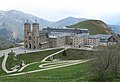 Basilica of Our Lady of La Salette, France

 Basilica of Our Lady of Knock, Ireland
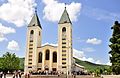 Shrine of Our Lady of Medjugorje, in Bosnia and Herzegovina
 Basilica of Our Lady of Laus, France
 Sanctuary of Our Lady of Peneda, Arcos de Valdevez, Portugal

.jpg)

_Basilique_1.jpg)


_Medjugorje_-_Hotel_Pansion_Porta_-_Bosnia_Herzegovina_-_Creative_Commons_by_gnuckx_(4695237966).jpg)
.JPG)


.JPG)

References[edit]
- Jump up ^ "Private and public revelation". Catholic Culture. Retrieved January 11, 2012.
- Jump up ^ John Delaney, A Woman Clothed with the Sun
- Jump up ^ "Vatican Recognizes Marian Apparition in France", Catholic News Agency, May 5, 2008
- Jump up ^ "Expert explains Church’s criteria for confirming Marian apparitions", Catholic News Agency, May 8, 2008
- Jump up ^ Mann, Benjamin, "Wisconsin chapel approved as first US Marian apparition site", Catholic News Agency, December 9, 2010
- Jump up ^ Dictionary of Mary, Catholic Book Publishing Co. New York. 1985, Imprimatur, p25-26
- Jump up ^ Papal Encyclical Lumen Gentium 62, Vatican.
- Jump up ^ Roses.org
- Jump up ^ Dictionary of Mary, Catholic Book Publishing Co. New York. 1985, Imprimatur, p25
- Jump up ^ http://www.ewtn.org/vexperts/showmessage_print.asp?number=419853&language=en
- ^ Jump up to: a b "Vatican recognizes Marian apparitions in France". Catholic News Agency. Retrieved 2011-02-20.
- Jump up ^ Paul Likoudis. "Our Lady of Laus Now On a Par with Lourdes". Catholic World News (republished from The Wanderer). Retrieved 2011-02-20.
- Jump up ^ "Expert explains Church’s criteria for confirming Marian apparitions". Catholic News Agency. 8 May 2008. Retrieved 22 February 2010.
- Jump up ^ Our Lady of Kibeho Our Lady of Sorrows
- Jump up ^ EWTN on Our Lady of Kibeho
- Jump up ^ Kibeho article
- Jump up ^ UN Report on Kibeho
- Jump up ^ Zenit News
- Jump up ^ Pilgrims to Our Lady of Guadalupe
- Jump up ^ Trudy Ring, 1996, International Dictionary of Historic Places, ISBN 978-1-884964-02-2 page 245
- Jump up ^ Sacred Destinations
- Jump up ^ Catholic encyclopedia, Our Lady of the Snow
- Jump up ^ Anglican Walsingham shrine
- Jump up ^ Catholic Walsingham shrine
- Jump up ^ Catherine Beebe, St. Dominic and the Rosary ISBN 0-89870-518-5
- Jump up ^ History of the Rosary http://www.ewtn.com/library/ANSWERS/ROSARYHS.htm
- Jump up ^ Catholic Encyclopedia http://www.newadvent.org/cathen/13184b.htm
- Jump up ^ History of the Dominicans http://www.domcentral.org/study/ashley/ds02ital2.htm
- Jump up ^ Calendarium Romanum (Libreria Editrice Vaticana, 1969), p. 105
- Jump up ^ Louis Saggi, O.Carm; Saint Simon Stock (XIII Century) Saint, Priest - Scholarly historical information
- ^ Jump up to: a b Eamon R. Carroll, O.Carm; Medieval Devotion to Mary Among the Carmelites
- Jump up ^ Andrew Jotischky; The Carmelites and Antiquity. Mendicants and their Pasts in the Middle Ages. Oxford: Oxford University Press, 2002.
- Jump up ^ The Order of Carmelites website; Simon Stock
- Jump up ^ Fr. Kieran Kavanaugh, OCD, Zenit News Service. Brown Scapular: A Silent Devotion July 16, 2008.
- Jump up ^ Herbert Thurston, S.J., "The Origin of the Scapular -- A Criticism." The Irish Ecclesiastical Record Vol XVI July–December 1904. pp. 59-75. Dublin: Browne & Nolan, Limited.
- Jump up ^ Bede Edwards, OCDS. Carmel Clarion Volume XXI, pp 17-22. "St. Simon Stock--The Scapular Vision & the Brown Scapular Devotion." July–August 2005, Discalced Carmelite Secular Order, Washington Province.
- Jump up ^ In his 2001 "Message to the Carmelite Family" on the occasion of the 750th anniversary of the apparition of Our Lady to St. Simon Stock, Pope John Paul II wrote that "I too have worn the Scapular of Carmel over my heart for a long time!" Message of John Paul II to the Carmelite Family March 25, 2001
- Jump up ^ Such as Fatima and the Scapular, page found 2010-06-24.
- Jump up ^ Catholic encyclopedia
- Jump up ^ Vincentian site
- Jump up ^ Society of the Green Scapular.
- Jump up ^ Society of the Green Scapular, page found 2010-06-25.
- Jump up ^ Ann Ball, 2003 Encyclopedia of Catholic Devotions and Practices ISBN 0-87973-910-X page 217
- Jump up ^ Catholic Pilgrims: Apparitions at Lourdes
- Jump up ^ [Taylor, Thérèse (2003). Bernadette of Lourdes. Burns and Oates. ISBN 0-86012-337-5]
- Jump up ^ Apparitions of the Modern Era, Univ.of Dayton
- Jump up ^ Razaq Raj, 2007, Religious Tourism and Pilgrimage Festivals, ISBN 978-1-84593-225-1 page 214
- Jump up ^ Thomas W. Petrisk, 1998, The Fatima Prophecies, St. Andrews Press, ISBN 978-1-891903-30-4 page 285
- Jump up ^ Catholic Online (www.catholic.org) - Our Lady of Fatima: Pope Benedict's Homily. 'I too Have Come as a Pilgrim'
- Jump up ^ Vatican - Homily of His Holiness Benedict XVI on the occasion of the 10th anniversary of the Beatification of Jacinta and Francisco, young shepherds of Fátima. Esplanade of the Shrine of Our Lady of Fátima. Thursday, 13 May 2010.
- Jump up ^ EWTN [1]
- Jump up ^ Notre Dame University [2]
- Jump up ^ Catholic News Agency [3]
- Jump up ^ «The Angelus», June 2000, Volume XXIII, No. 6 (Canada) by Rev. Fr. Fabrice Delestre [4]
- Jump up ^ Knock Shrine website
- Jump up ^ Ann Ball, 2003 Encyclopedia of Catholic Devotions and Practices ISBN 0-87973-910-X pages 73-74
- Jump up ^ Francois Leuret, 2006 Modern Miraculous Cures - A Documented Account Of Miracles And Medicine ISBN 1-4067-9918-1 page 63
- Jump up ^ Matthew Bunson, 2008, The Catholic Almanac, ISBN 978-1-59276-441-9 page 123
- Jump up ^ Michael Freze, 1993, Voices, Visions, and Apparitions, OSV Publishing ISBN 0-87973-454-X
- Jump up ^ van Houtryve, La Vierge des Pauvres, Banneux, 1947
- Jump up ^ Memorare http://www.memorare.com/mary/app1933.html
- Jump up ^ Our Lady of Akita
- ^ Jump up to: a b EWTN on Akita approval
- Jump up ^ Miriam and Stephen Weglian, "Let Heaven and Earth Unite", page 24, Faith Publishing Company, Milford Ohio, 1996
- Jump up ^ "Nicaragua Church-State Relations A Chronology - Part II"
- Jump up ^ Miracle Hunter web-site
- Jump up ^ Silvio Sirias, Bernardo and the Virgin, Northwestern University Press, 2005 ISBN 978-0-8101-2427-1
- Jump up ^ [5] EWTN statement on Kibeho
- Jump up ^ [6] Kibeho Shring Site
- Jump up ^ [7] Bishop Rubwejanga's statement on Devotion to Our Lady of Kibeho
- Jump up ^ "How the Church verifies Mary's visits as God's Ambassador". Retrieved 2011-09-19.
- Jump up ^ "Conceptionists celebrate their 500th anniversary". Retrieved 2011-09-20.
- Jump up ^ "Thousands turn out for procession of Our Lady of Good Success". Retrieved 2011-09-20.
- Jump up ^ Fr. Mauel Sousa Pereira, 2005, The Admirable Life of Mother Mariana, Vol. 1, Tradition in Action Incorporated, ISBN 0972651632, ISBN 9780972651639
- Jump up ^ "Marian Messenger". Retrieved 2011-09-19.
- Jump up ^ Catholic News Service
- Jump up ^ Diocese of Green Bay
- Jump up ^ St. Mary in the Orthodox concept by Tadrous Y. Malaty 1978 ISBN 0-908000-07-3 pages 116-120 [8]
- Jump up ^ Pearl Zaki (1977). Our Lord's Mother visits Egypt in 1968. Dar El Alam El Arabi. p. 24, 27.
- Jump up ^ Video of the Virgin Mary apparition in Cairo, Egypt from 1968-1970
- Jump up ^ Our Lady of Assiut
- Jump up ^ BBC News on Assiut
- Jump up ^ Assiut apparition account
- Jump up ^ McNally, Terrence, What Every Catholic Should Know about Mary ISBN 1-4415-1051-6 page 169
- Jump up ^ http://www.mytravelguide.com/attractions/profile-79378805-Australia_Adelaide_Shrine_Of_Our_Lady_Of_Yankalilla_The_.html
- Jump up ^ Our Lady of the Eucharist
- Jump up ^ Congregation for the Doctrine of the Faith letter on Bishop Gatti
- Jump up ^ Sbalchiero in: Laurentin/ Sbalchiero (2007), p. 1093-1097.
- Jump up ^ "St. Mary's Forane Church, Kuravilangad, Kottayam, Kerala, India".
- Jump up ^ http://www.ewtn.com/library/BISHOPS/ZANICMED.HTM
- Jump up ^ http://www.ewtn.com/expert/answers/medjugorje.htm
- Jump up ^ Winfield, Nicole (2010-03-17). "Vatican studies visions of Virgin Mary in Bosnia". Associated Press.
- Jump up ^ EWTN on Garabandal [9]
- Jump up ^ Judith Albright, 1997, Our Lady at Garabandal, ISBN 1-880033-04-6
- Jump up ^ Conchita Gonzales, 1983, Miracle at Garabandal, ISBN 0-385-18890-0
- Jump up ^ Michael Freze, 1993, Voices, Visions, and Apparitions, OSV Publishing ISBN 0-87973-454-X page 267
- Jump up ^ "Korattymuthy - Our Lady with Poovan Bananas". Koratty shrine.
- Jump up ^ Our Lady of Siluva
- Jump up ^ Our Lady of Siluva website
- Jump up ^ Lichen Basilica
- Jump up ^ Vaticanwebsite: John Paul II at Lichen
- Jump up ^ What occurred at La Codosera? - The apparitions of the Blessed Virgin Mary
- Jump up ^ This child who saw the Madonna. In La Provincia Pavese April 6, 2008, p. 35.
- Jump up ^ "I stood close to my mother's room and I saw her talking to a statue of the Madonna, crying 'This is my daughter. You can't do that to her. You've already experienced what it's like losing a son. Leave her alone.'"This child who saw the Madonna. In La Provincia Pavese April 6, 2008, p. 35.
- Jump up ^ Angela Volpini heir of Don Baget Bozzo, in La Provincia Pavese March 12, 2010, p. 22.
- Jump up ^ The apparitions of Virgin Mary in Turzovka, Czeckoslovakia [sic] (1958-1962) Retrieved on October 2, 2011.
- Jump up ^ Messages of Our Lady of Sorrows in Kibeho, Rwanda Our Lady of Kibeho
- Jump up ^ JUDGEMENT ON THE APPARITIONS OF KIBEHO EWTN on Our Lady of Kibeho
- Jump up ^ Remembering the forgotten Diggers Kibeho article
- Jump up ^ Witness to Genocide -- A Personal Account of the 1995 Kibeho Massacre UN Report on Kibeho
- Jump up ^ *Article about the bishop's trial The Tablet
- Jump up ^ EWTN [10]
- Jump up ^ University of Dayton
- Jump up ^ Catholic News Service [11]
- Jump up ^ University of Dayton on Pellevoisin
- Jump up ^ EWTN on Our Lady of All Nations[12]
- Jump up ^ Approbation of the Apparitions in Amsterdam
- Jump up ^ EL MENSAJE DE ONUVA - Apariciones de la Virgen en España. ONUVA, tierra de misericordia y de reparación a los Scmos. Corazones de Jesús y María
- Jump up ^ I am the Immaculate Purity - The apparitions of the Blessed Virgin Mary in Litmanová (Slovakia) Retrieved on October 1, 2011.
- Jump up ^ Manduria for Young People Movement
- Jump up ^ The Virgin of the Eucharist (Manduria, Italy)
- Jump up ^ The Blessed Mother of Goodness (São Marcos da Serra, Algarve, Portugal)
- ^ Jump up to: a b "Mystic claims that Mary appeared at Batim apparition". The Times of India, Panjim. 26 March 2012. Retrieved 13 April 2012.
- Jump up ^ Apparitions Information Index at The Marian Library/International Marian Research Institute, Dayton, Ohio
- Jump up ^ (Russian) Явление Богородицы в Цхинвале во время войны августа 2008 г. (видео) — OSInform agency,
- Jump up ^ Many residents of Tskhinvali saw the Holy Virgin during the shelling, the local bishop claims — Interfax, 19 August 2008
- Jump up ^ (Russian) В Цхинвали явилась Богородица — Utro.ru, 19 August 2008
- Jump up ^ Carmelita Rivas messages
- Jump up ^ Decree by Bishop Richard Lennon
- Jump up ^ Article explaining the Church's position
- Jump up ^ EWTN on Bayside apparitions
- Jump up ^ Vatican rejects Our Lady of Surbiton
- Jump up ^ Emmitsburg website
- Jump up ^ http://www.fraternitenotredame.com/Pages/EN_Pages/EN_History/EN_History-01.html
External links[edit]
- Foundation Marypages Design: The Apparitions of the Blessed Virgin Mary, Crowned Queen of Heaven
- The Miracle Hunter: Marian Appartitions (with links to letters from local bishops in some cases)
- The Catholic Community Forum: Marian Apparitions
- Korattymuthy - Our Lady with Poovan Bananas (Poovankula Matha) Official Website
- Fátima - Official Website
- Medjugorje - Official Website
- Eternal Word Television Network: MARIAN APPARITIONS IN THE AMERICAS
| |||


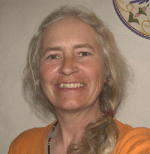 MARY E. (BETSY) RABYOR was born in Wisconsin and lived in Nevada, Florida and Spain. She went to college and was a computer programmer for 17 years, with family and suburban life. Since 1990, she has meditated and learned self-healing techniques. In August of 1999, she spiritually awakened, quit her job and devoted her life to self-realization and helping others. Shortly after starting Reiki self-healing in 2005, her kundalini unexpectedly awakened. She continues to work with her kundalini transformation today. She lives in Wisconsin and is a skilled distance healer, author, poet, intuitive, and spiritual mentor.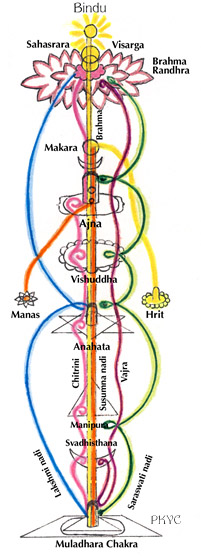

 Life changing phenomenom...


