Exploring Mysticism and Parapsychology. This blog is also an attempt to promote awareness of a Modern Universal Paradigm known as Multi-Dimensional Science. It offers a "Scientific" testable Hypothesis for a more "objective" understanding of claimed Psychic and Spiritual Phenomena. A link to this subject should be found on this page or alternatively it can be found easily via a word search.Please note that the Internet articles here may not always reflect the views of the Blogger.
By Shelly Fan - Jun 21, 2017 9,815 / Singularity Hub
Two thousand years ago, the ancient Greeks looked into the night sky and saw geometric shapes emerge among the stars: a hunter, a lion, a water vase.
In a way, they used these constellations to make sense of the random scattering of stars in the fabric of the universe. By translating astronomy into shapes, they found a way to seek order and meaning in a highly complex system.
As it turns out, the Greeks were wrong: most stars in a constellation don’t have much to do with one another. But their approach lives on.
This week, the Blue Brain Project proposed a fascinating idea that may explain the complexities of the human brain. Using algebraic topology, a type of mathematics that “projects” complex connections into graphs, they mapped out a path for complex functions to emerge from the structure of neural networks.
And get this: while the brain physically inhabits our three-dimensional world, its inner connections—mathematically speaking—operate on a much higher dimensional space. In human speak: the assembly and disassembly of neural connections are massively complex, more so than expected. But now we may have a language to describe them.
“We found a world that we had never imagined,” says Dr. Henry Markram, director of Blue Brain Project and professor at the EPFL in Lausanne, Switzerland who led the study.
This may be why it’s been so difficult to understand the brain, he says. “The mathematics usually applied to study networks cannot detect the high-dimensional structures and spaces that we now see clearly.”
A high-dimensional world
When we think about the brain, branchy neurons and gooey tissue come to mind—definitely 3D objects. Physically speaking, there are no high-dimensional mini-brains hidden within our own, and our neurons don’t jump into a higher plane of existence when they fire away.
Outside of physics, “dimension” is really just a fancy way of describing complexity. Take a group of three neurons that work together (A, B, and C), for example. Now think about how many ways they can connect together. Because information is generally only passed one way from a neuron to its downstream partner, A can only link to B or C. In topology speak, the dimension here is two.
Similarly, a group of four neurons has dimension three, five neurons dimension four and so on. The more neurons in a group, the higher the dimension—and so the system gets increasingly complex.
“In our study, dimension does not describe spatial dimensions, but rather the topological dimension of the geometric objects we are describing. A 7- or 11-dimensional simplex is still embedded in the physical three-dimensional space,” explains study author Max Nolte, a graduate student at EPFL, to Singularity Hub.
Multi-dimensional connections
To begin parsing out the organization of the brain, the team started with functional building blocks called simplices. Each simplex is a special group of neurons connected with each other in a very specific order.
One neuron is very influential and speaks first, one listens to all neurons, and others listen to a few neurons and speak to the ones they’re not listening to, says Nolte. “This specific structure makes sure that the listening neurons can really understand the speaking neurons in a brain where always millions of neurons are talking at the same time, like in a crowded stadium.”
As before, dimensions describe the complexity of a simplex.
In six different virtual brains, each reconstructed from experimental data obtained in rats, the team looked for signs of these abstract mathematical objects. Incredibly, the virtual brains contained extremely complex simplices—up to dimension seven—and roughly 80 million lower dimensional neuron “groups.”
The enormous amount of simplices hidden inside the brain suggests that each neuron is a part of an immense number of functional groups, much more than previously thought, says Nolte.
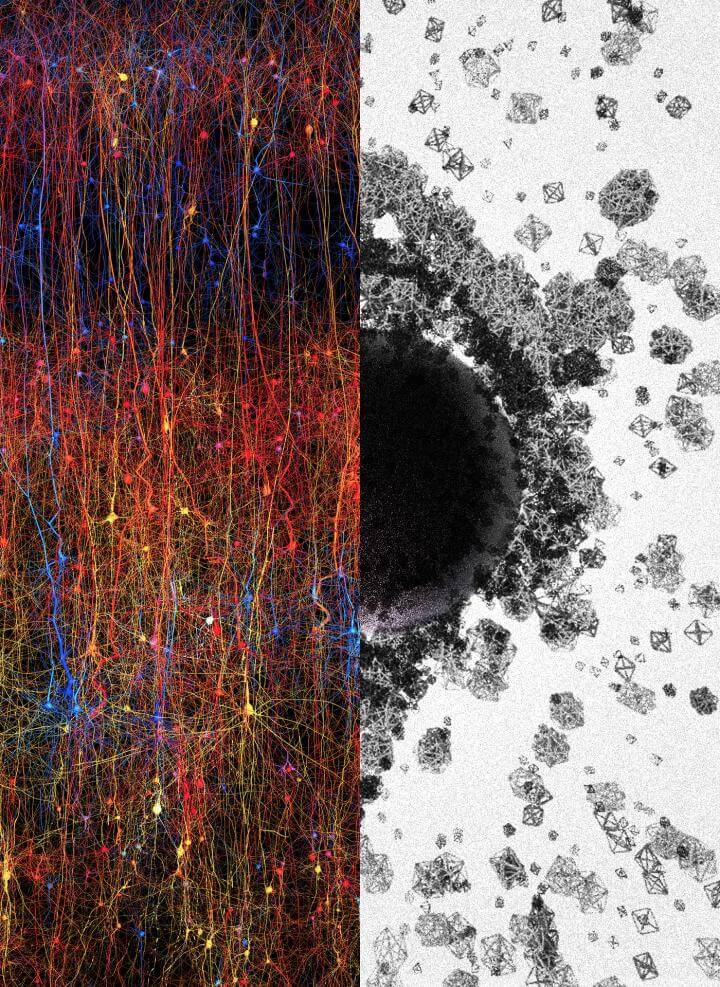
In their paper, the researchers attempted to mathematically map the brain’s neuronal networks. The image on the left is a digital copy of the neocortex. Next to it is a simplified image of the brain’s multi-dimensional structures and spaces. Image credit: Blue Brain Project
Emerging function
If simplices are building blocks, then how do they come together to form even more complicated networks?
When the team exposed their virtual brain to a stimulus, the neurons assembled into increasingly intricate networks, like blocks of Lego building a castle.
Again, it’s not necessarily a physical connection. Picture groups of neurons linking to others like a social graph, and the graphs associating into a web or other high-dimensional structure.
The fit wasn’t perfect: in between the higher-dimensional structures were “holes,” places where some connections were missing to make a new web.
Like simplices, holes also have dimensions. In a way, says Nolte, “the dimension of a hole describes how close the simplices were to reaching a higher dimension,” or how well the building blocks associated with each other.
The appearance of progressively higher dimensional holes tells us that neurons in the network respond to stimuli in an “extremely organized manner,” says Dr. Ran Levi at the University of Aberdeen, who also worked on the paper.
When we look at the reaction of the brain over time to a stimulus, we see abstract geometric objects forming and then falling apart as it builds functional networks, says Levi.
The brain first recruits simpler neural networks to build a 1D “frame.” These networks then associate into 2D “walls” with “holes” in between. Fast-forward and increasingly higher dimensional structures and holes form, until they reach peak organization—whatever connections the neurons need to get the job done.
Once there, the entire structure collapses, freeing up the simplices for their next tasks, like sand castles materializing and then disintegrating away.
“We don’t know…what the brain is doing when it forms these cavities,” says Levi to Singularity Hub.
What’s clear, however, is that neurons have to fire in a “fantastically ordered” manner for these high-dimensional structures to occur.
“It is quite clear that this hyper-organized activity is not just a coincidence. This could be the key to understanding what is going on when the brain is active,” says Levi.
Talking in sync
The team also worked out how neurons in the same or different groups talked to one another after a stimuli.
It really depends on where they are in the high-dimensional structure and their own groups.
Imagine two “stranger” neurons chatting away, says Nolte. They’ll probably say many unrelated things, because they don’t know each other.
Now, imagine after a stimulus they form high-dimensional networks. Like Twitter, the network allows one neuron to hear the other, and they may begin repeating some of the things the other one said. If they both follow dozens of other people, their tweets may be even more similar because their thoughts are influenced by a shared crowd.
“Using simplices, we don’t only count how many shared people they are following, but also how these people they are following are connected to each other,” says Nolte. The more interconnected two neurons are—that is, the more simplices they are a part of—the more they fire to a stimulus in the same way.
It really shows the importance of the functional structure of the brain, in that structure guides the emergence of correlated activity, says Levi.
Previous studies have found that the physical structure of neurons and synapses influence activity patterns; now we know that their connections in “high-dimensional space” also factor in.
Going forward, the team hopes to understand how these complicated, abstract networks guide our thinking and behaviors.
“It’s like finding a dictionary that translates a totally obscure language to another language that we are actually familiar with, even if we don’t necessarily understand all stories written in this language,” says Levi.
Now it’s time to decipher those stories, he adds.
Image credit: Shutterstock
Over time there have been other schools of thought formed under the umbrella of deism including Christian deism, belief in deistic principles coupled with the moral teachings of Jesus of Nazareth, and Pandeism, a belief that God became the entire universe and no longer exists as a separate being.[12]
For the history of the root words, pantheism and deism, see the overview of deism section, and history of pantheism section. The earliest use of the actual term, pandeism, appears to have come as early as 1787,[13] with another use related in 1838,[14] a first appearance in a dictionary in 1849 (in German, as 'Pandeismus' and 'Pandeistisch'),[15] and an 1859 usage of "pandeism" possibly in contrast to both pantheism and deism by Moritz Lazarus and Heymann Steinthal.[8] Physicist and philosopher Max Bernhard Weinstein in his 1910 work Welt- und Lebensanschauungen, Hervorgegangen aus Religion, Philosophie und Naturerkenntnis ("World and Life Views, Emerging From Religion, Philosophy and Nature"), presented the broadest and most far-reaching examination of pandeism written up to that point. Weinstein noted the distinction between pantheism and pandeism, stating "even if only by a letter (d in place of th), we fundamentally differ Pandeism from Pantheism."[16] But it has been noted that some pantheists have identified themselves as pandeists as well, to underscore that "they share with the deists the idea that God is not a personal God who desires to be worshipped".[17]
Noting that Victorian scholar George Levine has suggested that secularism can bring the "fullness" which "religion has always promised," other authors have since observed:[18]
For others, this "fullness" is present in more religious-oriented pantheistic or pandeistic belief systems with, in the latter case, the inclusion of God as the ever unfolding expression of a complex universe with an identifiable beginning but no teleological direction necessarily present.[18]
This is classed within a general tendency of postmodernity to be "a stunning amalgamation" of the views of William James and Max Weber, representing "the movement away from self-denial toward a denial of the supernatural", which "promises to fundamentally alter future geographies of mind and being by shifting the locus of causality from an exalted Godhead to the domain of Nature".[18] It has also been suggested that "many religions may classify themselves as pantheistic" but "fit more essentially under the description of panentheistic or pandeistic."[19]
Physicist and philosopher Max Bernhard Weinstein wrote that 6th century BC philosopher Xenophanes of Colophon spoke as a pandeist in stating that there was one god which "abideth ever in the selfsame place, moving not at all" and yet "sees all over, thinks all over, and hears all over."
The earliest seeds of pandeism coincide with notions of monotheism, which generally can be traced back to the Atenism of Akhenaten, and the Babylonian-era Marduk. Weinstein in particular identified the idea of primary matter derived from an original spirit as found by the ancient Egyptians to be a form of pandeism.[20] Weinstein similarly found varieties of pandeism in the religious views held in China[21] (especially with respect to Taoism as expressed by Lao-Tze),[22]India, especially in the HinduBhagavad Gita,[23] and among various Greek and Roman philosophers.
Specifically, Weinstein wrote that 6th century BC philosopher Xenophanes of Colophon spoke as a pandeist in stating that there was one god which "abideth ever in the selfsame place, moving not at all" and yet "sees all over, thinks all over, and hears all over."[24] He similarly found that ideas of pandeism were reflected in the ideas of Heraclitus, and of the Stoics.[25] Weinstein also wrote that pandeism was especially expressed by the later students of the 'Platonic Pythagoreans' and the 'Pythagorean Platonists.'[26] and among them specifically identified 3rd century BC philosopher Chrysippus, who affirmed that "the universe itself is God and the universal outpouring of its soul,"[27] as a pandeist as well.[25]Religious studies professor, F. E. Peters, however, found with respect to the Pythagoreans and the Milesians that "[w]hat appeared... at the center of the Pythagorean tradition in philosophy, is another view of psyche that seems to owe little or nothing to the pan-vitalism or pan-deism that is the legacy of the Milesians.[28] Amongst the Milesians, Englishhistorian of philosophy Andrew Gregory notes in particular that "some construction using pan-, whether it be pantheism, pandeism or pankubernism describes Anaximander reasonably well," though he does go on to question whether Anaximander's view of the distinction between apeiron and cosmos makes these labels technically relevant at all.[29]Gottfried Große in his 1787 interpretation of Pliny the Elder’s Natural History, describes Pliny, a first-century figure, as "if not a Spinozist, then perhaps a Pandeist."[13]
Weinstein examines the philosophy of 9th century theologian Johannes Scotus Eriugena, who proposed that "God has created the world out of his own being," and identifies this as a form of pandeism, noting in particular that Eriugena's vision of God was one which does not know what it is, and learns this through the process of existing as its creation.[30] In his great work, De divisione naturae (also called Periphyseon, probably completed around 867 AD), Eriugena proposed that the nature of the universe is divisible into four distinct classes:
1 – that which creates and is not created;
2 – that which is created and creates;
3 – that which is created and does not create;
4 – that which neither is created nor creates.
The first stage is God as the ground or origin of all things; the second is the world of Platonic ideals or forms; the third is the wholly physical manifestation of our Universe, which "does not create"; the last is God as the final end or goal of all things, that into which the world of created things ultimately returns to completeness with the additional knowledge of having experienced this world. A contemporary statement of this idea is that: "Since God is not a being, he is therefore not intelligible... This means not only that we cannot understand him, but also that he cannot understand himself. Creation is a kind of divine effort by God to understand himself, to see himself in a mirror."[31]
Weinstein also found that thirteenth century Catholic thinker Bonaventure—who championed the Platonic doctrine that ideas do not exist in rerum natura, but as ideals exemplified by the Divine Being, according to which actual things were formed—showed strong pandeistic inclinations.[32] Of Nicholas of Cusa, who wrote of the enfolding of creation in God and the unfolding of the divine human mind in creation, Weinstein wrote that he was, to a certain extent, a pandeist.[33] And, as to Franciscus Mercurius van Helmont, who had written A Cabbalistical Dialogue (Latin version first, 1677, in English 1682) placing matter and spirit on a continuum, and describing matter as a "coalition" of monads, Weinstein also found this to be a kind of pandeism.[34] Weinstein found that pandeism was strongly expressed in the teachings of Giordano Bruno, who envisioned a deity which had no particular relation to one part of the infinite universe more than any other, and was immanent, as present on Earth as in the Heavens, subsuming in itself the multiplicity of existence.[35] This was reiterated by others including Discover editor Corey S. Powell, who wrote that Bruno's cosmology was "a tool for advancing an animist or Pandeist theology."[36][37]
Italian theologian Giordano Bruno was charged with heresy and burned at the stake for propounding what has been deemed by some commentators to be a pandeistic ideology.
In the 1820s to 1830s, pandeism received some mention in Italy. In 1834, publisher Giovanni Silvestri posthumously published a volume of sermons of Italian Padre Filippo Nannetti di Bibulano (aka il Filippo Nani, Padre da Lojano; 1759-1829), who named pandeism as being among beliefs he condemned, railing against "Jews, Muslims, Gentiles, Schismatics, Heretics, Pandeists, Deists, and troubled, restless spirits."[38] Nannetti further specifically criticized pandeism, declaring, "To you, fatal Pandeist! the laws that create nature are contingent and mutable, not another being in substance with forces driven by motions and developments."[39] Within a few years thereafter came the 1838 publication of an anonymous treatise, Il legato di un vecchio ai giovani della sua patria ("The Legacy of an Old Man to the Young People of his Country"), whose author, discussing the theory of religion presented by Giambattista Vico a century earlier, mused that when man first saw meteor showers, "his robust imagination recognized the effects as a cause, then deifying natural phenomena, he became a Pandeist, an instructor of Mythology, a priest, an Augur."[40] Neither Nannetti nor the 1838 author defines pandeism distinctly enough to cleanly distinguish it from pantheism, or possibly polytheism. But, again in 1838, another Italian, phrenologistLuigi Ferrarese in Memorie Riguardanti la Dottrina Frenologica ("Thoughts Regarding the Doctrine of Phrenology") critically described Victor Cousin's philosophy as a doctrine which "locates reason outside the human person, declaring man a fragment of God, introducing a sort of spiritual pandeism, absurd for us, and injurious to the Supreme Being."[14]
The 1859 German work, Zeitschrift für Völkerpsychologie und Sprachwissenschaft by philosophers and frequent collaborators Moritz Lazarus and Heymann Steinthal, distinguished pandeism unequivocally, declaring: "Man stelle es also den Denkern frei, ob sie Theisten, Pan-theisten, Atheisten, Deisten (und warum nicht auch Pandeisten?)...[8] ("Man leaves it to the philosophers, whether they are Theists, Pan-theists, Atheists, Deists (and why not also Pandeists?)..." Literary critic, Hayden Carruth, said of 18th century figure Alexander Pope that it was "Pope's rationalism and pandeism with which he wrote the greatest mock-epic in English literature"[41] According to American Philosophy: An Encyclopedia, "later Unitarian Christians (such as William Ellery Channing), transcendentalists (such as Ralph Waldo Emerson and Henry David Thoreau), writers (such as Walt Whitman) and some pragmatists (such as William James) took a more pantheist or pandeist approach by rejecting views of God as separate from the world".[42] The Belgian poet Robert Vivier wrote of the pandeism to be found in the works of Nineteenth Century novelist and poet Victor Hugo.[43] Similarly in the Nineteenth Century, poet Alfred Tennyson revealed that his "religious beliefs also defied convention, leaning towards agnosticism and pandeism".[44][45]Charles Darwin has been described as having views that were "a good match for deism, or possibly for pandeism."[46]Friedrich Engels has also been described by at least one historian as having pandeistic views.[47]
Weinstein asserted the presence of pandeism in China,[21] including in Lao-Tze's Taoism,[22] and in India, especially in the HinduBhagavad Gita.[23] Other philosophers have also pointed to pandeism as having a presence in the cultures of Asia. In 1833, religionist Godfrey Higgins theorized in his Anacalypsis that "Pandeism was a doctrine, which had been received both by Buddhists and Brahmins."[48] In 1896, historian Gustavo Uzielli described the world's population as influenced "by a superhuman idealism in Christianity, by an anti-human nihilism in Buddhism, and by an incipient but growing pandeism in Indian Brahmanism."[49] But the following year, the Reverend Henry Grattan Guinness wrote critically that in India, "God is everything, and everything is God, and, therefore, everything may be adored. ... Her pan-deism is a pandemonium."[50] Likewise, twenty years earlier, in 1877, Peruvian scholar and historian Carlos Wiesse Portocarrero had written in an essay titled Philosophical Systems of India that in that country, "Metaphysics is pandeistic and degenerates into idealism."[51] German political philosopher Jürgen Hartmann observes that Hindu pandeism has contributed to friction with monotheistic Islam.[52]
Pandeism (in Chinese, 泛自然神论)[53] was described by Wen Chi, in a Peking University lecture, as embodying "a major feature of Chinese philosophical thought," in that "there is a harmony between man and the divine, and they are equal."[54] Zhang Dao Kui (张道葵) of the China Three Gorges University proposed that the art of China's Three Gorges area is influenced by "a representation of the romantic essence that is created when integrating rugged simplicity with the natural beauty spoken about by pandeism."[55] Literary critic Wang Junkang (王俊康) has written that, in Chinese folk religion as conveyed in the early novels of noted folk writer Ye Mei (叶梅),[56] "the romantic spirit of Pandeism can be seen everywhere."[57] Wang Junkang additionally writes of Ye Mei's descriptions of "the worship of reproduction under Pandeism, as demonstrated in romantic songs sung by village people to show the strong impulse of vitality and humanity and the beauty of wildness."[58] It has been noted that author Shen Congwen has attributed a kind of hysteria that "afflicts those young girls who commit suicide by jumping into caves-"luodong" 落洞" to "the repressive local military culture that imposes strict sexual codes on women and to the influence of pan-deism among Miao people," since "for a nymphomaniac, jumping into a cave leads to the ultimate union with the god of the cave".[59] Weinstein similarly found the views of 17th century JapaneseNeo-Confucian philosopher Yamazaki Ansai, who espoused a cosmology of universal mutual interconnectedness, to be especially consonant with pandeism.[60]
Pandeism has been proposed to be a traditional religious view that accords with modern science.
In The Pilgrimage from Deism to Agnosticism, Moncure Daniel Conway stated that the term, "Pandeism" is "an unscholarly combination".[61] See also Ottmar Hegemann, describing the "New Catholicism" of Franz Mach as actually a form of pandeism, in 1905.[62]A similar critique of Pandeism as an 'unsightly' combination of Greek and Latin was made in a review of Weinstein's discussion of Pandeism.[63] The reviewer further criticises Weinstein's broad assertions that Scotus Eriugena, Anselm of Canterbury, Nicholas of Cusa, Giordano Bruno, Mendelssohn, and Lessing all were Pandeists or leaned towards Pandeism.[63] Towards the beginning of World War I, an article in the Yale Sheffield Monthly published by the Yale UniversitySheffield Scientific School commented on speculation that the war "means the death of Christianity and an era of Pandeism or perhaps even the destruction of all which we call modern civilization and culture."[64] The following year, early 19th-century German philosopher Paul Friedrich Köhler wrote that Pantheism, Pandeism, Monism and Dualism all refer to the same God illuminated in different ways, and that whatever the label, the human soul emanates from this God. [65]
Pandeism was noted by literary critic Martin Lüdke as a philosophy expressed by early Twentieth-Century Portuguese poet Fernando Pessoa, especially as to those writings made under the pseudonym of Alberto Caeiro.[66] Pandeism was likewise noted by authors like Brazilian journalist and writer Otávio de Faria, and British scholar and translator of Portuguese fiction Giovanni Pontiero, among others, to be an influence on the writings of noted mid-Twentieth-Century Brazilian poet Carlos Nejar,[67][68] of whom de Faria wrote that "the pandeism of Nejar is one of the strongest poetic ideas that we have reached in the world of poetry."[68]
Pandeism was also examined by theologian Charles Hartshorne, one of the chief disciples of process philosopherAlfred North Whitehead. In his process theology, an extension of Whitehead's work, Hartshorne preferred pandeism to pantheism, explaining that "it is not really the theos that is described".[69]:347 However, he specifically rejected pandeism early on, finding that a God who had "absolute perfection in some respects, relative perfection in all others" was "able consistently to embrace all that is positive in either deism or pandeism."[69]:348 Hartshorne accepted the label of panentheism for his beliefs, declaring that "panentheistic doctrine contains all of deism and pandeism except their arbitrary negations".[69]:348[70] Charles Anselm Bolton states in a 1963 article, Beyond the Ecumenical: Pan-deism?[71] that he "first came upon this extension of ecumenism into pan-deism among some Roman Catholicscholars interested primarily in the 'reunion of the churches,' Roman, Orthodox, Anglican," and wondered, "what is the ultimate aim of the Curia in promoting the pan-deist movement."[71] Robert A. Heinlein especially enjoyed this idea, and raised it in several of his works. Literary critic Dan Schneider wrote of Heinlein's Stranger In A Strange Land that Jubal Harshaw's belief in his own free will, was one "which Mike, Jill, and the Fosterites misinterpret as a pandeistic urge, 'Thou art God!'"[72] Heinlein himself, in his "Aphorisms of Lazarus Long", in his 1973 book Time Enough for Love wrote, "God split himself into a myriad parts that he might have friends. This may not be true, but it sounds good—and is no sillier than any other theology."[73]
A 1995 newsarticle quoted this use of the term by Jim Garvin, a Vietnam veteran who became a Trappist monk in the Holy Cross Abbey of Berryville, Virginia. Garvin described his spiritual position as "'pandeism' or 'pan-en-deism,' something very close to the Native American concept of the all- pervading Great Spirit..."[74] The following year, Pastor Bob Burridge of the Geneven Institute for Reformed Studies wrote that: "If God was the proximate cause of every act it would make all events to be "God in motion". That is nothing less than pantheism, or more exactly, pandeism."[75] Burridge rejects this model, observing that in Christianity, "The Creator is distinct from his creation. The reality of secondary causes is what separates Christian theism from pandeism."[75] Burridge concludes by challenging that "calling God the author of sin demand[s] a pandeistic understanding of the universe effectively removing the reality of sin and moral law."[75]
More recently, pandeism has been classed as a logical derivation of German philosopher Gottfried Wilhelm Leibniz's proposition that ours was the best of all possible worlds.[76] In 2010, author William C. Lane contended that:
If divine becoming were complete, God's kenosis--God's self-emptying for the sake of love--would be total. In this pandeistic view, nothing of God would remain separate and apart from what God would become. Any separate divine existence would be inconsistent with God's unreserved participation in the lives and fortunes of the actualized phenomena."[76]:67
Acknowledging that American philosopher William Rowe has raised "a powerful, evidential argument against ethical theism," Lane further contended that pandeism offers an escape from the evidential argument from evil:
However, it does not count against pandeism. In pandeism, God is no superintending, heavenly power, capable of hourly intervention into earthly affairs. No longer existing "above," God cannot intervene from above and cannot be blamed for failing to do so. Instead God bears all suffering, whether the fawn's[77] or anyone else's.
Even so, a skeptic might ask, "Why must there be so much suffering,? Why could not the world's design omit or modify the events that cause it?" In pandeism, the reason is clear: to remain unified, a world must convey information through transactions. Reliable conveyance requires relatively simple, uniform laws. Laws designed to skip around suffering-causing events or to alter their natural consequences (i.e., their consequences under simple laws) would need to be vastly complicated or (equivalently) to contain numerous exceptions.[76]:76–77
In 2010 German astrophysicist and popular scientist Harald Lesch observed in a debate on the role of faith in science:
Suppose we would find the all-encompassing law of nature, we are looking for so that finally we could assure proudly, the world is built up this way and no differently -- immediately it would create a new question: What is behind this law, why is the world set up just so? This leads us beyond the limits of science in the field of religion. As an expert, a physicist should respond: We do not know, we'll never know. Others would say that God authored this law, that created the universe. A Pandeist might say that the all-encompassing law is God."[78]
In 2011, social scientist Niall Douglas wrote that in pandeism, "God is growth, God is structure/knowledge, God is everything and nothing simultaneously. And, rather heretically for the Abrahamic religions, to perceive i.e. to cognate i.e. to be of matter i.e. to be structured energy generating a gravimetric field is an aspect of God relating to another aspect of God through light, which is of course God. In this, the underlying metaphysics are most definitely Pandeist."[79] Alan Dawe's 2011 book The God Franchise, though mentioning pandeism in passing as one of numerous extant theological theories,[4] declines to adopt any "-ism" as encompassing his view, though Dawe's theory includes the human experience as being a temporarily segregated sliver of the experience of God. This aspect of the theology of pandeism (along with pantheism and panentheism) has been compared to the Biblical exhortation in Acts17:28 that "In him we live and move and have our being,"[80] while the Wycliffe Bible Encyclopedia had in 1975 described the religion of Babylon as "clearly a type of pan-deism formed from a synthesis of Christianity and paganism".[81] Another Christian theologian, Graham Ward, insists that "Attention to Christ and the Spirit delivers us from pantheism, pandeism, and process theology,"[82] and Catholic author Al Kresta observes that:
“New Age” cosmologies reject materialism, naturalism and physicalisma. They are commonly pantheistic or pandeistic. They frequently try to commandeer quantum physics and consciousness studies to illustrate their conception of the cosmos.[83]
Renegade priest Paul Kramer has deemed Pope Francis "a pandeist who does not believe in the transcendent God and Creator of Catholicism, but in the immanent ‘divine principle’ of Paganism, the life giving world soul (anima mundi) within the Universe," describing this as a creed "remarkably like a synthesis of the belief systems of Lord Shaftsbury (sic), Friedrich Schleiermacher, Benedict Spinoza, Auguste Compte, and Pierre Teilhard de Chardin."[84]
Also in 2011, in a study of Germany's Hesse region, German sociologist of religion and theologian Michael N. Ebertz and German television presenter and author Meinhard Schmidt-Degenhard concluded that "Six religious orientation types can be distinguished: "Christians" - "non-Christian theists" - "Cosmotheists" - "Deists, Pandeists and Polytheists" - "Atheists" - "Others"."[85] Pandeism has also been described as one of the "older spiritual and religious traditions" whose elements are incorporated into the New Age movement,[86][87] but also as among the handful of spiritual beliefs which "are compatible with modern science."[88] In 2013, Australianreligious studies scholar Raphael Lataster proposed that "Pandeism could be the most likely God-concept of all."[1]
In January 2016, a Kickstarter fundraising effort successfully funded a book titled Pandeism: An Anthology, set to contain articles from over a dozen different writers examining pandeism from many different points of view, thus being the broadest examination of the theory yet made.[89] The book includes writings by Bernardo Kastrup, Raphael Lataster, Anthony Peake, Michael Arnheim, Zoltan Istvan,[90]Robert G. Brown, and William Walker Atkinson.
^ Jump up to: abRaphael Lataster (2013). There was no Jesus, there is no God: A Scholarly Examination of the Scientific, Historical, and Philosophical Evidence & Arguments for Monotheism. p. 165. ISBN1492234419. This one god could be of the deistic or pantheistic sort. Deism might be superior in explaining why God has seemingly left us to our own devices and pantheism could be the more logical option as it fits well with the ontological argument's 'maximally-great entity' and doesn't rely on unproven concepts about 'nothing' (as in 'creation out of nothing'). A mixture of the two, pandeism, could be the most likely God-concept of all.
Jump up ^Sean F. Johnston (2009). The History of Science: A Beginner's Guide. p. 90. ISBN1-85168-681-9. In its most abstract form, deism may not attempt to describe the characteristics of such a non-interventionist creator, or even that the universe is identical with God (a variant known as pandeism).
Jump up ^Paul Bradley (2011). This Strange Eventful History: A Philosophy of Meaning. p. 156. ISBN0875868762. Pandeism combines the concepts of Deism and Pantheism with a god who creates the universe and then becomes it.
^ Jump up to: abAlan H. Dawe (2011). The God Franchise: A Theory of Everything. p. 48. ISBN0473201143. Pandeism: This is the belief that God created the universe, is now one with it, and so, is no longer a separate conscious entity. This is a combination of pantheism (God is identical to the universe) and deism (God created the universe and then withdrew Himself).
Jump up ^Ronald R. Zollinger (2010). "6". Mere Mormonism: Defense of Mormon Theology. ISBN1-46210-585-8. Pandeism. This is a kind of pantheism that incorporates a form of deism, holding that the universe is identical to God but also that God was previously a conscious and sentient force or entity that designed and created the universe.
^ Jump up to: abAllan R. Fuller (2010). Thought: The Only Reality. p. 79. ISBN1608445909. Pandeism is another belief that states that God is identical to the universe, but God no longer exists in a way where He can be contacted; therefore, this theory can only be proven to exist by reason. Pandeism views the entire universe as being from God and now the universe is the entirety of God, but the universe at some point in time will fold back into one single being which is God Himself that created all. Pandeism raises the question as to why would God create a universe and then abandon it? As this relates to pantheism, it raises the question of how did the universe come about what is its aim and purpose?
Jump up ^Peter C. Rogers (2009). Ultimate Truth, Book 1. p. 121. ISBN1438979681. As with Panentheism, Pantheism is derived from the Greek: 'pan'= all and 'theos' = God, it literally means "God is All" and "All is God". Pantheist purports that everything is part of an all-inclusive, indwelling, intangible God; or that the Universe, or nature, and God are the same. Further review helps to accentuate the idea that natural law, existence, and the Universe which is the sum total of all that is, was, and shall be, is represented in the theological principle of an abstract 'god' rather than an individual, creative Divine Being or Beings of any kind. This is the key element which distinguishes them from Panentheists and Pandeists. As such, although many religions may claim to hold Pantheistic elements, they are more commonly Panentheistic or Pandeistic in nature.
^ Jump up to: abcMoritz Lazarus and Heymann Steinthal (1859). Zeitschrift für Völkerpsychologie und Sprachwissenschaft [Journal of Social Psychology and Linguistics]. p. 262. Man stelle es also den Denkern frei, ob sie Theisten, Pan-theisten, Atheisten, Deisten (und warum nicht auch Pandeisten?)..." Translation: "Man leaves it to the philosophers, whether they are Theists, Pan-theists, Atheists, Deists (and why not also Pandeists?)...
Jump up ^Theresa J. Morris (2014). Knowing Cosmology: Ascension Age. p. 85. ISBN1495254119. Not all monists are pantheists. Exclusive monists believe that the universe, the God of the pantheist, simply does not exist. In addition, monists can be Deists, pandeists, theists or panentheists; believing in a monotheistic God that is omnipotent and all-pervading, and both transcendent and immanent.
Jump up ^Charles Brough (2010). The Last Civilization. p. 246. ISBN1426940572. Deism and pan-deism, as well as agnosticism and atheism, are all Non-Theisms.
Jump up ^Celeste Foley (2012). GOD-centric: Interior Spiritual Disciplines. p. 49. ISBN1475154984.
^ Jump up to: abGottfried Große (1787). Naturgeschichte: mit erläuternden Anmerkungen. p. 165. Beym Plinius, den man, wo nicht Spinozisten, doch einen Pandeisten nennen konnte, ist Natur oder Gott kein von der Welt getrenntes oder abgesondertes Wesen. Seine Natur ist die ganze Schöpfung im Konkreto, und eben so scheint es mit seiner Gottheit beschaffen zu seyn." Translation: "In Pliny, whom one could call, if not a Spinozist, then perhaps a Pandeist, Nature is not a being divided off or separated from the world. His nature is the whole of creation, in concrete, and the same appears to be true also of his divinity.
^ Jump up to: abLuigi Ferrarese (1838). Memorie risguardanti la dottrina frenologica. p. 15. Dottrina, che pel suo idealismo poco circospetto, non solo la fede, ma la stessa ragione offende (il sistema di Kant): farebbe mestieri far aperto gli errori pericolosi, così alla Religione, come alla Morale, di quel psicologo franzese, il quale ha sedotte le menti (Cousin), con far osservare come la di lui filosofia intraprendente ed audace sforza le barriere della sacra Teologia, ponendo innanzi ad ogn'altra autorità la propria: profana i misteri, dichiarandoli in parte vacui di senso, ed in parte riducendoli a volgari allusioni, ed a prette metafore; costringe, come faceva osservare un dotto Critico, la rivelazione a cambiare il suo posto con quello del pensiero istintivo e dell' affermazione senza riflessione e colloca la ragione fuori della persona dell'uomo dichiarandolo un frammento di Dio, una spezie di pandeismo spirituale introducendo, assurdo per noi, ed al Supremo Ente ingiurioso, il quale reca onda grave alla libertà del medesimo, ec, ec.
Jump up ^Christian Ferdinand Fleissbach (1849). Heilmittel gegen einen Krebsschaden der Deutschen Literatur: Erläuternde Bemerkungen. p. 31. Pantheismus, Pantheistisch, n. Pandeismus, Pandeistisch. Gebildet aus dem Griech. πᾶν und θεός.)
Jump up ^Max Bernhard Weinstein, Welt- und Lebensanschauungen, Hervorgegangen aus Religion, Philosophie und Naturerkenntnis ("World and Life Views, Emerging From Religion, Philosophy and Nature") (1910), page 227: "Wenn auch nur durch einen Buchstaben (d statt th), unterscheiden wir grundsätzlich Pandeismus vom Pantheismus."
Jump up ^Alex Ciurana, M.T.S., "The Superiority of a Christian Worldview," ACTS Magazine, Churches of God Seventh Day, December 2007, Volume 57, Number 10, page 11: "Sometimes pantheists will use the term "pandeism" to underscore that they share with the deists the idea that God is not a personal God who desires to be worshipped."
^ Jump up to: abcBruner, Michael S.; Davenport, John; Norwine, Jim (2013). "An Evolving Worldview: Culture-Shift in University Students". In Norwine, Jim. A World After Climate Change and Culture-Shift. Springer. p. 46. ISBN9400773528. Some of us think that postmodernity represents a similar change of dominant worldviews, one which could turn out to be just as singular as modernity by being a stunning amalgam of James and Weber. If we are correct, then the changed attitudes, assumptions, and values might work together to change ways of life which in turn transform our geographies of mind and being, that is, both the actual physical landscapes and the mental valuescapes we inhabit. One increasingly common outcome of this ongoing transformation, itself a symptom perhaps of post-industrial secular societies, is the movement away from self-denial toward a denial of the supernatural. This development promises to fundamentally alter future geographies of mind and being by shifting the locus of causality from an exalted Godhead to the domain of Nature. How this Nature is ultimately defined has broad repercussions for the, at times, artificial distinction between religious and secular worldviews. For Levine (2011), "secularism is a positive, not a negative, condition, not a denial of the world of spirit and of religion, but an affirmation of the world we're living in now ... such a world is capable of bringing us to the condition of 'fullness' that religion has always promised" (Levine quoted in Wood 2011). For others, this "fullness" is present in more religious-oriented pantheistic or pandeistic belief systems with, in the latter case, the inclusion of God as the ever unfolding expression of a complex universe with an identifiable beginning but no teleological direction necessarily present.
Jump up ^Jay Winter (2015). Behold the Frozen Sun. p. Chapter 12. Pantheism differs from Panentheism and Pandeism. (While many religions may classify themselves as pantheistic, they fit more essentially under the description of panentheistic or pandeistic.)
Jump up ^Max Bernhard Weinstein, Welt- und Lebensanschauungen, Hervorgegangen aus Religion, Philosophie und Naturerkenntnis ("World and Life Views, Emerging From Religion, Philosophy and Nature") (1910), page 155: "So wird es sich wohl um eine Urmaterie in Verbindung mit einem Urgeist handeln, was der pandeisierenden Richtung der ägyptischen Anschauungen entspricht"; page 228: "Aber bei den Ägyptern soll sich der Pandeismus auch vollständiger ausgedrückt finden."
^ Jump up to: abMax Bernhard Weinstein, Welt- und Lebensanschauungen, Hervorgegangen aus Religion, Philosophie und Naturerkenntnis ("World and Life Views, Emerging From Religion, Philosophy and Nature") (1910), page 121: "Es ist also nicht richtig, wenn die Anschauungen der Chinesen denen der Naturvölker gleichgesetzt werden, vielmehr gehören sie eigentlich dem Pandeismus statt dem Pananimismus, an, und zwar einem dualistischen."
^ Jump up to: abMax Bernhard Weinstein, Welt- und Lebensanschauungen, Hervorgegangen aus Religion, Philosophie und Naturerkenntnis ("World and Life Views, Emerging From Religion, Philosophy and Nature") (1910), page 234-235: "Pandeistische Andeutungen finden sich selbstverständlich auch bei vielen anderen Völkern. So könnte man den Taoismus der Chinesen, in der ihm von Lao-tse gegebenen Form, hierher rechnen, wenn er nicht auch dem Naturalismus zuzuzählen wäre, da bei ihm mehr die Natur als die Gottheit in den Vordergrund gestellt wird. Die Erwähnung an dieser Stelle muß genügen, zumal mit solchen Sätzen wie: "aus Tao ist alles hervorgegangen, in Tao kehrt alles zurück" nicht viel für unsere Frage anzufangen ist."
^ Jump up to: abMax Bernhard Weinstein, Welt- und Lebensanschauungen, Hervorgegangen aus Religion, Philosophie und Naturerkenntnis ("World and Life Views, Emerging From Religion, Philosophy and Nature") (1910), page 213: "Wir werden später sehen, daß die Indier auch den Pandeismus gelehrt haben. Der letzte Zustand besteht in dieser Lehre im Eingehen in die betreffende Gottheit, Brahma oder Wischnu. So sagt in der Bhagavad-Gîtâ Krishna-Wischnu, nach vielen Lehren über ein vollkommenes Dasein"; page 229: "Entschiedener tritt Pandeismus bei den Indiern hervor."
Jump up ^Max Bernhard Weinstein, Welt- und Lebensanschauungen, Hervorgegangen aus Religion, Philosophie und Naturerkenntnis ("World and Life Views, Emerging From Religion, Philosophy and Nature") (1910), page 231: "Pandeistisch ist, wenn der Eleate Xenophanes (aus Kolophon um 580-492 v. Chr.) von Gott gesagt haben soll: "Er ist ganz und gar Geist und Gedanke und ewig", "er sieht ganz und gar, er denkt ganz und gar, er hört ganz und gar."
^ Jump up to: abMax Bernhard Weinstein, Welt- und Lebensanschauungen, Hervorgegangen aus Religion, Philosophie und Naturerkenntnis ("World and Life Views, Emerging From Religion, Philosophy and Nature") (1910), page 233: "Dieser Pandeismus, der von Chrysippos (aus Soloi 280-208 v. Chr.) herrühren soll, ist schon eine Verbindung mit dem Emanismus; Gott ist die Welt, insofern als diese aus seiner Substanz durch Verdichtung und Abkühlung entstanden ist und entsteht, und er sich strahlengleich mit seiner Substanz durch sie noch verbreitet. Daß Gott als feurig gedacht wird (jedoch auch als Atem oder Äther) ist dem Menschen entnommen, dessen Wärme sein Lebensprinzip bedeutet; eine Idee, die sich schon bei den ersten griechischen Philosophen und namentlich bei Heraklit findet. Der stoische Pandeismus ist namentlich darin ein erklärter Emanismus, daß auch die Götter sich nur als Äußerungen und Ausflüsse des Welt-Gott (Zeus) darstellen wie die Seelen. Und damit kam er der Volksreligion durchaus entgegen, die ja von einer Theogonie ausging. Da die Gottheit die ganze Welt durchstrahlt und ihrerseits ein Materielles ist, so war es ganz folgerichtig von den Stoikern, wenn sie auch den leblos scheinenden Körpern vom göttlichen Odem mitteilten; sie betrachteten die Eigenschaften der Körper als materiell und hauchartig."
Jump up ^Max Bernhard Weinstein, Welt- und Lebensanschauungen, Hervorgegangen aus Religion, Philosophie und Naturerkenntnis ("World and Life Views, Emerging From Religion, Philosophy and Nature") (1910), page 234: "Die späteren Schüler der platonisierenden Pythagoreer und der pythagorisierenden Platoniker schlossen sich zum Teil diesem Pandeismus an. "
Jump up ^Andrew Gregory (2016). Anaximander: A Re-assessment. p. 100. ISBN1472506251. (Gregory defines a "pankubernist" as "someone who believes that everything steers").
Jump up ^Max Bernhard Weinstein, Welt- und Lebensanschauungen, Hervorgegangen aus Religion, Philosophie und Naturerkenntnis ("World and Life Views, Emerging From Religion, Philosophy and Nature") (1910), page 283-84: "Johannes Scotus Erigena (um das 9. Jahrhundert in Irland geboren) läßt in einer seiner mehreren Ansichten alles von Gott emaniert sein. Gottes Klarheit, welche mit Recht auch Dunkelheit genannt wird, breite sich über alles aus. Die ungeformte Materie soll nur das Unendliche bedeuten, welches, da es formlos sei, alle Formen in sich enthalte. Gott hat die Welt aus seinem eigenen Wesen gebildet. Jedes Geschöpf ist eine Theophanie, ein Sichoffenbarmachen Gottes. Gott sei an sich vorhanden wie ein Gedanke im Menschen bestehe; er manifestiere sich in der Welt durch sich selbst, wie ein Gedanke, der sich denkt, sich selbst zur Erkenntnis komme. So sei Gott ohne die Welt absolut negativ. Es klingt wie eine Blasphemie, wenn gesagt wird, Gott wisse nicht, was er sei, und er werde erst geschaffen mit der Schöpfung, indem er sich in seiner Schöpfung offenbart, die Schöpfung so aus Nichts hervorbringend. Das ist auch fast so abstrakt wie die indische Tad-Anschauung. Freilich bleibt es bei diesem absoluten, und ja auch nicht zu durchdringenden, Pandeismus nicht. Wie der Indier muß Scotus Gott doch etwas zuschreiben, Willen, und die Geschöpfe sind dann Willensakte. Der Wille ist persönlich als Emanation Gottes (als Christus) gedacht, wie wohl auch die Ursachen (zusammengefaßt als Heiliger Geist), die Scotus von Gott ausgehen läßt, Emanationen sind, und die Wirkungen, die wieder von ihnen ausgehen, Emanationen ihrer selbst darstellen."
Jump up ^Max Bernhard Weinstein, Welt- und Lebensanschauungen, Hervorgegangen aus Religion, Philosophie und Naturerkenntnis ("World and Life Views, Emerging From Religion, Philosophy and Nature") (1910), page 303: "Andere Ganz- oder Halbmystiker, wie den Alanus (gegen 1200), seinerzeit ein großes Kirchenlicht und für die unseligen Waldenser von verhängnisvoller Bedeutung, den Bonaventura (1221 im Kirchenstaate geboren), der eine Reise des Geistes zu Gott geschrieben hat und stark pandeistische Neigungen zeigt, den Franzosen Johann Gersan (zu Gersan bei Rheims 1363 geboren) usf., übergehen wir, es kommt Neues nicht zum Vorschein."
Jump up ^Max Bernhard Weinstein, Welt- und Lebensanschauungen, Hervorgegangen aus Religion, Philosophie und Naturerkenntnis ("World and Life Views, Emerging From Religion, Philosophy and Nature") (1910), page 306: "Er ist bis zu einem gewissen Grade Pandeist. Gott schafft die Welt nur aus sich (de nullo alio creat, sed ex se); indem er alles umfaßt, entfaltet er alles aus sich, ohne doch sich dabei irgend zu verändern."
Jump up ^Max Bernhard Weinstein, Welt- und Lebensanschauungen, Hervorgegangen aus Religion, Philosophie und Naturerkenntnis ("World and Life Views, Emerging From Religion, Philosophy and Nature") (1910), page 338: "Wie er die Seele stoisch betrachtet, so hat er sich im Grunde auch eine Art Pandeismus zurecht gelegt, indem Gott zwar von allen Dingen verschieden, aber doch nicht von allen Dingen abgetrennt oder geteilt sein soll."
Jump up ^Max Bernhard Weinstein, Welt- und Lebensanschauungen, Hervorgegangen aus Religion, Philosophie und Naturerkenntnis ("World and Life Views, Emerging From Religion, Philosophy and Nature") (1910), page 321: "Also darf man vielleicht glauben, daß das ganze System eine Erhebung des Physischen aus seiner Natur in das Göttliche ist oder eine Durchstrahlung des Physischen durch das Göttliche; beides eine Art Pandeismus. Und so zeigt sich auch der Begriff Gottes von dem des Universums nicht getrennt; Gott ist naturierende Natur, Weltseele, Weltkraft. Da Bruno durchaus ablehnt, gegen die Religion zu lehren, so hat man solche Angaben wohl umgekehrt zu verstehen: Weltkraft, Welt seele, naturierende Natur, Universum sind in Gott. Gott ist Kraft der Welt kraft, Seele der Weltseele, Natur der Natur, Eins des Universums. Bruno spricht ja auch von mehreren Teilen der universellen Vernunft, des Urvermögens und der Urwirklichkeit. Und damit hängt zu sammen, daß für ihn die Welt unendlich ist und ohne Anfang und Ende; sie ist in demselben Sinne allumfassend wie Gott. Aber nicht ganz wie Gott. Gott sei in allem und im einzelnen allumfassend, die Welt jedoch wohl in allem, aber nicht im einzelnen, da sie Ja Teile in sich zuläßt."
Jump up ^Padre Filippo Nannetti di Bibulano (aka il Filippo Nani, Padre da Lojano), in Sermons and Panegyrics of the Father Filippo Nani of Lojana, Giovanni Silvestri, publisher, 1834, p. 284, Sermon XVIII: Miracles: "Ma questa religione predestinta col taumaturgo segnale si trova ella nel mondo i' Dove? in qual gente? in qual lido? Nelle sinagoghe giudaiche, o nelle meschìte dell l'Asia? Nelle pagoda cinesi, o nella società di Ginevra? Giudei, Maomettani, Gentili, Scismatici, Eretici, Pandeisti, Deisti, geni torbidi, e inquieti." ("But this religion predestined by the thaumaturgist signal, where in the world is she? in which people? on which shores? In Jewish synagogues, or mosques of Asia? Pagoda in Chinese, or in society in Geneva? Jews, Muslims, Gentiles, Schismatics, Heretics, Pandeists, Deists, and troubled, restless spirits."
Jump up ^Padre Filippo Nannetti di Bibulano (aka il Filippo Nani, Padre da Lojano), in Sermons and Panegyrics of the Father Filippo Nani of Lojana, Giovanni Silvestri, publisher, 1834, p. 286, Sermon XVIII: Miracles: "A te, fatal Pandeista! le leggi della creata natura son contingenti e mutabili; non altro essendo in sostanza che moti e sviluppi di forze motrici."
Jump up ^Il legato di un vecchio ai giovani della sua patria" ("The Legacy of an Old Man to the Young People of his Country"): "Il selvaggio Nomado ex lege arrestato nelle spelonche dallo spavento, e dall'ammirazione con l'imponente spettacolo delle meteore, per la prima volta rivolse sopra se stesso lo sguardo della debole ragione, conobbe un potere fuori di lui più colossale della sua erculea brutalità, e per la prima volta concepì un culto. La robusta immaginazione gli fe ravvisare gli effetti come causa, quindi deificando i fenomeni naturali divenne un Pandeista, un istitutore della Mitologia, un sacerdote, un Augure." ("The wild nomad (who lived outside the law) stopped in the caves with fear and admiration at the impressive meteor shower, for the first time saw that reason was powerless, experienced a most colossal power outside himself of his Herculean brutality, and for the first time he understood worship (or conceived of a cult). His robust imagination recognized the effects as a cause, then deifying natural phenomena, he became a Pandeist, an instructor of Mythology, a priest, an Augur.").
Jump up ^Gene Edward Veith; Douglas Wilson & G. Tyler Fischer (2009). Omnibus IV: The Ancient World. p. 49. ISBN1932168869. Alfred Tennyson left the faith in which he was raised and near the end of his life said that his 'religious beliefs also defied convention, '. leaning towards agnosticism and pandeism.'
Jump up ^Malcolm Johnson (2014). Victorian Worthies: Vanity Fair's Leaders of Church and State. p. 72. ISBN0232531579.
Jump up ^Gustavo Uzielli (1896). Ricerche Intorno a Leonardo da Vinci. p. xxxv. Certo è che quel concetto forma una delle basi morali fondamentali di religiosi i cui segnaci sono oltre i due terzi della popolazione del globo, mentre è influenzato dall'indole speciale di ciascuna di esse, cioè da un idealismo sovrumano nel Cristianesimo, da un nichilismo antiumano nel buddismo, e da un pandeismo eclettico nell'incipiente ma progrediente Bramoismo indiano; e a queste credenze che ammettono il principio ideale della fratellanza universale..." Translation: "It is certain that this concept forms a fundamental moral bases of religious whose cable markers are more than two-thirds of the world's population, while special influence on the capacities of each of them, by a superhuman idealism in Christianity, by an anti-human nihilism in Buddhism, and by an incipient but growing pandeism in Indian Brahmanism; and those who admit the principle ideal of universal brotherhood...
Jump up ^Jürgen Hartmann (2014). Religion in der Politik: Judentum, Christentum, Islam [Religion in politics: Judaism, Christianity, Islam]. p. 237. ISBN3658047313. Mochten die Muslime in der großen Stadt auch ihre geschlossenen kleinen Welten aufbauen, kam es doch immer wieder zu Reibungen mit der hinduistischen Mehrheitsgesellschaft: Kastensystem vs. Egalität der Muslime, Fleischverzehr der Muslime vs. Vegetarismus der Hindus, Monotheismus der Muslime vs. Pandeismus und Heiligenverehrung unter den Hindus." Translation: "They want to build up their closed little worlds in the great city of the Muslims, but they came again and again into friction with the Hindu majority society: caste system vs. egalitarianism of the Muslims, meat consumption of the Muslims vs. vegetarianism of Hindus, monotheism of the Muslims vs. Pandeism and veneration of saints among the Hindus."
Jump up ^Definition of 泛自然神論 (泛自然神论, fànzìránshénlùn) from CEDICT, 1998: "pandeism, theological theory that God created the Universe and became one with it."
Jump up ^文池 (Wen Chi) (2002). 在北大听讲座: 思想的灵光 (Lectures at Peking University: Thinking of Aura). p. 121. ISBN7800056503. 在这里,人与天是平等和谐的,这就是说,它是泛自然神论或是无神论的,这是中国人文思想的一大特色。" Translation: "Here, there is a harmony between man and the divine, and they are equal, that is to say, it is either Pandeism or atheism, which is a major feature of Chinese philosophical thought.
Jump up ^张道葵 (Zhang Dao Kui), University of Three Gorges, College of Humanities, Department of Chinese, Hubei Province (2001). 文化研究 (Cultural Studies), Issues 1-12. p. 65. unknown ID: DHgyAQAAIAAJ. 泛自然神论的浪漫精神三峡文化的艺术原素是一种独特的理想浪漫精神,是纯朴粗犷、绚丽诡竒的.又是精萃的、理想的、充满对理想生活的憧憬与追求。CS1 maint: Multiple names: authors list (link)
Jump up ^王俊康 (Wang Junkang) (2007). 叶梅研究专集 (Ye Mei Special Collection). p. 188. ISBN7811083159. 在叶梅的早期小说里那种泛自然神论的浪漫精神随处可见,其目的是在张扬人性, 张扬泛自然神论下人性的自由。" Translation: " In the early novels of Ye Mei the romantic spirit of Pandeism can be seen everywhere, aimed at advocating for humanity, advocating for individual human freedom under Pandeism.
Jump up ^王俊康 (Wang Junkang) (2007). 叶梅研究专集 (Ye Mei Special Collection). p. 177. ISBN7811083159. 在《撒忧的龙船河》里的撒忧文化, "撒忧"又叫"撒阳"、"撒野"、"撒尔嗬" ,就是生长在泛自然神论文化下的生殖崇拜符号, 撒野现象就是指土家情歌中那些强烈的生命冲动和人性张扬中所表现出来的野性美。" Translation: "In "Spreading Worry on the Dragon Boat River", san yu, also known as san yang, san ye, and san er hu, are the words used to refer to the worship of reproduction under Pandeism, as demonstrated in romantic songs sung by village people to show the strong impulse of vitality and humanity and the beauty of wildness.
Jump up ^Max Bernhard Weinstein, Welt- und Lebensanschauungen, Hervorgegangen aus Religion, Philosophie und Naturerkenntnis ("World and Life Views, Emerging From Religion, Philosophy and Nature") (1910), page 235: "Von den Japanern soll einer ihrer bedeutendsten Philosophen, Yamazaki-Ansai, um die mitte des siebzehnten Jahrhunderts, entwickelt haben: "Gott ist das Wesen aller Dinge und durchdringt den Himmel und die Erde." Das klingt pandeistisch, kann jedoch auch metaphorisch gemeint sein, wie wir ja ähnliche Aussprüche von Gott tun.
Jump up ^Franz Mach und sein Altkatholizismus. Bon Dr. Ottmar Hegemann, Evangelische Kirchen-Zeitung für Oesterreich, Volume 22, Page 283, 1905: "Die von ihm vorgetragene „einheitlich-natürliche Weltanschauung des Monismus, wonach die Natur ein nach Zeitund Raum unendlich begrenzter Mechanismus oder Automat" sei, halten wir für im Grunde völlig irreligiös, für einen Pandeismus, der kaum über den Materialismus eines Höckel heraus kommt. Mach faßt sein Glaubensbekenntnis in die Worte: „Mir persönlich genügt der Glaube an den ewigen, schöpferischen Weltgeist oder Gottgeist, der sich in der mit ihm wesentlich eins seienden Natur und deren Erscheinungen betätigt, auslebt oder auswirkt." (S. 291).
^ Jump up to: abOtto Kirn, reviewer, Welt- und Lebensanschauungen, Hervorgegangen aus Religion, Philosophie und Naturerkenntnis ("World and Life Views, Emerging From Religion, Philosophy and Nature") in Emil Schürer, Adolf von Harnack, editors, Theologische Literaturzeitung ("Theological Literature Journal"), Volume 35, column 827 (1910): "Dem Verfasser hat anscheinend die Einteilung: religiöse, rationale und naturwissenschaftlich fundierte Weltanschauungen vorgeschwebt; er hat sie dann aber seinem Material gegenüber schwer durchführbar gefunden und durch die mitgeteilte ersetzt, die das Prinzip der Einteilung nur noch dunkel durchschimmern läßt. Damit hängt wohl auch das vom Verfasser gebildete unschöne griechisch-lateinische Mischwort des ,Pandeismus' zusammen. Nach S. 228 versteht er darunter im Unterschied von dem mehr metaphysisch gearteten Pantheismus einen ,gesteigerten und vereinheitlichten Animismus', also eine populäre Art religiöser Weltdeutung. Prägt man lieh dies ein, so erstaunt man über die weite Ausdehnung, die dem Begriff in der Folge gegeben wird. Nach S. 284 ist Scotus Erigena ein ganzer, nach S. 300 Anselm von Canterbury ein, halber Pandeist'; aber auch bei Nikolaus Cusanus und Giordano Bruno, ja selbst bei Mendelssohn und Lessing wird eine Art von Pandeismus gefunden (S. 306. 321. 346.)." Translation: "The author apparently intended to divide up religious, rational and scientifically based philosophies, but found his material overwhelming, resulting in an effort that can shine through the principle of classification only darkly. This probably is also the source of the unsightly Greek-Latin compound word, 'Pandeism.' At page 228, he understands the difference from the more metaphysical kind of pantheism, an enhanced unified animism that is a popular religious worldview. In remembering this borrowing, we were struck by the vast expanse given the term. According to page 284, Scotus Eriugena is one entirely, at p. 300 Anselm of Canterbury is 'half Pandeist'; but also Nicholas of Cusa and Giordano Bruno, and even in Mendelssohn and Lessing a kind of Pandeism is found (p. 306 321 346.)".
Jump up ^Louis S. Hardin, '17, "The Chimerical Application of Machiavelli's Principles", Yale Sheffield Monthly, pp 461–465, Yale University, May 1915, p. 463: "Are we virtuous merely because we are restrained by the fetters of the law? We hear men prophecy that this war means the death of Christianity and an era of Pandeism or perhaps even the destruction of all which we call moderncivilization and culture. We hear men predict that the ultimate result of the war will be a blessing to humanity."
Jump up ^Paul Friedrich Köhler (1916). Kulturwege und Erkenntnisse: Eine kritische Umschau in den Problemen des religiösen und geistigen Lebens. p. 193. Pantheismus und Pandeismus, Monismus und Dualismus: alles dies sind in Wirklichkeit nur verschiedene Formen des Gottschauens, verschiedene Beleuchtungsarten des Grundbegriffes, nämlich des Höchsten, von dem aus die verschiedenen Strahlungen in die Menschenseele sich hineinsenken und hier ein Spiegelbild projizieren, dessen Wahrnehmung die charakteriologische Eigenart des Einzelindividuums, die durch zeitliches, familiäres und soziologisches Milieu bedingte Auffassungsgabe vermittelt.
Jump up ^Martin Lüdke, "Ein moderner Hüter der Dinge; Die Entdeckung des großen Portugiesen geht weiter: Fernando Pessoa hat in der Poesie Alberto Caeiros seinen Meister gesehen", ("A modern guardian of things; The discovery of the great Portuguese continues: Fernando Pessoa saw its master in the poetry of Alberto Caeiros"), Frankfurter Rundschau, August 18, 2004. "Caeiro unterläuft die Unterscheidung zwischen dem Schein und dem, was etwa "Denkerge-danken" hinter ihm ausmachen wollen. Die Dinge, wie er sie sieht, sind als was sie scheinen. Sein Pan-Deismus basiert auf einer Ding-Metaphysik, die in der modernen Dichtung des zwanzigsten Jahrhunderts noch Schule machen sollte." Translation: "Caeiro interposes the distinction between the light and what "philosopher thoughts" want to constitute behind him. The things, as he sees them, are as they seem. His pandeism is based on a metaphysical thing, which should still become a school of thought under the modern seal of the twentieth century."
Jump up ^Giovanni Pontiero (1983). Carlos Nejar, poeta e pensador. p. 349. Otávio de Faria póde falar, com razão, de um pandeísmo de Carlos Nejar. Não uma poesia panteísta, mas pandeísta. Quero dizer, uma cosmogonia, um canto geral, um cancioneiro do humano e do divino. Mas o divino no humano". Translation: "Otávio de Faria spoke of the pandeism of Carlos Nejar. Not a pantheist poetry, but pandeist. I want to say, a cosmogony, one I sing generally, a chansonnier of the human being and the holy ghost. But the holy ghost in the human being.
^ Jump up to: abOtávio de Faria, "Pandeísmo em Carlos Nejar", in Última Hora, Rio de Janeiro, May 17, 1978. Quote: "Se Deus é tudo isso, envolve tudo, a palavra andorinha, a palavra poço o a palavra amor, é que Deus é muito grande, enorme, infinito; é Deus realmente e o pandeismo de Nejar é uma das mais fortes ideias poéticas que nos têm chegado do mundo da Poesia. E o que não pode esperar desse poeta, desse criador poético, que em pouco menos de vinte anos, já chegou a essa grande iluminação poética?" Translation: "If God is all, involves everything, swallows every word, the deep word, the word love, then God is very big, huge, infinite; and for a God really like this, the pandeism of Nejar is one of the strongest poetic ideas that we have reached in the world of poetry. And could you expect of this poet, this poetic creator, that in a little less than twenty years, he has arrived at this great poetic illumination?"
Jump up ^Donald Luther Jackson, Religious Lies – Religious Truths: It's Time to Tell the Truth!, page 175 (2012), ISBN 1475243987 : "Charles Hartshorne introduced his process theology in the 1940s, in which he examined, and discarded pantheism, deism, and pandeism in favor of panentheism, finding that such a doctrine contains all of deism and pandeism except their arbitrary negative aspects."
Jump up ^William Rowe used, as an example of needless suffering, a fawn horribly burned in a forest fire and unable to move, yet suffering for additional days before its death.
Jump up ^Southwest Broadcasting SWR2 Aula - Manuscript service (Transcript of a conversation) "God plus Big Bang = X; Astrophysics and faith" Discussants: Professor Hans Küng and Professor Harald Lesch, Editor: Ralf Caspary, broadcast: Sunday, 16th May 2010 at 8.30 clock, SWR2 (Harald Lesch referencing 1970 Nobel Prize laureate Hannes Alfvén); Quote in the show "Gott plus Urknall" ("God plus Big Bang") (SWR2 Hall of 16/05/2010), at 1:32 seconds: "Nehmen wir einmal an, wir würden das allumfassende Gesetz der Natur finden, nach dem wir suchen, so dass wir schließlich voller Stolz versichern könnten, so und nicht anders ist die Welt aufgebaut – sofort entstünde eine neue Frage: Was steht hinter diesem Gesetz, warum ist die Welt gerade so aufgebaut? Dieses Warum führt uns über die Grenzen der Naturwissenschaft in den Bereich der Religion. Als Fachmann sollte ein Physiker antworten: Wir wissen es nicht, wir werden es niemals wissen. Andere würden sagen, dass Gott dieses Gesetz aufstellte, also das Universum schuf. Ein Pandeist würde vielleicht sagen, dass das allumfassende Gesetz eben Gott sei."
Jump up ^Charles F. Pfeiffer; Howard Frederic Vos; John Ream (1975). Wycliffe Bible Encyclopedia. p. 190. ISBN0802496970.
Jump up ^Graham Ward (2016). How the Light Gets In: Ethical Life I. p. 313. ISBN0199297657. Attention to Christ and the Spirit delivers us from pantheism, pandeism, and process theology.
Jump up ^Al Kresta, Dangers to the Faith: Recognizing Catholicism's 21st-Century Opponents, "Science and Warfare With Religion" (2013), p. 255-256, n. 30, ISBN 1592767257.
Jump up ^Henry Harrison Epps, Jr. (2012). End times Organizations, Doctrines and Beliefs. p. 220. ISBN1477515836. The New Age movement includes elements of older spiritual and religious traditions ranging from atheism and monotheism through classical pantheism, naturalistic pantheism, pandeism and panentheism to polytheism combined with science and Gaia philosophy; particularly archaeoastronomy, astronomy, ecology, environmentalism, the Gaia hypothesis, psychology, and physics.
Jump up ^Istvan, Zoltan (January 27, 2017). "Transhumanism and Theistcideism". In Mapson, Knujon. Pandeism: An Anthology. John Hunt Publishing. pp. 274–291. ISBN978-1785354120.