Showing posts with label buddhist. Show all posts

Friday, 20 November 2015

Blind men and an elephant


From Wikipedia, the free encyclopedia/Blogger Ref  http://www.p2pfoundation.net/Multi-Dimensional_Science
Jump to: navigation, search
The story of the blind men and an elephant originated in the Indian subcontinent from where it has widely diffused. It is a story of a group of blind men (or men in the dark) who touch an elephant to learn what it is like. Each one feels a different part, but only one part, such as the side or the tusk. They then compare notes and learn that they are in complete disagreement.
It is a parable that has crossed between many religious traditions and is part of Jain, Buddhist, Sufi, Hindu and Bahá’í lore. The tale later became well known in Europe, with 19th century American poet John Godfrey Saxe creating his own version as a poem.[1] The story has been published in many books for adults and children, and interpreted in a variety of ways.
The blind men and the elephant
(wall relief in Northeast Thailand)


The story[edit]

In various versions of the tale, a group of blind men (or men in the dark) touch an elephant to learn what it is like. Each one feels a different part, but only one part, such as the side or the tusk. They then compare notes and learn that they are in complete disagreement.
The stories differ primarily in how the elephant's body parts are described, how violent the conflict becomes and how (or if) the conflict among the men and their perspectives is resolved.
In some versions, they stop talking, start listening and collaborate to "see" the full elephant. When a sighted man walks by and sees the entire elephant all at once, the blind men also learn they are all blind. While one's subjective experience is true, it may not be the totality of truth. If the sighted man was deaf, he would not hear the elephant bellow.
It has been used to illustrate a range of truths and fallacies; broadly, the parable implies that one's subjective experience can be true, but that such experience is inherently limited by its failure to account for other truths or a totality of truth. At various times the parable has provided insight into the relativism, opaqueness or inexpressible nature of truth, the behavior of experts in fields where there is a deficit or inaccessibility of information, the need for communication, and respect for different perspectives.

Jain[edit]

A Jain version of the story says that six blind men were asked to determine what an elephant looked like by feeling different parts of the elephant's body. The blind man who feels a leg says the elephant is like a pillar; the one who feels the tail says the elephant is like a rope; the one who feels the trunk says the elephant is like a tree branch; the one who feels the ear says the elephant is like a hand fan; the one who feels the belly says the elephant is like a wall; and the one who feels the tusk says the elephant is like a solid pipe.
A king explains to them:
All of you are right. The reason every one of you is telling it differently is because each one of you touched the different part of the elephant. So, actually the elephant has all the features you mentioned.[2]
The ancient Jain texts often explain the concepts of anekāntvāda and syādvāda with the parable of the blind men and an elephant (Andhgajanyāyah), which addresses the manifold nature of truth.[3] This parable resolves the conflict, and is used to illustrate the principle of living in harmony with people who have different belief systems, and that truth can be stated in different ways (in Jain beliefs often said to be seven versions). This is known as the Syadvada, Anekantvada, or the theory of Manifold Predications.[2]
Two of the many references to this parable are found in Tattvarthaslokavatika of Vidyanandi (9th century) and Syādvādamanjari of Ācārya Mallisena (13th century). Mallisena uses the parable to argue that immature people deny various aspects of truth; deluded by the aspects they do understand, they deny the aspects they don't understand. "Due to extreme delusion produced on account of a partial viewpoint, the immature deny one aspect and try to establish another. This is the maxim of the blind (men) and the elephant."[4] Mallisena also cites the parable when noting the importance of considering all viewpoints in obtaining a full picture of reality. "It is impossible to properly understand an entity consisting of infinite properties without the method of modal description consisting of all viewpoints, since it will otherwise lead to a situation of seizing mere sprouts (i.e., a superficial, inadequate cognition), on the maxim of the blind (men) and the elephant."[5]
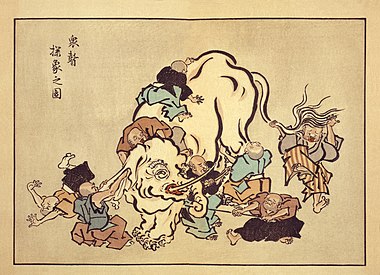
Buddhist[edit]

"Blind monks examining an elephant", an ukiyo-e print by Hanabusa Itchō (1652–1724).
The Buddha twice uses the simile of blind men led astray. In the Canki Sutta he describes a row of blind men holding on to each other as an example of those who follow an old text that has passed down from generation to generation.[6] In the Udana (68–69)[7] he uses the elephant parable to describe sectarian quarrels. A king has the blind men of the capital brought to the palace, where an elephant is brought in and they are asked to describe it.
When the blind men had each felt a part of the elephant, the king went to each of them and said to each: 'Well, blind man, have you seen the elephant? Tell me, what sort of thing is an elephant?'
The men assert the elephant is either like a pot (the blind man who felt the elephant's head), a winnowing basket (ear), a plowshare (tusk), a plow (trunk), a granary (body), a pillar (foot), a mortar (back), a pestle (tail) or a brush (tip of the tail).
The men cannot agree with one another and come to blows over the question of what it is like and their dispute delights the king. The Buddha ends the story by comparing the blind men to preachers and scholars who are blind and ignorant and hold to their own views: "Just so are these preachers and scholars holding various views blind and unseeing.... In their ignorance they are by nature quarrelsome, wrangling, and disputatious, each maintaining reality is thus and thus." The Buddha then speaks the following verse:
O how they cling and wrangle, some who claim
For preacher and monk the honored name!
For, quarreling, each to his view they cling.
Such folk see only one side of a thing.[8]

Sufi Muslim[edit]

The Persian Sufi poet Sanai of Ghazni (currently, Afghanistan) presented this teaching story in his The Walled Garden of Truth.[9]
Rumi, the 13th Century Persian poet and teacher of Sufism, included it in his Masnavi. In his retelling, "The Elephant in the Dark", some Hindus bring an elephant to be exhibited in a dark room. A number of men touch and feel the elephant in the dark and, depending upon where they touch it, they believe the elephant to be like a water spout (trunk), a fan (ear), a pillar (leg) and a throne (back). Rumi uses this story as an example of the limits of individual perception:
The sensual eye is just like the palm of the hand. The palm has not the means of covering the whole of the beast.[10]
Rumi does not present a resolution to the conflict in his version, but states:
The eye of the Sea is one thing and the foam another. Let the foam go, and gaze with the eye of the Sea. Day and night foam-flecks are flung from the sea: oh amazing! You behold the foam but not the Sea. We are like boats dashing together; our eyes are darkened, yet we are in clear water.[10]
Rumi ends his poem by stating "If each had a candle and they went in together the differences would disappear." [11]

Hindu[edit]

Ramakrishna Paramahamsa used this parable to discourage dogmatism:[12]
A number of blind men came to an elephant. Somebody told them that it was an elephant. The blind men asked, ‘What is the elephant like?’ and they began to touch its body. One of them said: 'It is like a pillar.' This blind man had only touched its leg. Another man said, ‘The elephant is like a husking basket.’ This person had only touched its ears. Similarly, he who touched its trunk or its belly talked of it differently. In the same way, he who has seen the Lord in a particular way limits the Lord to that alone and thinks that He is nothing else.

John Godfrey Saxe[edit]

One of the most famous versions of the 19th century was the poem "The Blind Men and the Elephant" by John Godfrey Saxe (1816–1887).
And so these men of Hindustan
Disputed loud and long,
Each in his own opinion
Exceeding stiff and strong,
Though each was partly in the right
And all were in the wrong.
The poem begins:
It was six men of Indostan
To learning much inclined,
Who went to see the Elephant
(Though all of them were blind),
That each by observation
Might satisfy his mind[13]
They conclude that the elephant is like a wall, snake, spear, tree, fan or rope, depending upon where they touch. They have a heated debate that does not come to physical violence. But in Saxe's version, the conflict is never resolved.
Moral:
So oft in theologic wars,
The disputants, I ween,
Rail on in utter ignorance
Of what each other mean,
And prate about an Elephant
Not one of them has seen!
Natalie Merchant sang this poem in full on her Leave Your Sleep album (Disc 1, track 13).

Modern treatments[edit]

The story is seen as a metaphor in many disciplines, being pressed into service as an analogy in fields well beyond the traditional. In physics, it has been seen as an analogy for the wave–particle duality.[14] In biology, the way the blind men hold onto different parts of the elephant has been seen as a good analogy for the Polyclonal B cell response.[15]
The fable is one of a number of tales that cast light on the response of hearers or readers to the story itself. Idries Shah has commented on this element of self-reference in the many interpretations of the story, and its function as a teaching story:
...people address themselves to this story in one or more [...] interpretations. They then accept or reject them. Now they can feel happy; they have arrived at an opinion about the matter. According to their conditioning they produce the answer. Now look at their answers. Some will say that this is a fascinating and touching allegory of the presence of God. Others will say that it is showing people how stupid mankind can be. Some say it is anti-scholastic. Others that it is just a tale copied by Rumi from Sanai – and so on.[16]
Shah adapted the tale in his book The Dermis Probe. This version begins with a conference of scientists, from different fields of expertise, presenting their conflicting conclusions on the material upon which a camera is focused. As the camera slowly zooms out it gradually becomes clear that the material under examination is the hide of an African elephant. The words 'The Parts Are Greater Than The Whole' then appear on the screen. This retelling formed the script for a short four-minute film by the animator Richard Williams. The film was chosen as an Outstanding Film of the Year and was exhibited at the London and New York film festivals.[17]
The story enjoys a continuing appeal, as shown by the number of illustrated children's books of the fable; there is one for instance by Paul Galdone and another, Seven Blind Mice, by Ed Young (1992).
In the title cartoon of one of his books, cartoonist Sam Gross postulated that one of the blind men, encountering a pile of the elephant's fewmets, concluded that "An elephant is soft and mushy."
An elephant joke inverts the story in the following way:
Six blind elephants were discussing what men were like. After arguing they decided to find one and determine what it was like by direct experience. The first blind elephant felt the man and declared, 'Men are flat.' After the other blind elephants felt the man, they agreed.
Moral:
"We have to remember that what we observe is not nature in itself, but nature exposed to our method of questioning." - Werner Heisenberg

See also[edit]

References[edit]

  1. Jump up ^ Martin Gardner (1 September 1995). Famous Poems from Bygone Days. Courier Dover Publications. p. 124. ISBN 978-0-486-28623-5. Retrieved 2012-08-25. 
  2. ^ Jump up to: a b "Elephant and the blind men". Jain Stories. JainWorld.com. Retrieved 2006-08-29. 
  3. Jump up ^ Hughes, Marilynn (2005). The voice of Prophets. Volume 2 of 12. Morrisville, North Carolina: Lulu.com. pp. 590–591. ISBN 1-4116-5121-9. 
  4. Jump up ^ Mallisena, Syādvādamanjari, 14:103–104. Dhruva, A.B. (1933) pp. 9–10.
  5. Jump up ^ Mallisena, Syādvādamanjari, 19:75–77. Dhruva, A.B. (1933) pp. 23–25.
  6. Jump up ^ Accesstoinsight.org
  7. Jump up ^ Katinkahesselink.net
  8. Jump up ^ Wang, Randy. "The Blind Men and the Elephant". Retrieved 2006-08-29. 
  9. Jump up ^ Included in Idries Shah, Tales of the Dervishes ISBN 0-900860-47-2 Octagon Press 1993.
  10. ^ Jump up to: a b Arberry, A.J. (2004-05-09). "71 – The Elephant in the dark, on the reconciliation of contrarieties". Rumi – Tales from Masnavi. Retrieved 2006-08-29. 
  11. Jump up ^ For an adaptation of Rumi's poem, see this song version by David Wilcox here.
  12. Jump up ^ Gupta, Mahendranath (11 March 1883). "Chapter V – Vaishnavism and sectarianism – harmony of religions". Kathamrita. Vol. II. ISBN 81-88343-01-3. 
  13. Jump up ^ Saxe, John Godfrey. "Wikisource link to The Blind Men and the Elephant". The poems of John Godfrey Saxe. Wikisource.  Wikisource link [scan]
  14. Jump up ^ For example, Quantum theory by David Bohm, p. 26. Retrieved 2010-03-03.
  15. Jump up ^ See for instance The lymph node in HIV pathogenesis by Michael M. Lederman and Leonid Margolis, Seminars in Immunology, Volume 20, Issue 3, June 2008, pp. 187–195
  16. Jump up ^ Shah, Idries. "The Teaching Story: Observations on the Folklore of Our "Modern" Thought". Retrieved 2010-03-05. 
  17. Jump up ^ Octagon Press page for The Dermis Probe, with preview of story

External links[edit]

Friday, 10 October 2014

Zen Riddles are Strange


Zen Riddle #1 - bell: Blogger Ref http://www.p2pfoundation.net/Multi-Dimensional_Science


How do you stop a temple bell 100 miles away?
Here's the answer....(Show/Hide)


Want more riddles? Choose one!
#16-bridge #3-stars #4-boat

...but easy to solve.


Zen riddles are complicated questions about everything.
Forget about logic and jump out of the riddle. That's it!

The answer of the riddles doesn't matter: say something creative, the mad the better. Done.

There are only very more few rules for answering these riddles who're sometimes called Koans, Zen Koans or Buddhist koans.

You want to find answers yourself? Want to know the rules of the riddle-koan-game? Try !


Buddha history

Buddhist Koan
"Cut a tree five hundred miles away from you. Cut it right now!!"

Sounds impossible?

Right. Zen koans ask for the impossible to be done on the spot!

The solution has to be as mad and paradoxical as the riddle is.

Let's try a mad reaction to the cutting tree riddle: "Great job. Let's have a beer!"

That's a multi-purpose reaction to many Zen koans.

Unfortunately some people, especially Zen masters, may not want to have a beer with you. That's sad, but that's how they are.


Buddha history

What gives life meaning
Okay, to satisfy those guys who can't accept your creativity there is a "way of the rules".
  • First rule to solve Zen koans: Look for THINGS, mentioned in the riddle.
  • Second rule: Look for ACTION mentioned in the riddle.
  • Third rule: Look for the uttering of HOLY actors.
There's no holiness in the riddle above, but tree, saw or axe are "things" and cutting is "action".

Produce a combination of the first and second rules:

Move your hand with the saw back and forth and hum while cutting the tree.

This time the Zen master smiles thinly and nods.

Now you've a good chance to go for the next Koan or for some Zen practice at Meditation Hall

Besides madness and rule-driven solutions there other more simple Koan answers. On the cutting the distant tree riddle just say: "Yes, a tree is green" or move your arms like branches of a tree.

Enough of cutting trees.
Let's try another Koan, a dog riddle: Why did your dog bark throughout the night?


the way of Zen

Koan Practice
Stupid question. Who knows why a dog barks? They bark, that's all.

But Zen riddles are not about explaining, but about the madness of everything.


"Let's have a beer", is again a good solution to the barking dog riddle. But as I said, not everybody appreciates creativity. Bark yourself, walk on hands and knees, lift one leg and piss, that may be more acceptable.

Why? Remember the rules? Let's try: What are the "things" of the riddle? Yes, the dog and the night. What is the action? Barking. Right? Combine them and there's another answer: Bow wow.


the way of Zen

Zen Koans
Other creative answers: "The moon is shining." Or: sniff and say: "Here's a stinking dog around."

Or just walk carefully: Step, step, step. Why? Don't ask. It just came in my mind.

In normal life this kind of reactions on a question or a problem would be seen as childish or mad. In Zen it's a sign of maturity.

Finding out how to answer a riddle or koan can be time consuming, even if you follow my wonderful instructions.

You may look for help by Zen books that comment on koans, one 's smarter then the other.

Don't hope for solutions, you'll only be showered with vain and confusing Zen-talk.

Traditional Zen-people insist on the secrecy of riddle and koan solutions.
They believe in decoding hundreds of koans by somebody leads to enlightenment. Ok. Fine.

Good luck.


Read more: http://www.heartofmeditation.com/zen-riddles.html#ixzz3FjeQesI5

Wednesday, 12 December 2012

Tibetan Psychic Traditions

By S.M.RONEY-DOUGAL  2012


INTRODUCTION


This article describes the early stages of a research project in India with Tibetan meditation practitioners, looking at the relationship between meditation attainment and psychic awareness. As this is an overview to give a flavour of the psychic traditions of the culture, I shall mention several different traditions quite briefly, rather than give an in-depth account of any one of them. There is very little literature about Tibet’s psychic traditions, so much of what follows is based on interviews with various people.


The Tibetan culture is renowned for its psychic practitioners, but there has been no scientific research into their practices. Tibetan traditions incorporate psi extensively, with three main areas that appear to have ancient origins:

1) The oldest Tibetan traditions are those of the oracles, which involves deity possession;

2) Mo divination, which often involves a Tibetan deity called Palden Lhamo;

3) and the mahasiddhis.

There are two areas of more recent beliefs that relate primarily to the monastic communities and derive directly from Buddhism: attainment of psychic abilities through Buddhist meditation practice, and a belief in consciously chosen reincarnation, resulting in tulkus who are identified using a variety of psychic practices.

Tibetan traditions are a unique mixture of original shamanic Bon practices, Buddhism, which came to Tibet about 1,300 years ago, and Indian Buddhist tantric traditions, which came to Tibet about 1,000 years ago (Schlagintweit, 1999). The psychic aspects of Tibetan tradition primarily date from the pre-Buddhist shamanic period, though they are not inimical to Buddhism per se and so have been extensively incorporated by the monks into their practices. There are many different types of Buddhism, and that in Tibet is renowned for its inclusion and development of psychic abilities.


A. Belief


Every culture has its own world-view. Exploring a different culture can often shed light on our own belief systems and help us to see our own concepts. Beliefs are an intrinsic part of one’s mental make-up determined to a great degree by the culture in which one grows up. We are, for the most part, completely unconscious of our belief systems until they are pointed out to us, or we go to a completely different culture where people hold very different beliefs.

Most Tibetan people accept the psychic as an every day part of life. An example of the place divination has in everyday life for Tibetans is their use of astrology. Their calendars specify more than a dozen different attributes of each day, e.g., whether or not it is auspicious to start a business, get married, hold a funeral or even to have a party!


1. The Tibetan Oracles


Tibetans have the tradition of oracles (kuten, which literally means medium). These mediums go into trance, becoming possessed by a deity, who then speaks through the medium giving advice and prophecy, which is used to make decisions by people at every level of society, e.g. Dalai Lama and the Tibetan government consult the Nechung Oracle, who is recognised as the state oracle. The oracle is held in high esteem as the following quote from the Dalai Lama shows:


For hundreds of years now, it has been traditional for the Dalai Lama, and the Government, to consult Nechung during the New Year festivals. In addition, he might well be called upon at other times if either have specific queries. I myself have dealings with him several times a year. This may sound far-fetched to twentieth century western readers. . . . But I do so for the simple reason that as I look back over the many occasions when I have asked questions of the oracle, on each one of them time has proved that his answer was correct. . . .

Surprising as it may seem, the oracle’s replies to questions are rarely vague. As in the case of my escape from Lhasa, he is often very specific. (Dalai Lama, 2002).


There are numerous oracles. Many monasteries will have their own resident oracle, who sometimes is a monk, as well as the more common village lay oracles.

The following information about oracles was given by Kirti Tsenshab Rinpoche (2005) in a series of private interviews. (see picture 1) Kirti Tsenshab Rinpoche was recommended as he was a great authority on tantric aspects of Tibetan Buddhism. I feel so grateful and blessed to have been able to spend time in his presence – a truly holy man.

There are two factors involved in an accurate prophecy: the ability of the medium and the faith of the participants. He considered faith to be very important, and likened this participation between the medium and the sitter to needing a crutch if you have a bad leg — to be effective in walking you need both. Many of the people I have spoken with have reiterated this point of the importance of faith. For example, Penor Rinpoche (2006), who is head of the Nyingma sect, said with regard to divination that the diviner must have complete faith in the deity, and the questioner must have complete faith in the diviner.

Thus, a medium requires complete faith in their abilities from the sitter, and as there are both good and fraudulent mediums, one must check their reliability over a long period in order to increase one’s trust in them. He considered that it is essential to check in order to know whether the oracle’s divination will be successful. He likened Buddhists to scientists in that they always check everything. He explained that if you have a precognition, you can increase the certainty of your experience by asking lots of other people what they think, and so check it out. He said to make ratings for everything, e.g., for a 3 or 6 month prophecy check the person who has given it: are they reliable? How do they express themselves? What are their qualifications? Education? The way they dress? Do they speak well? What is their credibility? In similar vein he says we must analyse everything. By analogy he said that someone can appear happy or sad, but this may just be the appearance. He was very firm that things of the senses can often deceive us, and that when we’re sick our senses are faulty.

Kirti Tsenshabe Rinpoche also mentioned the Tibetan tantric teaching that an oracle becomes possessed by a deity because of the wind energy in their channels. This wind energy is conceived in a similar manner to prana of the Yogic tantric tradition, and the channels are equivalent to the nadis. He considers that some people have the ability to see the future because of past-life karma, which is related to their wind energy. Many other people I spoke with have repeated this point.


2. Mo Divination


Far more common than the oracles, is the practice of Mo divination. Nearly every monastery will have at least one lama who does Mo divination. There are also many lay village people who “do the Mo.”

An article in a Tibetan magazine (Cho Yang) states that the purpose of performing divination is to look into a person’s life situation in order to:


“recommend how to respond or deal with it. Remedial action, in the form of rituals, evokes positive forces and can result in a change in the person’s karma. . . . . When performing a divination, an individual is relying on the power vested in him by a particular deity. This power may have been acquired through a connection with the deity in a past life, and reinforced through retreats involving recitation of a mantra as many as one million times, identifying himself with the deity with clear concentration and the generation of divine pride. . . . The motivation for performing divination must be pure . . . the fundamental motive for engaging in the practice of divination should be to help sentient beings.”(Tseten et al, 1995, p. 111-112)

This quote shows the typical Tibetan blending of shamanic with Buddhist beliefs. As in the beliefs about the oracle, connection with a deity is considered an essential part of the psychic act, and also there is mention of the Buddhist teachings of karma and altruistic motivation.

The Cho Yang journal article lists 11 different divination methods, some of which are mentioned below:


(i) Doughball divination is done by high lamas in order to help find an important reincarnation, which means it is used only rarely. The names of potential candidates are written on paper and then rolled into a ball of dough. All candidate names are in equal-sized balls, great care being taken to make sure that all the balls are identical. These balls are placed in a sealed bowl, which is put in front of a sacred object, such as a statue in a temple, and for three days monks remain in the temple reciting prayers day and night. On the fourth day the cover is removed and a high lama rolls the doughballs round in the bowl until one of them falls out. That is the ball containing the answer. I was told that, in the case of the latest Panchen Lama who has been imprisoned by the Chinese, this process was repeated three times, and each time the same name came up.

The most common forms of divination are Dice and Mala divination. In Mala divination the person holds the mala (a string of prayer beads) with the fingers of each hand holding a bead at random. The intervening beads are then counted out three at a time until one, two or three beads are left, this giving the outcome of the divination

In a similar manner, dice will be thrown, the diviner blowing on the dice before throwing. Normally three dice are used.

In the above two forms of divination, the advice is specified by books which tell you what the particular outcomes mean. For example, in general with the dice, odd numbers are auspicious whilst even numbers are inauspicious. With the mala the best outcome is three beads.

Whilst doughball, dice and mala divination rely on a “random” event having a meaningful relationship with the person’s question (synchronicity), in the next most common forms of divination, direct clairvoyance is used.


(ii) Mirror divination is special to a protector deity known as Dorje (or Lhamo) Yudronmai. The mirror is placed ceremonially and, as with the previous forms of Mo, rituals are performed. The diviner sees appearances, reflections of writings and letters from the deity. When I visited a lovely old Tibetan lady called Amathaba, (see picture 2) living in one of the Tibetan settlements in south India, she saw a misty dawn scene which gradually cleared, and interpreted this as there being an initial difficulty which would then get resolved. She recommended asking the local nuns to say special prayers, and to hang prayer flags to help overcome the obstacles. This is a very common practice.

She says it was a gift she was born with and which ran in the family, she being the seventh person in the family to have inherited this gift. In her case she uses three mirrors, placed upright in a bowl of rice. In two of them she sees the deities connected with the divination, and in the front mirror the actual reading. She is thought of very highly in the community and many people consult her.

In Thumb nail divination you look into the thumbnail and blow on it in order to receive the vision. When the Mo is done via mirror or thumbnail reading, the diviner will tend to see particular symbolic visions, which are then interpreted in the light of the querent’s problem.

Also in this category come precognitive or clairvoyant dreams. Again, as with most Tibetan methods, these are related to a particular deity. Specific things are attributed to different symbols as in mirror divination (Tseten et al, 1995, p.114). I was told of a local woman who consulted a lama and was told by him to have a dream about her problem. The lama also noted their own dream that night. The two dreams were then compared and predictions made by the lama, which turned out to be correct. Kirti Tsenshab Rinpoche (2005) corroborates this saying that prophecies can appear as visions in dreams, but considers this less reliable because not all dreams are prophetic, so one is never completely sure whether or not it is an accurately prophetic dream.


(iii) The next group of practices tend to be done by the querent themselves. Until 1959, 80% of Tibetans were semi-nomadic to varying degrees. Their practices are accordingly much simpler than the previous methods, and the information required is primarily whether or not it is auspicious to do a certain task.

Bootstrap divination is popular among nomads. The straps, which are wide pieces of webbing tape, are folded into squares and suddenly pulled apart. If they part easily, this is a positive sign — if they tangle, this is considered to be unlucky. Several people have mentioned this form of divination to me and it is apparently very popular in Tibet.

Tibetans commonly take note of omens such as certain birds being seen, overhearing certain music, or people saying auspicious words, which are all positive. There are numerous negative signs as well, such as the chatter of monkeys, or interestingly, having a black cat cross your path before you set out on a journey. Why a black cat should have this mystique both in Britain and Tibet is very strange!

Examining flames in a ritual fire or observing a butter lamp is also a form of divination. In this case one invokes the fire god and then observes the flame. Different types of flames mean different things.

In interviews with diviners, apart from the importance of faith, which is always mentioned, the other aspect that is considered absolutely vital is that of prayers to Buddha, or a protector deity, most commonly to Palden Lhamo, who is the main protector deity of Tibet and of divination. Dice and mala divination in particular are normally associated with the deity Palden Lhamo. All of the diviners I have spoken to have reiterated that they are not psychic, they are the channel for the deity who thereby through them controls the fall of the dice, or whatever method they use. They do not consider that they do anything other than mediate between the querent and the deity.

Kirti Tsenshab Rinpoche (2005) says that when you do the Mo, if your supplication to the deity is good, then you will have a good Mo. In general a good relation with the deity increases your ability. He also says that those who have good faith in Buddhism are better at doing the Mo, and in time their ability increases. It is also considered important that the diviner has purified their “energy” channels (Kirti Tsenshab, 2005; Topgyal, 2005). One Rinpoche I interviewed (Drakser, 2006) had undertaken three months of purification practices, chanting mantras specific to the deity, doing prostrations and pujas, before he was considered fit to practice Mo divination.

As can be seen from this list of different types of practices, divination ranges from the most simple “good or bad luck” omens through to highly developed clairvoyant skills, and from practices that anyone can do to those normally performed only by monks.


3. Meditation


This aspect of Tibetan psychic tradition is the form most related to Buddhist teachings. In Buddhism there are two meditation disciplines: the shamatha discipline of one-pointed concentration and the vipassana discipline of contemplative insight. Developing shamatha (calm-abiding or mental quiescence) is considered to be an essential first step. Many traditional Mahayana and modern Tibetan Buddhist texts (e.g. Conze, 1990; Lamrimpa, 1995, p.63) relate meditation attainment to development of psychic powers, as do Yogic teachings.

It seems that this “clairvoyancy” is more akin to what in the West we would define as omniscience, rather than the clairvoyance we research in parapsychology, since the Buddhist clairvoyancy includes what we consider to be miraculous powers. Traditional Buddhist scriptures talk about the six superknowledges which you gain on attaining perfection of concentration, and make it very clear that practice of concentration meditation brings both enlightenment and psychic awareness, and that you cannot have one without the other.

In interviews with various monks, it was stressed over and over again that only a few people attain samadhi and clairvoyant abilities, and even then the clairvoyance is no more than 80% reliable. Omniscience arises only with full enlightenment. Not everyone who practices meditation will attain samadhi, so not everyone who practices meditation will become psychic. In other words:


there is a genius for enlightenment;

there is a genius for meditation;

there is a genius for psychic awareness;

We can all learn anything but not everyone has a talent. Only a few have genius.

My recent research at a yoga ashram and with Tibetan Buddhist monks supports this teaching, in that those who had practised meditation for longer, in terms of decades of practice, do seem to show more reliable psychic awareness as measured by a picture test for precognition and clairvoyance. However, this research is still in the early stages, so it can at present only be considered that the teachings have been suggestively confirmed. (2)


B. Warnings about Psi


It seems that most cultures have some sort of reservation around psychic phenomena. We find stories of psychic abilities being used for negative purposes in most cultures, and, in an apparent paradox, this is also prominent in Tibetan culture.


1. Fear of Sorcery


As already mentioned, Tibetan culture is still very close to its shamanic roots. Shamanic cultures accept the psychic as part and parcel of life (Eliade, 1923). What is very apparent in shamanic cultures is the awe and the fear that surround the psychic manifestations.

Demons, and the fear of them, are apparently very common in Tibet. For example, amongst the Tibetans, disease is often thought to be caused by a bad spirit (Jhongur, 2006). A story was told how someone fell ill when a tree in the garden was cut down, and this was related to the spirit of the tree. This is a classic shamanic belief. Sickness is often related to a sorcerer who sends the bad spirit, or hex, at someone’s request. This is not to say that shamans only use their psychic abilities for negative purposes, but it is to say that they have been used sufficiently often in this way for people to develop a fear of the psychic. The well-known stories about Milarepa, who was said to have killed lots of people at a distance, exemplify the fear of “bad” magic and the belief that people can do such terrible acts.

In an interview with an astrologer (Jhongur, 2006), I was told that there is a belief in sickness resulting from people talking about the person (“Mikha-Suk”). This corresponds to the ‘evil eye’ in Western culture, and basically means harm due to excessive praise for any kind of success or accomplishment, such as owning a specially beautiful object, or a newly built house which has become talk of the town (Nyima, 2007). Very young children are felt to be prone to this and need special protection

There is also fear of a spirit called a “disa” (literally smell-eater), which is a kind of trapped spirit which runs after food and is supposed to be satisfied with the mere smell of the food placed for it (Nyima,2007).

There is a belief in possession by a spirit that may be from a dead person or may come from someone who is still alive, often contained within an object that used to belong to that person. An amulet is an object worn around the neck as charm against evil or injury. It is always used for protection from unknown harm. One sort of amulet, called a “ga’u,” is a small silver casket which will contain, relics, photos of holy people etc. Tibetans often carry a ga’u in their coat. And of course the usual of a man using a charm to make a young girl fall in love with him!

I found it very interesting that, in my interviews with Kirti Tsenshab Rinpoche (2005), he again and again reiterated the importance of Buddhism for creating a moral sphere within which one could use one’s psychic abilities. In many ways Buddhism is being strongly affirmed in order to morally “move on” from some of the problems that one encounters within a shamanic culture.


Attracting Spirits


One fear is that if you talk about psychic phenomena you might attract a spirit to you, and that might not be beneficial. For example, there is a belief that if you are possessed by a spirit, as with the oracles, you yourself stop developing at the level of the spirit that possesses you — or you just stop developing per se.

Tibetans consider that all ghosts can harm us. There are many stories of a special sort of ghost they call “hungry ghosts,” and of others who will lure you to your death. Kirti Tsenshab Rinpoche said to beware of obstacles from ghosts when doing the Mo divination. They, or other beings, can obstruct the ability and can harm us. He considers that we gain protection from praying to the protector deity at the onset of the divination, from positive karma and from merit (Kirti Tsenshab, 2005).

He also says that there are two directions for personal development — going into the unconscious and going for super-consciousness. Psi abilities are normally considered to be related to the former, e.g. oracular trance, dreams or hypnosis, and in spiritual development one is going for the latter. Spirit connection, as in mediumistic practice, is definitely connected with the unconscious aspect of consciousness.

For Tibetans this is a complex, paradoxical subject because as Buddhists, the high lamas do Mo divination on request by people, who come to them for a variety of reasons. They also do divination for the tulku identification. And there are many oracles, some of them official state oracles. So the practice of psi is everywhere. The need for protection is acknowledged, and the prevalence of fraudulent practitioners, but not a taboo on practising. My translators have all said that Tibetans are very comfortable with this apparent contradiction.


2. Detrimental Effects on One’s Spiritual Development


Ego and Humility


The fear of an immoral use of psi is a very obvious surface fear; the fear of pride is a subtler level of fear. In the Indian subcontinent and amongst the Tibetan people it is considered wrong to pay any special attention to psi. Manifesting psychic abilities is thought to have detrimental effects on one’s spiritual development. It is stressed that having attained Enlightenment, one is no longer disturbed spiritually by attainment of psychic abilities, whereas, for unenlightened people, psychic abilities are seen as very tricky indeed, associated with deception, with glamour and with pride.

His Holiness, the Dalai Lama, in his book “Freedom in Exile” (2002), expresses a wish for Western science to explore Tibetan psychic traditions. However, when I met Geshe Samten (2005), the director of Sarnath Institute, he told me that, whilst Tibet has a rich tradition of psychic abilities, even those with a reputation of psychic awareness would deny their abilities. He stated that it is taboo to say that you are psychic or to “show off” your abilities. There must be a genuine purpose for doing the psychic practice. Even to say one has reached a certain level of meditation is considered an obstruction on the path to enlightenment. Humility is considered essential for one’s spiritual development. For example, the Dalai Lama repeatedly says that he is a simple monk and is not clairvoyant.


Confidentiality and Secrecy


There is a Tibetan tradition about not speaking of things because they are secret teachings. For example, the Dalai Lama writes of Herbert Benson’s research (Benson et al, 1982) with Tum-mo meditators:


As a strong believer in the value of modern science, I decided to let him proceed, though not without some hesitation. I knew that many Tibetans were uneasy about the idea. They felt that the practices in question should be kept confidential because they derive from secret doctrines.” (Dalai Lama, 2002, ch.12)

Tibetan monks and nuns who are working with techniques that are thought to be related to development of psychic awareness, make vows that they will not speak about their practice or reveal their capabilities. Practitioners take their vows first and then they do the study and practice.

This level of fear, that acknowledging one’s psychic abilities, which are considered to manifest at one level of development on the path, is an obstacle to one’s spiritual growth, is a quite subtle understanding of psi and its manifestation from which we could learn.


Power Corrupts


Another aspect of the fear of the psychic is the knowledge that power corrupts, and glamorous psychic abilities are seen as very powerful. In an introduction by Francis Story to a book on early Buddhist Pali Canon, he says:


It is true that certain psychic faculties capable of a worldly application, such as the Dibba-cakkhu (clairvoyance), Dibba-sota (clairaudience), Mano-Maya-Kaya (projection of the ‘astral body’) and other paranormal powers are developed in the course of Buddhist meditation. . . .The Buddha and the Arhats possessed such powers and when need arose they exercised them for the sake of the ignorant who demanded ‘signs and wonders.’ But in general the Buddha deplored their use, preferring to spread the Dhamma by the ‘miracle of teaching’ and the self-propagating power of truth. To those not yet fully emancipated from worldly delusion they can become attachment-forming faculties, and as such have to be guarded against and overcome in the struggle for Nibbanna. In the Buddhist view, one who embarks on concentration exercises to obtain supernormal powers (Iddhi) is doing so with the wrong intention and at great danger to himself. If all power corrupts, supernormal power can corrupt superlatively. (Mahathera, 1975, p.iv)

This is a very real fear and I am sure that most people can think of examples of this facet of human experience.


Fraud: Distinguishing Fact from Fantasy and the Problems of Attracting Glamour


One of the Buddhist precepts is not to claim to possess powers you do not have. Already noted above, in my discussions with Kirti Rinpoche (2005) were his frequent references to checking that the practitioner is not a charlatan, for example when talking about the oracles. He also said that it is most important to check the appearances of the psychic practitioner: don’t be caught by appearances, see what is really being taught. He reiterated not to look at the outer appearance, and to check for the meaning. He used an analogy of a poem, and warned against being misled by beautiful words.


Why is it that we are so fascinated by psychic abilities? Why do we so easily venerate those who possess them? This is the root cause behind both the fraudulent pretence of psi and the ego glorification people experience when demonstrating psychic abilities.


Conclusion


I am aware that this is just a beginning, a first touch on the surface of a deep and complex culture and its traditional beliefs about the psychic realm.

What I find really fascinating is His Holiness, the Dalai Lama, is encouraging scientific research into this topic. And he is doing this with full awareness of the difficulties:


I am well aware, however, of the danger of tying spiritual belief to any scientific system. . . . This is not to say that I consider things like the oracle and the ability of monks to survive nights spent out in freezing condition to be evidence of magical powers. Yet I cannot agree with our Chinese Brothers and sisters, who hold that Tibetan acceptance of these phenomena is evidence of our backwardness and barbarity. Even from the most rigorous scientific viewpoint, this is not an objective attitude. At the same time, even if a principle is accepted, it does not mean that everything connected with it is valid. . . . . Great vigilance must be maintained at all times when dealing in areas about which we do not have great understanding. This, of course, is where science can help. After all, we consider things to be mysterious only when we do not understand them. . . . . Through mental training, we have developed techniques to do things which science cannot yet adequately explain. This, then, is the basis of the supposed ‘magic and mystery’ of Tibetan Buddhism. (Dalai Lama, 2002, pp. 230-243)

Ignorance is a major obstacle on the path. The scientific method has “truth” as its aim. Does a real and deep understanding of the process of psi enable one not to fall into the traps surrounding the development and use of psychic abilities? I think it does and I think that this is one of the best reasons for undertaking parapsychological research within the Tibetan culture.


ACKNOWLEDGEMENTS


Deep gratitude to His Holiness, Dalai Lama for inspiring this project and to his secretary, Tenzin Geyche Tethong, for his support; to the Perrott-Warwick Fund and Bial Foundation (grant no. 64/04) for supporting this research; to Geshe Jampel Dakpa for all his help and for affiliating this project to Sarah College, Dharamsala; to Khangser Rinpoche for enabling the research to take place at SeraJey monastic university, Bylakuppe; to Yaki Platt and Gen Andu for their excellent translator skills and unfailing good spirits; and last, but not least, to all those interviewed who gave of their time and wisdom.


S.M.RONEY-DOUGAL

Psi Research Centre,

Glastonbury.


REFERENCES


Amathaba (2006). Personal interviews, 11th Jan., 9th Feb.


Benson, H. et al (1982). “Body temperature changes during the practice of gTum-mo (heat) yoga,” Nature, 295, 234-236..


Conze, E. (trans. & ed.) (1995). The Large Sutra on Perfect Wisdom, Motilal Banarsidaa, New Delhi.


Dalai Lama, H.H. (2002). Freedom in Exile, Abacus.


Drakser Rinpoche (2006) Personal audience, 25th Jan.


Eliade, M. (1923). Shamanism: Archaic Techniques of Ecstasy, Penguin Arkana, UK.


Jhongur, (2006). Personal interviews, 11th March, 1st May.


Kirti Tsenshab, Rinpoche (2005). Personal audience, 14th March, 23rd March, 19th April.


Lamrimpa, Gen (1995). Calming The Mind: Tibetan Buddhist Teachings on Cultivating Meditative Quiescence. Snow Lion, USA.


Lodro, Gedun (1998). Calm Abiding and Special Insight, Snow Lion Pubs., USA.


Mahathera, Paravahera Vajiranana (1975). Buddhist Meditation in Theory and Practice: A General Exposition to the Pali Canon of the Theravada School, Buddhist Missionary Society, Malaysia,


Ngawang Nyima, Acharya (2007) Letter to the Editor, J. Society for Psychical Research, ,


Penor Rinpoche (2006). Personal audience, 16th Feb.


Roney-Dougal, S.M. & Solfvin, J. (2006). Yogic Attainment in Relation to Awareness of Precognitive Targets, J. Parapsychology, 70(1), 91-120.


Samten, Geshe (2005). Personal interview, 25th January.


Schlagintweit, E. (1999). Buddhism in Tibet, Book Faith India


Topgyal, Geshe (2005). Personal interview, 14th April.


Tseten, D. et al (1995). Looking into the Future, Cho Yang: The Voice of Tibetan Religion and Culture, 6, 111-118.


(1) An earlier and more complete version of this article was published in the Journal of the Society for Psychical Research, 2006.


(2) The yoga studies have been published (Roney-Dougal & Solfvin, 2006) and the first Buddhist study has been presented at a conference and submitted to a journal, but is not yet published,


http://www.psi-researchcentre.co.uk/article_5.htm

Wednesday, 5 December 2012

Edward Salim Michael

From Wikipedia, the free encyclopedia


Jump to: navigation, search

Edward Salim Michael was born in Manchester, England in 1921 and died near Nice, France in 2006. Composer of symphonic music, he is also the author of books on spirituality and meditation. He regarded himself as a Buddhist, but as his teaching was based on his direct experience, he did not hesitate to quote Christian, Hindu, or Sufi mystics.
Em-michael.jpg

Contents

[hide]

[edit] Biographical Elements

Edward Salim Michael spent his childhood in Iraq, which was then under British rule. He experienced poverty and insecurity. He was approximately twelve years old when his parents left Baghdad for Syria, which was under French rule, then for Egypt and for Palestine (which was not yet Israel) and still at that time under British rule. His family returned to London just before World War II. As a British subject, he was enrolled in the Royal Air Force, as a soldier on the ground. He was just nineteen years old. He had never been to school, could not read or write and barely spoke English. The chaplain (Anglican) from his camp took interest in him and taught him to read and write. The Chaplain's wife who was violist in a string quartet was surprised at Edward Salim Michael's amazing ability to memorize music. She decided to teach him the basics of composition, which he assimilated at stunning speed. Two years later, his first orchestral work, a scherzo for orchestra ("The Dionysia"), won a competition in London, where it was performed at the Royal Albert Hall by the London Philharmonic Orchestra conducted by John Hollingsworth.
After the war, he pursued his musical studies at the Guildhall School of Music and Drama in London where he worked with Berthold Goldschmidt (student of Hindemith), then with Mátyás Seiber (student of Zoltán Kodály) and also studies the violin (with Max Rostal). In studying the violin he demonstrated the same astonishing capabilities he had shown for composition. In 1947, he won a first prize in orchestra conducting and started a career as a solo violinist.
He gave numerous concerts in which he performed the thirty-five or so concertos that he had in his repertory as well as some fifty sonatas and more than two hundred other pieces for violin before leaving for Paris in 1950 to study with Nadia Boulanger.
Because of painful health problems he soon had to abandon the violin and conducting. From then onward, he devoted himself solely to composition.
In 1949 for the first time in his life he saw a statue of Buddha. He remained petrified in front of it and, when he returned to his home, he immediately put himself in the same posture as the statue. Closing his eyes, he began to focus on an internal sound that he heard within the ears and the head, without even knowing that what he was doing was meditation and that the sound on which he focused was known in India as the Nada, a form of concentration known to both Hindus and Buddhists.
Alongside his career as a musician, he undertook with passion a spiritual practice. Thanks to the exceptional ability to concentrate that he had developed as a composer, he began to have rapidly profound spiritual experiences.
At this time in his life, he was living in Paris in extremely precarious conditions. After four years of a most intense spiritual practice, he had, at the age of thirty-three, an extremely powerful experience of awakening to what one may call his Buddha Nature as well as the Infinite in oneself.
He continued to compose and struggle on a daily basis for his musical works to be played. He composed many orchestral pieces among them a Mass for mixed choir, two string orchestras, celesta, harp, glockenspiel and percussions. In 1954, he won the Vercelli prize for a Psalm for a male choir. Two years later, his Mass was performed by the orchestra of Radio France directed by Eugene Bigot. The next year, his Nocturne for flute and orchestra won the Lili Boulanger prize in the United States, given by a jury which included Igor Stravinsky and Aaron Copland.
As his music (that he signed with his first name Edward) remained tonal, it was becoming increasingly difficult to get it performed. He finally decided to give up composing and he traveled to India, the country of his maternal grandmother, to dedicate himself fully to his inner life. He spent nearly seven years there, continuing the same practice of intense concentration and meditation.
He returned to France in 1974, and began to teach Hatha Yoga, which he had practiced intensively for years. Soon, his students were more interested in his spiritual teaching than in Hatha Yoga. At their request, he began writing his first book, written in English, The Way of Inner Vigilance, published in London in 1983, which he signed with his middle name Salim. Seven other books written directly in French followed before he departed from this world.
He also published with his wife Michele Michael a translation in French (from English) of the famous Buddhist text the Dhammapada.

[edit] His music

Edward Michael wanted always to remain tonal. His music shows a deep understanding of the laws of harmony allied to a perfect mastery of musical construction. His orchestration is always of great richness and depth. It features remarkably eastern ranges in western music, with all that it can bring of flexibility, color and new expression. Mystery and poetry plus a dramatic expression defines his inspiration that is often philosophical, even mystical.

[edit] His Teaching

Edward Salim Michael addresses his teaching to the seeker or the aspirant who is, as he said, "someone who has embarked on a spiritual path to try to find his True Identity, a state of Vast Consciousness, already present in him, but obscured by his ordinary mind and the clouds of his incessant thoughts. It is a man or a woman who struggles for enlightenment and his emancipation. "
What characterizes his teaching is the importance he attaches to what he calls a moment of true presence, which can be recognized through a sustained concentration during exercises such as those exposed in his books. Indeed, it is only through this sustained concentration that the seeker can feel the difference with his ordinary state and begin to understand how he "sleeps" ordinarily in himself without knowing it.
It is from the moment the aspirant clearly feels the difference between his habitual state of waking-sleep, when he is plunged into « the whirls of his mental world », and another state of being when he is present and aware of himself in a manner which is not habitual to him that he will know in which direction to focus his efforts.
If the aspirant has experienced enlightenment, his work will continue on another level, because illumination is not liberation. He will then have to struggle patiently to find again and again this other state of being and consciousness that he has recognized in himself until he arrives to stay permanently within it. Only then will he have reached liberation.
The path that Edward Salim Michael teaches is the path he himself followed. It is devoid of dogma ; personal understanding and experience are the criteria of it and it is for that reason that Edward Salim Michael regarded himself as a Buddhist.

[edit] Main musical works

[edit] For orchestra (s) string

  • Mass for mixed chorus, two string orchestras, Celestat, harp, glockenspiel and percussion. 36' (E. Ricordi)
  • Initiation 18'30 (E. Choudens)
  • Les Soirées de Tedjlah (Tedjlah ‘s Evenings) for mezzo soprano, (vocalise) two flutes, piano and string orchestra (Vercelli Price). 20' (E. Transatlantique)

[edit] For symphonic orchestra

  • Nocturne for flute solo (or Ondes Martenot) and orchestra (Lili Boulanger Price). 6'30 (E. Transatlantique)
  • Fata Morgana, symphonic poem for orchestra. 8'30 (E. Ricordi)
  • Le jardin de Tinajatama (Tinajatama’s garden) for orchestra. 10' (E. Ricordi)
  • Elegy for orchestra 5'30 (E. Ricordi)
  • Le festin des Dieux (The Feast of the Gods) for orchestra. 6' (E. Choudens)
  • Trois Tableaux (Three pictures) for orchestra. 11'30 (E. Transatlantique)
  • Le rêve d'Himalec (Himalec’s Dream) for orchestra. 13' - 1946 (E. Transatlantique) 13 '
  • Rapsody concertante for violin and orchestra. 14' (E. Choudens)
  • Kamaal, magical tale for narrator and orchestra. 40' (E. Transatlantique)
  • La Vision de Lamis Helacim (Lamis Helacim’s Vision) symphonic poem for large orchestra (E. Ricordi)
  • La reine des pluies (The Queen of rain) choreographic poem for large orchestra. 8' (E. Choudens)

[edit] His books

The Way of Inner Vigilance (translated in French by Michele Michael), reprinted at the beginning of 2010 by Inner Tradition under the title : The Law of Attention, Nada Yoga and the Way of inner Vigilance.
Other books written in French – to be translated -
  • Pratique Spirituelle et Eveil Intérieur (Spiritual Practice and Inner Awakening)
  • La Quête Suprême (The Supreme Quest)
  • Les obstacles à l'Illumination et à la Libération (The Obstacles to Enlightenment and Liberation)
  • Les Fruits du chemin de l'Éveil (the Fruits of the path of Enlightenment)
  • S'eveiller, une question de vie ou de mort (To awaken, a matter of life or death)
  • Dans le silence de l'Insondable (In the Silence of the Infathomable)
  • Du fond des Brumes (From the depths of Mist) (posthumous book, published after the death of the author)

[edit] See also

[edit] References

[edit] External links


Reviving the Ancient Polymath Spirit to Meet Modern Challenges We can embrace interdisciplinary learning for innovative problem-solving. Posted January 16, 2025 | Reviewed by Gary Drevitch

  by   Nigel R. Bairstow Ph.D. Disconnection Dynamics Psychology Today Key points Ancient Arab polymaths excelled by integrating diverse kno...