Showing posts with label francis galton. Show all posts

Thursday, 19 November 2015

The Galton Paper on Mental Imagery........

Classics in the History of Psychology
An internet resource developed by
Christopher D. Green
York University, Toronto, Ontario
ISSN 1492-3173
(Return to Classics index) Blogger Ref http://www.p2pfoundation.negt/Multi-Dimensional_Science
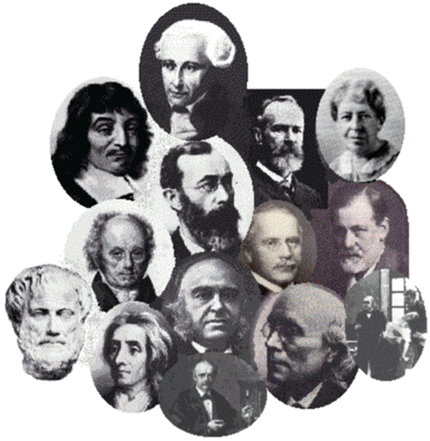
Collage of significant contributors to psychological thought


Statistics of Mental Imagery


Francis Galton (1880)
First published in Mind, 5, 301-318.

Posted September 2000


An outline is given in the following memoir of some of the earlier results of an inquiry which I am still prosecuting, and a comparatively new statistical process will be used in it for the first time in dealings with psychological data. It is that which I described under the title of "Statistics by Intercomparison" in the Philosophical Magazine of Jany., 1875.
The larger object of my inquiry is to elicit facts that shall define the natural varieties of mental disposition in the two sexes and in different races, and afford trustworthy data as to the relative frequency with which different faculties are inherited in different degrees. The particular branch of the inquiry to which this memoir refers, is Mental Imagery; that is to say, I desire to define the different degrees of vividness with which different persons have the faculty of recalling familiar scenes under the form of mental pictures, and the peculiarities of the mental visions of different persons. The first questions that I put referred to the illumination, definition and colouring of the mental image, and they were framed as follows (I quote from my second and revised schedule of questions):--
"Before addressing yourself to any of the Questions on the opposite page, think of some definite object -- suppose it is your breakfast-table as you sat down to it this morning -- and consider carefully the picture that rises before your mind's eye. [p. 302]
1. Illumination. -- Is the image dim or fairly clear? Is its brightness comparable to that of the actual scene ?
2. Definition. -- Are all the objects pretty well defined at the same time, or is the place of sharpest definition at any one moment more contracted than it is in a real scene?
3. Colouring. -- Are the colours of the china, of the toast, bread-crust, mustard, meat, parsley, or whatever may have been on the table, quite distinct and natural?"
There were many other questions besides these, of which I defer mention for the moment.
The first results of my inquiry amazed me. I had begun by questioning friends in the scientific world, as they were the most likely class of men to give accurate answers concerning this faculty of visualising, to which novelists and poets continually allude, which has left an abiding mark on the vocabularies of every language, and which supplies the material out of which dreams and the well-known hallucinations of sick people are built up.
To my astonishment, I found that the great majority of the men of science to whom I first applied, protested that mental imagery was unknown to them, and they looked on me as fanciful and fantastic in supposing that the words 'mental imagery' really expressed what I believed everybody supposed them to mean. They had no more notion of its true nature than a colour-blind man who has not discerned his defect has of the nature of colour. They had a mental deficiency of which they were unaware, and naturally enough supposed that those who were normally endowed, were romancing. To illustrate their mental attitude it will be sufficient to quote a few lines from the letter of one of my correspondents, who writes:--
"These questions presuppose assent to some sort of a proposition regarding the 'mind's eye' and the 'images' which it sees….. This points to some initial fallacy…… It is only by a figure of speech that I can describe my recollection of a scene as a 'mental image' which I can 'see' with my 'mind's eye'….. I do not see it… any more than a man sees the thousand lines of Sophocles which under due pressure he is ready to repeat. The memory possesses it, &c."Much the same result followed some inquiries made for me by a friend among members of the French Institute.
On the other hand, when I spoke to persons whom I met in general society, I found an entirely different disposition to prevail. Many men and a yet larger number of women, and many boys and girls, declared that they habitually saw mental imagery, and that it was perfectly distinct to them and full of colour. [p. 303] The more I pressed and cross-questioned them, professing myself to be incredulous, the more obvious was the truth of their first assertions. They described their imagery in minute detail, and they spoke in a tone of surprise at my apparent hesitation in accepting what they said. I felt that I myself should have spoken exactly as they did if I had been describing a scene that lay before my eyes, in broad daylight, to a blind man who persisted in doubting the reality of vision. Reassured by this, I recommenced to inquire among scientific men, and soon found scattered instances of what I sought, though in by no means the same abundance as elsewhere. I then circulated my questions more generally among my friends, and so obtained the replies that are the main subject of this memoir. The replies were from persons of both sexes and of various ages, but I shall confine my remarks in this necessarily brief memoir to the experiences derived from the male sex alone.
I have also received batches of answers from various educational establishments, and shall here make use of those sent by the Science Master of the Charterhouse, Mr. W. H. Poole, which he obtained from all the boys who attended his classes, after fully explaining the meaning of the questions, and interesting the boys in them. They have the merit of returns derived from a general census, which my other data lack, because I cannot for a moment suppose that the writers of them are a haphazard proportion of those to whom they were sent. Indeed, I know some men who, disavowing all possession of the power, cared to send no returns at all, and many more who possessed it in too faint a degree to enable them to express what their experiences really were, in a manner satisfactory to themselves. Considerable similarity in the general style of the replies will however be observed between the two sets of returns, and I may add that they accord in this respect with the oral information I have elsewhere obtained. The conformity of replies from so many different sources, the fact of their apparent trustworthiness being on the whole much increased by cross-examination (though I could give one or two amusing instances of break-down), and the evident effort made to give accurate answers, have convinced me that it is a much easier matter than I had anticipated to obtain trustworthy replies to psychological questions. Many persons, especially women and intelligent children, take pleasure in introspection and strive their very best to explain their mental processes, I think that a delight in self-dissection must be a strong ingredient in the pleasure that many are said to take in confessing themselves to priests.
Here then are two rather notable results: the one is the proved facility of obtaining statistical insight into the processes of other [p. 304] persons' minds; and the other is that scientific men as a class have feeble powers of visual representation. There is no doubt whatever on the latter point, however it may be accounted for. My own conclusion is, that an over-readiness to perceive clear mental pictures is antagonistic to the acquirement of habits of highly generalised and abstract thought, and that if the faculty of producing them was ever possessed by men who think hard, it is very apt to be lost by disuse. The highest minds are probably those in which it is not lost, but subordinated, and is ready for use on suitable occasions. I am however bound to say, that the missing faculty seems to be replaced so serviceably by other modes of conception, chiefly I believe connected with the motor sense, that men who declare themselves entirely deficient in the power of seeing mental pictures can nevertheless give life-like descriptions of what they have seen, and call otherwise express themselves as if they were gifted with a vivid visual imagination They can also become painters of the rank of Royal Academicians.
The facts I am now about to relate, are obtained from the returns of 100 adult men, of whom 19 are Fellows of the Royal Society, mostly of very high repute, and at least twice, and I think I may say three times, as many more are persons of distinction in various kinds of intellectual work. As already remarked, these returns taken by themselves, do not profess to be of service in a general statistical sense, but they are of much importance in showing how men of exceptional accuracy express themselves when they are speaking of mental imagery. They also testify to the variety of experiences to be met with in a moderately large circle. I will begin by giving a few cases of the highest, of the medium, and of the lowest order of the faculty of visualising. The hundred returns were first classified according to the order of the faculty, as judged from the whole of what was said in them, and all I knew from other sources of the writers; and the number prefixed to each quotation shows its place in the class-list.
VIVIDNESS OF MENTAL IMAGERY.
(From returns furnished by 100 men, at least half of whom are distinguished in science or in other fields of intellectual work.)
Cases where the faculty is very high.
1. Brilliant, distinct, never blotchy.
2. Quite comparable to the real object. I feel as though I was dazzled, e.g., when recalling the sun to my mental vision.
3. In some instances quite as bright as an actual scene.
4. Brightness as in the actual scene.
5. Thinking of the breakfast table this morning, all the objects in my mental picture are as bright as the actual scene. [p. 305]
6. The image once seen is perfectly clear and bright.
7. Brightness at first quite comparable to actual scene.
8. The mental image appears to correspond in all respects with reality. I think it is as clear as the actual scene.
9. The brightness is perfectly comparable to that of the real scene.
10. I think the illumination of the imaginary image is nearly equal to that of the real one.
11. All clear and bright; all the objects seem to me well defined at the same time.
12. I can see my breakfast table or any equally familiar thing with my mind's eye, quite as well in all particulars as I can do if the reality is before me.
Cases where the faculty is mediocre.
46. Fairly clear and not incomparable in illumination with that of the real scene, especially when I first catch it. Apt to become fainter when more particularly attended to.
47. Fairly clear, not quite comparable to that of the actual scene. Some objects are more sharply defined than others, the more familiar objects coming more distinctly in my mind.
48. Fairly clear as a general image; details rather misty.
49. Fairly clear, but not equal to the scene. Defined, but not sharply; not all seen with equal clearness.
50. Fairly clear. Brightness probably at least one-half to two-thirds of original. [The writer is a physiologist.] Definition varies very much, one or two objects being much more distinct than the others, but the latter come out clearly if attention be paid to them.
51. Image of my breakfast table fairly clear, but not quite so bright as the reality. Altogether it is pretty well defined; the part where I sit and its surroundings are pretty well so.
52. Fairly clear, but brightness not comparable to that of the actual scene. The objects are sharply defined; some of them are salient, and others insignificant and dim, but by separate efforts I can take a visualised inventory of the whole table.
53. Details of breakfast table when the scene is reflected on, are fairly defined and complete, but I have had a familiarity of many years with my own breakfast table, and the above would not be the case with a table seen casually unless there were some striking peculiarity in it.
54. I can recall any single object or group of objects, but not the whole table at once. The things recalled are generally clearly defined. Our table is a long one; I can in my mind pass my eyes all down the table and see the different things distinctly, but not the whole table at once.
Cases where the faculty is at the lowest.
89. Dim and indistinct, yet I can give an account of this morning's breakfast table; -- split herrings, broiled chickens, bacon, rolls, rather light coloured marmalade, faint green plates with stiff pink flowers, the girls' dresses, &c., &c. I can also tell where all the dishes were, and where the people sat (I was on a visit). But my imagination is seldom pictorial except between sleeping and waking, when I sometimes see rather vivid forms.
90. Dim and not comparable in brightness to the real scene. Badly defined with blotches of light; very incomplete.
91. Dim, poor definition; could not sketch from it. I have a difficulty in seeing two images together.
92. Usually very dim. I cannot speak of its brightness, but only of its faintness. Not well defined and very incomplete. [p. 306]
93. Dim, imperfect.
94. I am very rarely able to recall any object whatever with any sort of distinctness. Very occasionally an object or image will recall itself, but even then it is more like a generalised image than an individual image. I seem to be almost destitute of visualising power, as under control.
95. No power of visualising. Between sleeping and waking, in illness and in health, with eyes closed, some remarkable scenes have occasionally presented themselves, but I cannot recall them when awake with eyes open, and by daylight, or under any circumstances whatever when a copy could be made of them on paper. I have drawn both men and places many days or weeks after seeing them, but it was by an effort of memory acting on study at the time, and assisted by trial and error on the paper or canvas, whether in black, yellow or colour, afterwards.
96. It is only as a figure of speech that I can describe my recollection of a scene as a 'mental image' which I can 'see' with my 'mind's eye.'.. The memory possesses it, and the mind can at will roam over the whole, or study minutely any part.
97. No individual objects, only a general idea of a very uncertain kind.
98. No. My memory is not of the nature of a spontaneous vision, though I remember well where a word occurs in a page, how furniture looks in a room, &c. The ideas are not felt to be mental pictures, but rather the symbols of facts.
99. Extremely dim. The impressions are in all respects so dim, vague and transient, that I doubt whether they can reasonably be called images. They are incomparably less than those of dreams.
100. My powers are zero. To my consciousness there is almost no association of memory with objective visual impressions. I recollect the breakfast table, but do not see it.
These quotations clearly show the great variety of natural powers of visual representation. I will proceed to examine the subject more closely, and to compare the returns from the 100 men with those from the Charterhouse boys, on the principle of my "Statistics by Intercomparison," which I must first explain at sufficient length.
There are many who deny to statistics the title of a science, and say that it is a mere collection of facts. For my part I think that there is such a thing as a science of statistics, though its field is narrowed almost to a point. Its object is to discover methods of epitomising a great, even an infinite, amount of variation in a compact form. To fix the ideas, it is well to take as an example the heights of men, in which case the science of statistics enables us to specify, by means of a very few figures, the conditions of stature that characterise the whole of the adult male inhabitants, say of the British Isles. These figures will suffice to inform us that there are so many per cent. between such and such heights, and so many between such other heights, giving us material whence we can answer any such question as this:-- Out of 1000 men how many are we likely to find between 5 feet and 6 feet in height? If the figures do not give the answer directly, we can find it by interpolation and easy calculation from them. So again, if we wish to compare the heights of [p. 307] Englishmen and Frenchmen, statistics show how to obtain the average height of the two races, and the two averages may be readily compared, which goes a considerable way towards answering the question; or, if we wish it, we may compare very much more in detail, all the facts that are needed for the purpose being contained in the few figures of which I spoke.
But all these operations require the use of an external standard. The men must be separately measured by a foot-rule before their measurements can be classified, and the same need of an external standard of measurement is felt in every case with which the ordinary methods of statistics profess to deal. The standard of measurement may be that of time, weight, length, price, temperature, &c., but without the almanack or watch, the scales, the foot-rule, the coin, the thermometer, &c., statistics of the ordinary form to which I refer, cannot be made.
In my process, there is no necessity for an external standard. It clearly comes to the same thing whether I take eleven men and, measuring them one against another, range them in order, beginning with the highest and ending with the lowest, or if I measure them separately with a foot-measure, and range them in the order of the magnitude of the measurements recorded in my note-book. In each case the tallest man will stand first, the next tallest second, and so on to the last. In each case the same man will occupy the sixth or middlemost place, and will therefore represent the medium height of the whole of them. I do not wish to imply that 'medium' is identical with 'mean' or 'average,' for it is not necessarily so. But I do say that the word medium may be strictly defined, and therefore if we wish to compare the heights of Englishmen with Frenchmen, we shall proceed just as scientifically if we compare their medium heights as if we compare their average heights. Now it will be observed that we have got the medium heights without a foot-rule or any external standard; we have done so altogether by the method of intercomparison. In the particular question with which we are dealing I have classified the answers according to the degree of vividness of mental imagery to which they depose, and I pick out the middlemost answer and say that the description given in it describes the medium vividness of mental imagery in the group under discussion. If I want to compare two such groups I compare their respective middlemost answers, and judge which of the two implies the higher faculty.
Thus much is a great gain, yet I claim to effect more; but in order to explain what that is I must return to the illustration of heights of men. Suppose them as before to be all arranged in order of their stature, at equal distances apart on a long line A B, with their backs turned towards us. If there [p. 308] be a thousand men, we must suppose A B to be divided into 1000 equal parts, and a man to be set in the middle of each part. The tallest man will have A close to his left, and the shortest man will have B close to his right. They will form a series as shewn in Fig. I., where the subdivisions of A B are indicated by the vertical lines, and the positions where the men are standing are shown by the dots half-way between those lines.
Owing to the continuity of every statistical series, the imaginary line drawn along the tops of the heads of the men will form a regular curve, and if we can record this curve we shall be furnished with data whereby to ascertain the height of every man in the whole series. Drawing such a curve for Englishmen and another for Frenchmen, and superimposing the two, we should be able to compare the statures of the two nations in the minutest particulars.
A curve is recorded by measuring its ordinates. If we divide A B by a sufficient number of equi-distant subdivisions and measure the ordinates at each of them as has been done in Fig. [p. 309] II. (where the ordinates only are shewn, and not the curve), we can at any time plot them to scale, and by tracing a free line touching their tops, we can with more or less precision, reproduce the curve. It happens, however, from the peculiar character of all statistical curves, that ordinates at equal distances apart are by no means the most suitable. The mediocre cases are always so numerous that the curve flows in a steady and almost straight line about its middle, and it becomes a waste of effort to take many measurements thereabouts. On the other hand its shape varies rapidly at either end, and there the observations ought to be numerous. The most suitable stations are those which correspond to ordinates that differ in height by equal degrees, and these places admit of being discovered by a priori considerations on certain general suppositions.[1]
We shall however do well to ignore those minutiƦ on which I laid much stress in the Memoir, and adopt the simpler plan of successive subdivisions of A B, and of measuring the ordinates shown by darkened lines in Fig. II., and severally named there as 'middlemost,' first and last 'quartile,' first and last 'octile,' and first and last 'suboctile'. This is far enough for our present wants, though the system admits of indefinite extension. By measuring the 'ordinate,' I mean measuring the 'man' whose place in the series is nearest to the true position of that ordinate. Absolute coincidence is not needed in such rude work as this; thus in a series of 100 men either the 50th or the 51st will do duty for the middlemost. The places I have actually taken in the series of 100 men for the several stations, are, the 6th and 94th for the first and last suboctile, the 12th and 88th for the octiles, the 25th and 75th for the quartiles, and the 50th for the middlemost.
Seven men thus become the efficient representatives of a very large class. It will be found as a general rule that these seven selected representatives will differ each from the next by approximately equal intervals, the difference between the suboctile and the octile being usually about the same as that between the octile and quartile, and between the quartile and the middlemost. [p. 310]
As a matter of interest, and for the chance of finding very exceptional cases, I also record the highest and the lowest of the series, but it must be clearly understood that these have no solid value for purposes of comparison. In the first place, their position as ordinates is uncertain unless the number of the group of cases is given, for when the number is large the position of the highest and lowest will be nearer to A and B respectively than when it is small. In the second place, the highest and lowest being outside cases, they are more liable to be of an exceptional character than any of those which stand between neighbours, one on either hand of it.
The comparison of any two groups is made by collating their seven representatives each to each, the first suboctile of the one with the first suboctile of the other, the first octile with the first octile, the first quartile with the first quartile, and so on. I also collate the highest of each, and again the lowest of each, as a mere matter of interest, but not as an accurate statistical operation, for the reasons already given.
It is possible that I may be thought to have somewhat loosely expressed myself under the necessity of foregoing the use of technical terms, but the mathematical reader who demands precision of statement will understand me, while it would require a treatise and much study to make the mathematical substratum of my method perfectly intelligible to a person who was not familiar with the laws of 'Probabilities' and 'Frequency of Error'
In the following comparison between the 100 Adult Englishmen and the 172 Charterhouse boys, I have divided the latter into two groups, to serve as a check upon one another. Group A includes boys of the four upper classes in the school, group B those of the five lower classes. I have combined their replies as to Illumination and Definition under the single head of 'Vividness,' and have taken no editorial liberties whatever except of the most pardonable description. It is wonderful how well and graphically the boys write, and how much individual character is shown in their answers.
VIVIDNESS OF IMAGERY.
HIGHEST.
Adult Males.--Brilliant, distinct, never blotchy.
Charterhouse A.--The image is perfectly clear. I can see every feature in every one's face and everything on the table with great clearness. The light is quite as bright as reality
Charterhouse B.-The image that arises in my mind is perfectly clear. The brightness is decidedly comparable to that of the real scene, for I can see in my mind's eye just as well as if I was beholding the scene with my real eye. [p. 311]
FIRST SUBOCTILE.
Adult Males.--The image once seen is perfectly clear and bright.
Charterhouse A.--It is very clear and is as bright as it actually was. Everything occurs most distinctly. I can imagine everything at once, but can think a great deal more clearly by thinking more on a particular object.
Charterhouse B.--I see it exactly as it was, all clearly defined just as it was.
FIRST OCTILE.
Adult Males.--I can see my breakfast table or any equally familiar thing with my mind's eye quite as well in all particulars as I can do if the reality is before me.
Charterhouse A.--To me the picture seems quite clear and the brightness equal to the real scene. I cannot see the whole scene at the same instant, but I see one thing at once and can turn my eye mentally to another object very quickly so that I soon get the whole scene before my mind.
Charterhouse B.--Fairly clear, I cannot see everything at the same time, but what I do see seems almost real.
FIRST QUARTILE.
Adult Males.--Fairly clear; illumination of actual scene is fairly represented. Well defined. Parts do not obtrude themselves, but attention has to be directed to different points in succession to call up the whole.
Charterhouse A.--The image is fairly clear but its brightness is dimmer than the actual. The objects are mostly defined clearly and at the same time.
Charterhouse B.--Fairly clear, the objects are pretty well defined at the same time.
MIDDLEMOST.
Adult Males.--Fairly clear. Brightness probably at least one-half to two-thirds of the original. Definition varies very much, one or two objects being much more distinct than the others, but the latter come out clearly if attention be paid to them.
Charterhouse A.--The image is fairly clear, but its brightness is not comparable to that of the actual scene. The objects are pretty well defined at the same time.
Charterhouse B.--The image is pretty clear, but not so clear as the actual thing. I cannot take in the whole table at once, and I cannot see more than three plates at once, and when I try to see both ends of the table I cannot see anything of the middle. I can see nothing beyond the table, but the table itself seems to stand out from the distance beyond.
LAST QUARTILE.
Adult Males.--Dim, certainly not comparable to the actual scene. I have to think separately of the several things on the table to bring them clearly before the mind's eye, and when I think of some things the others fade away in confusion.
Charterhouse A.--The image is fairly clear. I cannot see everything at once, but as I think of them they come clearly before me. The objects are not all defined at the same time, and the place of sharpest definition is more contracted than in real scene.
Charterhouse B.--If I think of any particular thing without the others, it seems clear; all at once, are not clear.
LAST OCTILE.
Adult Moles.--Dim and not comparable in brightness to the real scene. [p. 312] Badly defined with blotches of light; very incomplete; very little of one object is seen at one time.
Charterhouse A.--I can call up to my mind the picture of the breakfast table in every detail, but seem to see everything through a darkened pane of glass. I see just the same number of people, plates, &c., the whole time, provided of course that I do not change my idea of the scene to any great degree.
Charterhouse B.--Rather dim; the objects are pretty well defined.
LAST SUBOCTILE.
Adult Males.--I am very rarely able to recall any object whatever with any sort of distinctness. Very occasionally an object or image will recall itself, but even then it is more like a genereralised image than an individual one. I seem to be almost destitute of visualising power as under control.
Charterhouse A.--The image is dim, dark, and smaller than the actual scene, and the objects nearest to me show most distinctly. The whole picture is more or less of a dark green tint.
Charterhouse B.--Dim. The place of sharpest definition is more contracted than in a real scene.
LOWEST.
Adult Males.--My powers are zero. To my consciousness there is almost no association of memory with objective visual impressions. I recollect the table, but do not see it.
Charterhouse A.--Image dim, the brightness much less than in the real scene. Only one object is very clearly visible at the same time.
Charterhouse B.--Very dim. I can only see one part at a time.
I gather from the foregoing paragraphs that the A and B boys are alike in mental imagery, and that the adult males are not very dissimilar to them; but the latter do not seem to form so regular a series as the boys. They are avowedly not members of a true statistical group, being an aggregate of one class of persons who replied because they had remarkable powers of imagery and had much to say, of another class of persons, the scientific, who on the whole are very deficient in that gift, and of a third class who may justly be considered as fair samples of adult males.
I next proceed to colour, and annex the returns to the third of the above questions, which I have classified on the same principle as before.
COLOUR REPRESENTATION.
HIGHEST.
Adult Males.--Perfectly distinct, bright, and natural.
Charterhouse A.--Yes, perfectly distinct and natural.
Charterhouse B.--The colours look more clear than they really are.
FIRST SUBOCTILE.
Adult Males.--White cloth, blue china, argand coffee pot, buff stand with sienna drawing, toast, -- all clear.
Charterhouse A.--I see the colours just as if they were before me, and perfectly natural.
Charterhouse B.--The colours are especially distinct in every case. [p. 313]
FIRST OCTILE.
Adult Males.--All details seen perfectly.
Charterhouse A.--Quite distinct and natural.
Charterhouse B.--All colours are perfectly distinct to me in my mind's eye, in whatever scene or shape they appear to me.
FIRST QUARTILE.
Adult Male.--Colours distinct-and natural till I begin to puzzle over them.
Charterhouse A.--Quite distinct and natural.
Charterhouse B.--The colours of the china, &c., are quite distinct and natural.
MIIDDLEMOST.
Adult Males.--Fairly distinct, though not certain that they are accurately recalled.
Charterhouse A.--They are all distinct after a little thought, and are natural.
Charterhouse B.--Yes, quite distinct and natural.
LAST QUARTILE.
Adult Males.--Natural, but very indistinct.
Charterhouse A.--The colours of the most pronounced things on the table are distinct, as the white tablecloth and yellow mustard.
Charterhouse B.--Some are; china, mustard, toast,-- the others are not.
LAST OCTILE.
Adult Males.--Faint, can only recall colours by a special effort for each.
Charterhouse A.--Colours not very distinct.
Charterhouse B.--They are natural, but not very distinct.
LAST SUBOCTILE.
Adult Males.--(Power is nil.)
Charterhouse A.--The colours are very dim.
Charterhouse B.--The colours seem to be more like shades, but they have some colour in them.
LOWEST.
Adult Males.--(Power is nil.)
Charterhouse A.--(Power is nil.)
Charterhouse B.--(Power is nil.)
The same general remarks may be made about the distribution of the faculty of colour representation as about that of the vividness of imagery. It seems that on the whole, colour is more easily recalled than form, and especially so by the young. As the faculty of visual representation is being dropped by disuse, colour disappears earlier than form. This I may remark, was the case with the often quoted hallucinations of Nicolai, which, in his progress to recovery, faded in colour before they faded in outline.
One of my correspondents, an eminent engineer, who has a highly developed power of recalling form, but who described himself as deficient in the power of recalling colour, tells me that since receiving and answering my questions he has practised [p. 314] himself in visualising colours and has succeeded perfectly in doing so. It now gives him great pleasure to recall them.
It will be of interest to extract the few instances from the returns of the Adult Males in which peculiarities were noticed in connexion with colour representation, other than in its degree of vividness. Each sentence is taken from a different return.
Light colours quite distinct, darker ones less so.
Patchy.
Generally hueless, unless excited.
Mostly neutral.
Brown colour, e.g. of the gravy, is difficult to visualise.
Another question that I put was as follows:--
"Extent of field of view.--Call up the image of some panoramic view (the walls of your room might suffice); can you force yourself to see mentally a wider range of it than could be taken in by any single glance of the eyes? Can you mentally see more than three faces of a die, or more than one hemisphere of a globe at the same instant of time?"
It would have been possible to classify the Charterhouse returns, but the answers were not so generally good as to make it advisable to spend pains upon them. I therefore content myself with the replies of the Adult Males, but shall subsequently add a few facts taken from those of the boys, in a separate paragraph.
EXTENT OF FIELD OF MENTAL VIEW.
HIGHEST.--My mental field of vision is larger than the normal one. In the former I appear to see everything from some commanding point of view, which at once embraces every object and all sides of every object.
FIRST SUBOCTILE.--A wider range. A faint perception I think of more than three sides of a room. Rather more I think than one hemisphere, but am not quite sure about this.
FIRST OCTILE.--Field of view corresponding to reality.
FIRST QUARTILE.--Field of view corresponding to reality.
MIDDLEMOST.--Field of view corresponding to reality.
LAST QUARTILE.--I think the field of view is distinctly smaller than the reality. The object I picture starts out distinct with a hazy outline.
LAST OCTILE.--Much smaller than the real. I seem only to see what is straight in front as it were.
LAST SUBOCTILE.
                                    } No field of view at all
LOWEST.
It may seem strange to some that the field of mental vision should occasionally be wider than reality, but I have sufficient [p. 315] testimony to the fact from correspondents of unquestionable accuracy. Here are cases from the returns:--
I seem to see the whole room as though my eye was everywhere. I can see all around objects that I have handled.
I can see three walls of a room easily, and with an effort the fourth. I can see all the faces of a die and the whole globe, but die and globe seem transparent.
[An eminent mineralogist told me that familiarity with crystals gave him the power of mentally seeing all their facets simultaneously.]
This subject is of interest to myself on account of a weird nightmare by which I am occasionally plagued. In my dream, a small ball appears inside my eye. I speak in the singular, because the two eyes then seem fused into a single organ of vision, and I see by a kind of touch-sight all round the ball at once. Then the ball grows, and still my vision embraces the whole of it; it continues growing to an enormous size, and at the instant when the brain is ready to burst, I awake in a fright. Now, what I see in an occasional nightmare, others may be able to represent to themselves when awake and in health.
From the foregoing statistical record it will be seen that in one quarter of the cases, that is to say, in the last quartile and in all below, the field of mental view is decidedly contracted. The Charterhouse returns (A and B combined) give a higher ratio. They show that in at least 74 out of the 172 cases, or in 43 per cent. of them, it is so; indeed, the ratio may be much larger, as I hardly know what to say about 51 cases, owing to insufficient description. I am inclined to believe that habits of thought render the mental field of view more comprehensive in the man than in the boy, though at the same time it causes the images contained in it to become fainter.
A few of the boys' answers are much to the point. I append some of them:--
The part I look at is much smaller than reality, with a haze of black all round it. It is like a small picture.
I have to fix my eyes on one spot in my imagination, and that alone is fairly defined.
I cannot see anything unless I look specially at it, which is not the case with my real eyes.
I have to more my mental eyes a good deal about. The objects are not, defined at the same time, but I think of them one at a time; also, if I am thinking of anything, as a map for instance, I can only imagine one name at a time.
The next question that I put referred to the apparent position of the image. It was as follows:--
"Distance of images.--Where do mental images appear to be situated? within the head, within the eye-ball, just-in front of [p. 316] the eyes, or at a distance corresponding to reality? Can you project an image upon a piece of paper ?"
Unfortunately this question was not included among those that I first issued, and I have not a sufficient number of answers to it from adult males to justify a statistical dependence on them even on that ground alone. It is better in this case to rely on the Charterhouse boys, of whom only twelve failed to answer the question. Reducing to percentages, I find:--
The more closely the image resembles in its vividness the result of actual vision the more nearly should we expect its distance to appear to coincide with that of the real object, and this as a matter of fact I find to be the case. The meaning of the word reflection is bending backwards, and those who reflect have the sense of a turning back from without to within the head. When a mental scene arises vividly and without any effort, the position of the vision is more frequently external, as it is in an hallucination.
I will next give the results of the latter part of the question, about the ability to project images on paper.
For the same reason as in the last case the returns from the adult males are insufficient. I have five clear cases only among them of an affirmative answer, out of which I will quote the following :--
ABILITY TO PROJECT AN IMAGE.
Holding a blank piece of paper in my hand, I can imagine on it a photograph or any object that it will hold.
The Charterhouse boys in at least 18 cases, or in ten per cent. of them, appear to have this power. The following are a few of their answers:--
I can think things to be upon it blank piece of paper.
I can place a mental image wherever I like, outside the head, either in the air or upon any substance.
After looking at a blank wall for some time, I can imagine what I am thinking of. [p. 317]
I can half project an image upon paper, but could not draw round it, it being too indistinct. I see the effect, but not the details of it.
I find it very hard to project an image on a piece of paper, but if I think for some time and look very hard at the paper, I sometimes can.
I can project an image on to anything, but the longer I keep it the fainter it gets, and I don't think I could keep it long enough to trace it.
I find indirectly from the answers to other questions that' visual representations are by no means invariably of the same apparent size as the real objects. The change is usually on the side of reduction, not of enlargement. Among the Charterhouse boys there are thirteen of the one to two cases of the other, and I think, but I have not yet properly worked it out, that the returns from adults generally, male and female, show somewhat similar results. The following are extracts from the reports of the boys:--
IMAGES LARGER THAN REALITY.
The place and objects in a mental picture seem to be larger altogether than the reality; thus a room seems loftier and broader, and the objects in it taller.
They look larger than the objects [? such objects as may be handled] really are, and seem much further off, they look about five yards off,.. they look bout five yards off.

IMAGES SMALLER THAN REALITY.
Very small and close.
Much smaller and very far off.
All the objects are clearly defined, but the image appears much smaller.
The difference that I see is, that everything I call up in my mind seems to be a long way off.
The difference is that it is much smaller.
Space does not admit, neither is this the most suitable opportunity of analysing more of the numerous data which I have in hand, but before concluding I would say a few words on the "Visualised Numerals" which I described first in Nature, Jan. 15, 1880, but very much more fully and advisedly in a memoir read before the Anthropological Institute in March, 1880, which will be published in its Transactions a few weeks later than the present memoir. It will contain not only my own memoir and numerous illustrations, but the remarks made on it at the meeting by gentlemen who had this curious habit of invariably associating numbers with definite forms of mental imagery. It is a habit that is quite automatic, the form is frequently very vivid and sometimes very elaborate and highly coloured, and its origin is always earlier than those who see it can recollect. Those who visualise numerals in number-forms are apt to see the letters of the alphabet, the months of the year, dates, &c., also in forms; but whereas they nearly always can suggest some clue to the origin of the latter, they never can, or [p. 318] hardly ever can, to that of the numerals. I have argued in the memoir just mentioned, partly from this fact and partly because some of the number-forms twist and plunge and run out of sight in the strangest ways, unlike anything the child has ever seen, that these are his natural, self-developed lines of mnemonic thought, and are survivals of the earliest of his mental processes, and a clue to much that is individual in the constitution of his mind. I found that only about one in thirty adult males saw these forms, but suspected that they were more common in early life, and subsequently lost by disuse. This idea is abundantly confirmed by the returns of the Charterhouse boys. Nearly one in four has the habit of referring numbers to some visual mental form or other; often it is only a straight line, sometimes more elaborate. No doubt as the years go by, most of these will be wholly forgotten as useless and even cumbrous, but the rest will serve some useful turn in arithmetic and become fixed by long habit, and will gradually and insensibly develop themselves. For want of space I muse here close my statement of facts; and, my data being thus imperfectly before the reader, it would be premature in me to generalise. I trust, however, that what has been adduced is enough to give a fair knowledge of the variability of the visualising faculty in the English male sex, and I hope that the examples of the use of my "Statistics by Intercomparison" will convince psychologists that the relative development of various mental qualities in different races admits of being pretty accurately defined.


Footnotes
[1] These are discussed in the Memoir already referred to, "Statistics by Intercomparison," by myself, in Phil. Mag., Jan., 1876, but there are some errors, and also some appearances of error owing to faults of expression, in that article, which were first pointed out to me by Mr. J. W. L. Glaisher. There is a full mathematical discussion bearing on the matter in a memoir by Mr. D. McAlister in the Proceedings of the Royal Society, 1879, on the "Law of the Geometric Mean," to which and to the immediately preceding paper by myself on the "Geometric Mean," I would refer the mathematical reader. Mr. J. W. L. Glaisher has also taken the subject in hand and calculated tables, and I trust that his memoir thereon may before long be published

Tuesday, 2 October 2012

Sir Francis Galton.


From Wikipedia, the free encyclopedia


Jump to: navigation, search

Sir Francis Galton
Born(1822-02-16)16 February 1822
Birmingham, England
Died17 January 1911(1911-01-17) (aged 88)
Haslemere, Surrey, England
ResidenceEngland
NationalityEnglish
FieldsAnthropology and polymathy
InstitutionsMeteorological Council
Royal Geographical Society
Alma materKing's College London
Cambridge University
Doctoral advisorWilliam Hopkins
Doctoral studentsKarl Pearson
Known forEugenics
The Galton board
Regression toward the mean
Standard deviation
Weather map
Notable awardsLinnean Society of London's Darwin–Wallace Medal in 1908.
Copley medal (1910)
Sir Francis Galton FRS (/ˈfrɑːnsÉŖs ĖˆÉ”É”Ėltən/; 16 February 1822 – 17 January 1911), cousin of Douglas Strutt Galton, cousin of Charles Darwin, was an English Victorian polymath: anthropologist, eugenicist, tropical explorer, geographer, inventor, meteorologist, proto-geneticist, psychometrician, and statistician. He was knighted in 1909.
Galton was a very bright child growing up, learning to read at the age of two and a half. A little before he was 4 years old, he had already written his first letter; learned how to do multiplication and tell time when an average child would have learned to do all that after the age of 7.[1]
Galton had a prolific intellect, and produced over 340 papers and books. He also created the statistical concept of correlation and widely promoted regression toward the mean. He was the first to apply statistical methods to the study of human differences and inheritance of intelligence, and introduced the use of questionnaires and surveys for collecting data on human communities, which he needed for genealogical and biographical works and for his anthropometric studies.
He was a pioneer in eugenics, coining the term itself and the phrase "nature versus nurture". His book Hereditary Genius (1869) was the first social scientific attempt to study genius and greatness.[2]
As an investigator of the human mind, he founded psychometrics (the science of measuring mental faculties) and differential psychology and the lexical hypothesis of personality. He devised a method for classifying fingerprints that proved useful in forensic science. He also conducted research on the power of prayer, concluding it had none by its null effects on the longevity of those prayed for.[3]
As the initiator of scientific meteorology, he devised the first weather map, proposed a theory of anticyclones, and was the first to establish a complete record of short-term climatic phenomena on a European scale.[4] He also invented the Galton Whistle for testing differential hearing ability. [5]

Contents

[hide]

[edit] Biography

[edit] Early life

Galton was born at "The Larches", a large house in the Sparkbrook area of Birmingham, England, built on the site of "Fair Hill", the former home of Joseph Priestley, which the botanist William Withering had renamed. He was Charles Darwin's half-cousin, sharing the common grandparent Erasmus Darwin. His father was Samuel Tertius Galton, son of Samuel "John" Galton. The Galtons were famous and highly successful Quaker gun-manufacturers and bankers, while the Darwins were distinguished in medicine and science.
Both families boasted Fellows of the Royal Society and members who loved to invent in their spare time. Both Erasmus Darwin and Samuel Galton were founding members of the famous Lunar Society of Birmingham, whose members included Boulton, Watt, Wedgwood, Priestley, Edgeworth, and other distinguished scientists and industrialists. Likewise, both families were known for their literary talent: Erasmus Darwin composed lengthy technical treatises in verse; Galton's aunt Mary Anne Galton wrote on aesthetics and religion, and her notable autobiography detailed the unique environment of her childhood populated by Lunar Society members.

Portrait of Galton by Octavius Oakley, 1840
Galton was by many accounts a child prodigy — he was reading by the age of 2, at age 5 he knew some Greek, Latin and long division, and by the age of six he had moved on to adult books, including Shakespeare for pleasure, and poetry, which he quoted at length (Bulmer 2003, p. 4). Later in life, Galton would propose a connection between genius and insanity based on his own experience. He stated, “Men who leave their mark on the world are very often those who, being gifted and full of nervous power, are at the same time haunted and driven by a dominant idea, and are therefore within a measurable distance of insanity[6]
Galton attended King Edward's School, Birmingham, but chafed at the narrow classical curriculum and left at 16.[7] His parents pressed him to enter the medical profession, and he studied for two years at Birmingham General Hospital and King's College, London Medical School. He followed this up with mathematical studies at Trinity College, University of Cambridge, from 1840 to early 1844.[8]
According to the records of the United Grand Lodge of England, it was in February 1844 that Galton became a freemason at the so-called Scientific lodge, held at the Red Lion Inn in Cambridge, progressing through the three masonic degrees as follows: Apprentice, 5 Feb 1844; Fellow Craft, 11 March 1844; Master Mason, 13 May 1844. A curious note in the record states: "Francis Galton Trinity College student, gained his certificate 13 March 1845".[9] One of Galton's masonic certificates from Scientific lodge can be found among his papers at University College, London.[10]
A severe nervous breakdown altered Galton's original intention to try for honours. He elected instead to take a "poll" (pass) B.A. degree, like his half-cousin Charles Darwin (Bulmer 2003, p. 5). (Following the Cambridge custom, he was awarded an M.A. without further study, in 1847). He then briefly resumed his medical studies. The death of his father in 1844 had left him financially independent but emotionally destitute,[11] and he terminated his medical studies entirely, turning to foreign travel, sport and technical invention.
In his early years Galton was an enthusiastic traveller, and made a notable solo trip through Eastern Europe to Constantinople, before going up to Cambridge. In 1845 and 1846 he went to Egypt and travelled down the Nile to Khartoum in the Sudan, and from there to Beirut, Damascus and down the Jordan.
In 1850 he joined the Royal Geographical Society, and over the next two years mounted a long and difficult expedition into then little-known South West Africa (now Namibia). He wrote a successful book on his experience, "Narrative of an Explorer in Tropical South Africa". He was awarded the Royal Geographical Society's gold medal in 1853 and the Silver Medal of the French Geographical Society for his pioneering cartographic survey of the region (Bulmer 2003, p. 16). This established his reputation as a geographer and explorer. He proceeded to write the best-selling The Art of Travel, a handbook of practical advice for the Victorian on the move, which went through many editions and is still in print.
In January 1853 Galton met Louisa Jane Butler (1822–1897) at his neighbour's home and they were married on 1 August 1853. The union of 43 years proved childless. [12] [13]

Louisa Jane Butler

[edit] Middle years

Galton was a polymath who made important contributions in many fields of science, including meteorology (the anti-cyclone and the first popular weather maps), statistics (regression and correlation), psychology (synaesthesia), biology (the nature and mechanism of heredity), and criminology (fingerprints). Much of this was influenced by his penchant for counting or measuring. Galton prepared the first weather map published in The Times (1 April 1875, showing the weather from the previous day, 31 March), now a standard feature in newspapers worldwide.[14]
He became very active in the British Association for the Advancement of Science, presenting many papers on a wide variety of topics at its meetings from 1858 to 1899 (Bulmer 2010, p. 29). He was the general secretary from 1863 to 1867, president of the Geographical section in 1867 and 1872, and president of the Anthropological Section in 1877 and 1885. He was active on the council of the Royal Geographical Society for over forty years, in various committees of the Royal Society, and on the Meteorological Council.
James McKeen Cattell, a student of Wilhelm Wundt who had been reading Galton's articles, decided he wanted to study under him. He eventually built a professional relationship with Galton, measuring subjects and working together on research.[15]
In 1888, Galton established a lab in the science galleries of the South Kensington Museum. In Galton's lab, participants could be measured in order to gain knowledge of their strengths and weaknesses. Galton also used these data for his own research. He would typically charge people a small fee for his services.[16]
During this time, Galton wrote a controversial letter to the Times titled 'Africa for the Chinese', where he argued that the Chinese, as a race capable of high civilization and (in his opinion) only temporarily stunted by the recent failures of Chinese dynasties, should be encouraged to immigrate to Africa and displace the supposedly inferior aboriginal blacks.[17]

[edit] Heredity and eugenics


Galton in his later years
The publication by his cousin Charles Darwin of The Origin of Species in 1859 was an event that changed Galton's life.[18] He came to be gripped by the work, especially the first chapter on "Variation under Domestication" concerning the breeding of domestic animals.
Galton devoted much of the rest of his life to exploring variation in human populations and its implications, at which Darwin had only hinted. In so doing, he established a research programme which embraced multiple aspects of human variation, from mental characteristics to height; from facial images to fingerprint patterns. This required inventing novel measures of traits, devising large-scale collection of data using those measures, and in the end, the discovery of new statistical techniques for describing and understanding the data.
Galton was interested at first in the question of whether human ability was hereditary, and proposed to count the number of the relatives of various degrees of eminent men. If the qualities were hereditary, he reasoned, there should be more eminent men among the relatives than among the general population. To test this, he invented the methods of historiometry. Galton obtained extensive data from a broad range of biographical sources which he tabulated and compared in various ways. This pioneering work was described in detail in his book Hereditary Genius in 1869 [2]. Here he showed, among other things, that the numbers of eminent relatives dropped off when going from the first degree to the second degree relatives, and from the second degree to the third. He took this as evidence of the inheritance of abilities.
Galton recognized the limitations of his methods in these two works, and believed the question could be better studied by comparisons of twins. His method envisaged testing to see if twins who were similar at birth diverged in dissimilar environments, and whether twins dissimilar at birth converged when reared in similar environments. He again used the method of questionnaires to gather various sorts of data, which were tabulated and described in a paper The history of twins in 1875. In so doing he anticipated the modern field of behavior genetics, which relies heavily on twin studies. He concluded that the evidence favored nature rather than nurture. He also proposed adoption studies, including trans-racial adoption studies, to separate the effects of heredity and environment.
Galton recognised that cultural circumstances influenced the capability of a civilization's citizens, and their reproductive success. In “Hereditary Genius”, he envisaged a situation conducive to resilient and enduring civilisation as follows:
The best form of civilization in respect to the improvement of the race, would be one in which society was not costly; where incomes were chiefly derived from professional sources, and not much through inheritance; where every lad had a chance of showing his abilities, and, if highly gifted, was enabled to achieve a first-class education and entrance into professional life, by the liberal help of the exhibitions and scholarships which he had gained in his early youth; where marriage was held in as high honour as in ancient Jewish times; where the pride of race was encouraged (of course I do not refer to the nonsensical sentiment of the present day, that goes under that name); where the weak could find a welcome and a refuge in celibate monasteries or sisterhoods, and lastly, where the better sort of emigrants and refugees from other lands were invited and welcomed, and their descendants naturalized. (p362) [2]
Galton invented the term eugenics in 1883 and set down many of his observations and conclusions in a book, Inquiries into Human Faculty and Its Development.[19] He believed that a scheme of 'marks' for family merit should be defined, and early marriage between families of high rank be encouraged by provision of monetary incentives. He pointed out some of the tendencies in British society, such as the late marriages of eminent people, and the paucity of their children, which he thought were dysgenic. He advocated encouraging eugenic marriages by supplying able couples with incentives to have children. On October 29, 1901, Galton chose to address eugenic issues when he delivered the second Huxley lecture at the Royal Anthropological Institute[15]
The Eugenics Review, the journal of the Eugenics Education Society, commenced publication in 1909. Galton, the Honorary President of the society, wrote the foreword for the first volume.[15] The First International Congress of Eugenics was held in July 1912. Galton died just two weeks before the day of the congress. Winston Churchill and Carls Elliot were among the attendees.[15]

[edit] Empirical Test of Pangenesis and Lamarkism

Galton conducted wide-ranging inquiries into heredity which led him to challenge Charles Darwin's hypothetical theory of pangenesis. Darwin had proposed as part of this hypothesis that certain particles, which he called "gemmules" moved throughout the body and were also responsible for the inheritance of acquired characteristics. Galton, in consultation with Darwin, set out to see if they were transported in the blood. In a long series of experiments in 1869 to 1871, he transfused the blood between dissimilar breeds of rabbits, and examined the features of their offspring.[20] He found no evidence of characters transmitted in the transfused blood (Bulmer 2003, pp. 116–118).
Darwin challenged the validity of Galton's experiment, giving his reasons in an article published in Nature where he wrote:
Now, in the chapter on Pangenesis in my Variation of Animals and Plants under Domestication I have not said one word about the blood, or about any fluid proper to any circulating system. It is, indeed, obvious that the presence of gemmules in the blood can form no necessary part of my hypothesis; for I refer in illustration of it to the lowest animals, such as the Protozoa, which do not possess blood or any vessels; and I refer to plants in which the fluid, when present in the vessels, cannot be considered as true blood." He goes on to admit: "Nevertheless, when I first heard of Mr. Galton's experiments, I did not sufficiently reflect on the subject, and saw not the difficulty of believing in the presence of gemmules in the blood.[21]
Galton explicitly rejected the idea of the inheritance of acquired characteristics (Lamarckism), and was an early proponent of "hard heredity" through selection alone. He came close to rediscovering Mendel's particulate theory of inheritance, but was prevented from making the final breakthrough in this regard because of his focus on continuous, rather than discrete, traits (now known as polygenic traits). He went on to found the biometric approach to the study of heredity, distinguished by its use of statistical techniques to study continuous traits and population-scale aspects of heredity.
This approach was later taken up enthusiastically by Karl Pearson and W.F.R. Weldon; together, they founded the highly influential journal Biometrika in 1901. (R.A. Fisher would later show how the biometrical approach could be reconciled with the Mendelian approach.) The statistical techniques that Galton invented (correlation, regression—see below) and phenomena he established (regression to the mean) formed the basis of the biometric approach and are now essential tools in all the social sciences.

[edit] Innovations in statistics and psychological theory

[edit] Historiometry

The method used in Hereditary Genius has been described as the first example of historiometry. To bolster these results, and to attempt to make a distinction between 'nature' and 'nurture' (he was the first to apply this phrase to the topic), he devised a questionnaire that he sent out to 190 Fellows of the Royal Society. He tabulated characteristics of their families, such as birth order and the occupation and race of their parents. He attempted to discover whether their interest in science was 'innate' or due to the encouragements of others. The studies were published as a book, English men of science: their nature and nurture, in 1874. In the end, it promoted the nature versus nurture question, though it did not settle it, and provided some fascinating data on the sociology of scientists of the time.

[edit] The Lexical Hypothesis

Sir Francis was the first scientist to recognize what is now known as the Lexical Hypothesis.[22] This is the idea that the most salient and socially relevant personality differences in people’s lives will eventually become encoded into language. The hypothesis further suggests that by sampling language, it is possible to derive a comprehensive taxonomy of human personality traits.

[edit] The questionnaire

Galton's inquiries into the mind involved detailed recording of people's subjective accounts of whether and how their minds dealt with phenomena such as mental imagery. In order to better elicit this information, he pioneered the use of the questionnaire. In one study, he asked his fellow members of the Royal Society of London to describe mental images that they experienced. In another, he collected in-depth surveys from eminent scientists for a work examining the effects of nature and nurture on the propensity toward scientific thinking.[23]

[edit] Variance and standard deviation

Core to any statistical analysis, is the concept that measurements vary: they have both a central tendency or mean, and a spread around this central value: variance. In the late 1860s, Galton conceived of a measure to quantify normal variation: the standard deviation. [1]
Galton was a keen observer. In 1906, visiting a livestock fair, he stumbled upon an intriguing contest. An ox was on display, and the villagers were invited to guess the animal's weight after it was slaughtered and dressed. Nearly 800 participated, but not one person hit the exact mark: 1,198 pounds. Galton stated that "the middlemost estimate expresses the vox populi, every other estimate being condemned as too low or too high by a majority of the voters"[24], and calculated this value (in modern terminology, the median) as 1,207 pounds. To his surprise, this was within 0.8% of the weight measured by the judges. Soon afterwards, he acknowledged[25] that the mean of the guesses, at 1,197 pounds, was even more accurate.[26][27]

[edit] Experimental derivation of the normal distribution

Studying variation, Galton invented the quincunx, a pachinko-like device, also known as the bean machine, as a tool for demonstrating the law of error and the normal distribution (Bulmer 2003, p. 4).

[edit] Bivariate normal distribution

He also discovered the properties of the bivariate normal distribution and its relationship to regression analysis.

[edit] Correlation and Regression

After examining forearm and height measurements, Galton introduced the concept of correlation in 1888 (Bulmer 2003, pp. 191–196). Correlation is the term used by Aristotle in his studies of animal classification, and later and most notably by Georges Cuvier in Histoire des progrĆØs des sciences naturelles depuis 1789 jusqu'Ć  ce jour (5 volumes, 1826–1836). Correlation originated in the study of correspondence as described in the study of morphology. See R.S. Russell, Form and Function. He was not the first to describe the mathematical relationship represented by the correlation coefficient, but he rediscovered this relationship and demonstrated its application in the study of heredity, anthropology, and psychology.[23] Galton's later statistical study of the probability of extinction of surnames led to the concept of Galton–Watson stochastic processes (Bulmer 2003, pp. 182–184). This is now a core of modern statistics and regression.
Galton invented the use of the regression line (Bulmer 2003, p. 184), and was the first to describe and explain the common phenomenon of regression toward the mean, which he first observed in his experiments on the size of the seeds of successive generations of sweet peas. He is responsible for the choice of r (for reversion or regression) to represent the correlation coefficient.[23] In the 1870s and 1880s he was a pioneer in the use of normal distribution to fit histograms of actual tabulated data.

[edit] Theories of perception

Galton went beyond measurement and summary to attempt to explain the phenomena he observed. Among such developments, he proposed an early theory of ranges of sound and hearing, and collected large quantities of anthropometric data from the public through his popular and long-running Anthropometric Laboratory, which he established in 1884 where he studied over 9,000 people.[15] It was not until 1985 that these data were analyzed in their entirety.


[edit] Differential Psychology

Galton's study of human abilities ultimately led to the foundation of differential psychology and the formulation of the first mental tests.

[edit] Composite Photography

Galton also devised a technique called composite photography, (produced by superimposing multiple photographic portraits of individuals representing a “natural” kind—like Jewish men, criminals, patients with tuberculosis, etc.—onto the same photographic plate, thereby yielding a blended whole, or “composite”), that he hoped could generalize the facial appearance of his subject into an “average” or “central type.”.[28][5] See also entry Modern physiognomy under Physiognomy).
This work began in the 1880s while the Jewish scholar Joseph Jacobs studied anthropology and statistics with Francis Galton. Jacobs asked Galton to create a composite photograph of a Jewish type.[29] One of Jacobs' first publications that used Galton's composite imagery was “The Jewish Type, and Galton’s Composite Photographs,” Photographic News, 29, (April 24, 1885): 268–269.
Galton hoped his technique would aid medical diagnosis, and even criminology through the identification of typical criminal faces. However, after exhaustive experimentation he concluded that such types were not attainable in practice.[citation needed]

[edit] Fingerprints

In a Royal Institution paper in 1888 and three books (Finger Prints, 1892; Decipherment of Blurred Finger Prints, 1893; and Fingerprint Directories, 1895)[30] Galton estimated the probability of two persons having the same fingerprint and studied the heritability and racial differences in fingerprints. He wrote about the technique (inadvertently sparking a controversy between Herschel and Faulds that was to last until 1917), identifying common pattern in fingerprints and devising a classification system that survives to this day.
The method of identifying criminals by their fingerprints had been introduced in the 1860s by Sir William James Herschel in India, and their potential use in forensic work was first proposed by Dr Henry Faulds in 1880, but Galton was the first to place the study on a scientific footing, which assisted its acceptance by the courts (Bulmer 2003, p. 35). Galton pointed out that there were specific types of fingerprint patterns. He described and classified them into eight broad categories. 1: plain arch, 2: tented arch, 3: simple loop, 4: central pocket loop, 5: double loop, 6: lateral pocket loop, 7: plain whorl, and 8: accidental.[31]

[edit] Final years

In an effort to reach a wider audience, Galton worked on a novel entitled Kantsaywhere from May until December 1910. The novel described a utopia organized by a eugenic religion, designed to breed fitter and smarter humans. His unpublished notebooks show that this was an expansion of material he had been composing since at least 1901. He offered it to Methuen for publication, but they showed little enthusiasm. Galton wrote to his niece that it should be either “smothered or superseded”. His niece appears to have burnt most of the novel, offended by the love scenes, but large fragments survive.[32]

[edit] Honours and impact

Over the course of his career Galton received many major awards, including the Copley medal of the Royal Society (1910). He received in 1853 the highest award from the Royal Geographical Society, one of two gold medals awarded that year, for his explorations and map-making of southwest Africa. He was elected a member of the prestigious Athenaeum Club in 1855 and made a Fellow of the Royal Society in 1860. His autobiography also lists the following:[33]
  • Silver Medal, French Geographical Society (1854)
  • Gold Medal of the Royal Society (1886)
  • Officier de l'Instruction Publique, France (1891)
  • D.C.L. Oxford (1894)
  • Sc.D. (Honorary), Cambridge (1895)
  • Huxley Medal, Anthropological Institute (1901)
  • Elected Hon. Fellow Trinity College, Cambridge (1902)
  • Darwin Medal, Royal Society (1902)
  • Linnean Society of London's Darwin–Wallace Medal (1908)
Galton was knighted in 1909. His statistical heir Karl Pearson, first holder of the Galton Chair of Eugenics at University College London (now Galton Chair of Genetics), wrote a three-volume biography of Galton, in four parts, after his death (Pearson 1914, 1924, 1930). The eminent psychometrician Lewis Terman estimated that his childhood IQ was on the order of 200, based on the fact that he consistently performed mentally at roughly twice his chronological age (Forrest 1974). (This follows the original definition of IQ as mental age divided by chronological age, rather than the modern distribution-deviate definition.)
The flowering plant genus Galtonia was named in his honour.

[edit] Major Works

[edit] See also

[edit] References

  1. ^ Newman, James R. (1953). "Francis Galton". Scientific American,INC.
  2. ^ a b c Galton, F. (1869). Hereditary Genius. London: Macmillan.
  3. ^ http://www.abelard.org/galton/galton.htm
  4. ^ Francis Galton (1822–1911) – from Eric Weisstein's World of Scientific Biography
  5. ^ a b Galton, Francis (1883). Inquiries into Human Faculty and Its Development. London: J.M. Dent & Co.
  6. ^ Pearson, K. (1914). The life, letters and labours of Francis Galton (4 vols.). Cambridge:Cambridge University Press.
  7. ^ Oxford Dictionary of National Biography accessed 31 January 2010
  8. ^ Venn, J.; Venn, J. A., eds. (1922–1958). "Galton, Francis". Alumni Cantabrigienses (10 vols) (online ed.). Cambridge University Press.
  9. ^ 'Scientific Lodge No. 105 Cambridge' in Membership Records: Foreign and Country Lodges, Nos. 17-145, 1837-1862. London: Library and Museum of Freemasonry (manuscript)
  10. ^ M. Merrington and J. Golden (1976) A List of the Papers and Correspondence of Sir Francis Galton (1822-1911) held in The Manuscripts Room, The Library, University College London. The Galton Laboratory, University College London (typescript), at Section 88 on p. 10
  11. ^ citation?
  12. ^ Life of Francis Galton by Karl Pearson Vol 2 : image 0320
  13. ^ http://www.stanford.edu/group/auden/cgi-bin/auden/individual.php?pid=I7570&ged=auden-bicknell.ged
  14. ^ http://www.galton.org/meteorologist.html
  15. ^ a b c d e Gillham, Nicholas Wright (2001). A Life of Sir Francis Galton: From African Exploration to the Birth of Eugenics, Oxford University Press. ISBN 0-19-514365-5.
  16. ^ Hergenhahn, B.R., (2008). An Introduction to the History of Psychology. Colorado: Wadsworth Pub.
  17. ^ http://galton.org/letters/africa-for-chinese/AfricaForTheChinese.htm
  18. ^ Forrest DW 1974. Francis Galton: the life and work of a Victorian genius. Elek, London. p84
  19. ^ Inquiries into Human Faculty and Its Development by Francis Galton
  20. ^ Science Show — 25/11/00: Sir Francis Galton
  21. ^ http://darwin-online.org.uk/content/frameset?itemID=F1751&viewtype=side&pageseq=1
  22. ^ Caprara, G. V., & Cervone, D. (2000). Personality: Determinants, Dynamics, and Potentials. New York: Cambridge University Press. pp. 68. ISBN 0-521-58310-1.
  23. ^ a b c Clauser, Brian E. (2007). The Life and Labors of Francis Galton: A review of Four Recent Books About the Father of Behavioral Statistics. 32(4), p. 440-444.
  24. ^ Galton, F., "Vox Populi", Nature, March 7, 1907, accessed 2012-07-25
  25. ^ "The Ballot Box", Nature, March 28, 1907, accessed 2012-07-25
  26. ^ adamsmithlives.blogs.com posting
  27. ^ Schell, Barbara A Boyt (2007). Clinical And Professional Reasoning In Occupational Therapy. Lippincott Williams & Wilkins. pp. 372. ISBN 0-7817-5914-5.
  28. ^ Galton, F. (1878). Composite portraits. Journal of the Anthropological Institute of Great Britain and Ireland, 8, 132–142.
  29. ^ Daniel Akiva Novak. Realism, photography, and nineteenth-century Cambridge University Press, 2008 ISBN 0-521-88525-6
  30. ^ Conklin, Barbara Gardner., Robert Gardner, and Dennis Shortelle. Encyclopedia of Forensic Science: a Compendium of Detective Fact and Fiction. Westport, Conn.: Oryx, 2002. Print.
  31. ^ Innes, Brian (2005). Body in Question: Exploring the Cutting Edge in Forensic Science. New York: Amber Books. pp. 32–33. ISBN 1-904687-42-3.
  32. ^ Life of Francis Galton by Karl Pearson Vol 3a : image 470
  33. ^ Galton, Francis (1909). Memories of My Life:. New York: E. P. Dutton and Company. http://books.google.com/?id=MvAIAAAAIAAJ&pg=PA331&dq=Galton+awards+and+Degrees.

[edit] Further reading

[edit] External links

Reviving the Ancient Polymath Spirit to Meet Modern Challenges We can embrace interdisciplinary learning for innovative problem-solving. Posted January 16, 2025 | Reviewed by Gary Drevitch

  by   Nigel R. Bairstow Ph.D. Disconnection Dynamics Psychology Today Key points Ancient Arab polymaths excelled by integrating diverse kno...