Signs of a Kundalini Rising
Blogger Ref http://www.p2pfoundation.net/Multi-Dimensional_Science
Individual experiences of Kundalini process vary considerably, but the basic signs of a Kundalini rising that a person might experience include:
Kundalini Shakti’s efforts to improve her status can affect the subtle body (mind and energy), causing a variety of experiences, including subtle body activities that feel physical. People can have a Kundalini release at some point in their lives, or they can begin this lifetime born with an active Kundalini process. They may be aware of something special going on, or they may not realize it until the process ripens later in life. Kundalini process can be experienced as pleasant and gentle or as dramatic and uncomfortable. One need not be having a “spiritual emergency” to be having a deep Kundalini process.
Although there are clearly discernable patterns to Kundalini process, Kundalini risings offer a limitless array of possibilities, and each is unique. A Kundalini rising does not necessarily result in automatic holiness, virtue, genius, special abilities, extraordinary experiences, or peculiar discomforts. Many people have risings that produce few remarkable manifest characteristics other than some form of sensitivity and yearning and a talent or quality that stands out to some degree. Such an individual is more aware of the subtle aspects of life and is unsatisfied enough to seek more from life. This may develop into an intense longing that urges the individual to find purpose, meaning, and spiritual life, if they are not unduly distracted into less satisfying temporary substitutes in the mean time.
With correct guidance, an experiencer can properly support Kundalini Shakti’s efforts for spiritual advancement, and progress can be safely improved, yielding personal transformation and spiritual growth. If a person does not know how to correctly support their process and if they engage in unhealthy and unspiritual lifestyle behaviors, their vital energy may become dissipated or misdirected. This can stress the subtle body, possibly yield eventual uncomfortable consequences and postpone spiritual progress.
Not all Kundalini risings manifest phenomena that can be called spiritual experiences. In fact, some incomplete risings can be quite difficult because Kundalini Shakti’s efforts to improve her status can affect subtle body dynamics, causing a variety of experiences, including subtle body activities that feel physical and may be uncomfortable. Blocked risings or risings through cul-de-sac routes may yield some distressing and non-ordinary symptoms and will thwart further spiritual development until the block or misdirection is corrected. The strain on the subtle body may render the experiencer ultra sensitive and urgently distressed, especially if they do not know how to properly support their rising.
Individuals might also use or misuse any special abilities provided by their risings for their own worldly purposes, and this might eventuate in some discomforting side effects. If the gifts provided by an arisen Kundalini Shakti are harnessed for non-spiritual purposes, the resulting dissipation or misdirection of vital energy and likely ego inflation can postpone further spiritual progress until the diffusion is contained and the inauspicious focus corrected. Other factors are sometimes present that complicate a rising.
An uncomfortable rising can result when Kundalini Shakti emerges spontaneously by means of non-spiritual catalysts (such as life shock or incorrect intervention) in an unprepared individual whose subtle body is weak, toxified, or unbalanced and who may have no frame of reference for interpreting and responding to the experience as potentially spiritual. An emotional reaction to the rising itself can further disturb the subtle body. Kundalini Shakti will work to resolve limitations in the individual’s system, and the experiences produced by her effort may be felt as uncomfortable and thus be considered problematic by the experiencer. It may even be labeled a “spiritual emergency” or “kundalini syndrome.” It may be wrongly pathologized by others who do not understand spiritual experiences because the process may meet enough criteria to be deemed a diagnosable disorder or syndrome. Kundalini process is not a pathology, however, and it is considered a blessing to be sought after by spiritual aspirants.
A blocked rising may eventuate in distressing discomforts, and the purification and restoration that follows an improvement in a rising may also involve some discomfort. But eventually, these difficulties can be improved A healthy, spiritual lifestyle supports a positive Kundalini process. With the spiritual understanding and dedicated correct effort of the seeker to cooperate with Kundalini Shakti’s purpose, grace is bestowed by the divine correct to advance the person’s spiritual progress. Practicing appropriate spiritual methods allows Kundalini Shakti to correct (divert, unblock, elevate) a stuck rising so difficulties with risings can be improved over time. Unimpeded risings through a direct route can eventually impart a gentle process culminating in full spiritual attainment.
Many modern books define “kundalini” as mere energy, but Traditional Kundalini Science defines it as Shakti, the divine source of all energy. In the Vedic and Yogic texts, the various kinds of energy in the human subtle system are referred to as the pranas or vayus. Shakti, however, is the Holy Spirit within. In addition, the popular term “kundalini awakening” may be used to refer to an initial release, arousal, or stirring of Kundalini Shakti in a person with a new rising. But it is also used to describe something different: a new awareness of an already existent rising that a person was born with, unbeknownst to them. Such showings of an unknown rising are often mistaken for an initial release. An individual’s rising can become apparent at a karmically ripe time when the process makes some attempt to improve its status or is stimulated or strained by some other factor. According to this model, these individuals experience a spontaneous “ripening” of their rising, sometimes following some inner or outer circumstance, but possibly with few apparent external catalysts to explain the change.
 According to Traditional Kundalini Science, Kundalini Shakti constantly strives to attain a lasting Oneness experience by elevating to Bindu, the pinnacle where she can reside in union with Pure Consciousness. For her ascent, there are six routes, the Shakti nadis, through which she is able to elevate. The Shakti nadis are: Susumna, Vajra, Chitrini, Brahma, Saraswati, and Lakshmi. The most common risings are through Susumna, Vajra, Saraswati nadis. There are also various energy center (chakra) levels in these routes at which she might act or take up residence in the course of her efforts until she can go higher.
The kind of rising a person gets depends on the vitality and dynamics occurring in their subtle body at the time of the initial Kundalini release. This, along with their individual nature based on the pattern of past karmas they carry, determines the types of experiences they have. Non-ordinary experiences can occur at any level. An advanced healthy rising is full of peace, awareness, and understanding.
Correct spiritual practice can affect the quality of a rising, as can factors such as lifestyle behaviors and the interference of subtle influences. The kind of risings people have, along with the past karmas they carry, determine the types of experiences they go through. It is the effect of the rising on vayu (energy) dynamics and the contents of the person’s mind that creates the experienced phenomena reported by people with a Kundalini rising.
To prevent or remedy a blocked rising and to assure spiritual development, careful effort is required to make the individual’s container (body, energy, mind, discernment) strong and pure so Kundalini Shakti can function comfortably and spiritual growth can be attained. Therefore, the great spiritual traditions provide methods that serve to unblock or divert incomplete risings to make them stable and allow them to proceed to spiritual results.
 No Rising, Kundalini Stirring, Kundalini Arousal, Kundalini Release, Partial Rising and Intermediate Rising (in Susumna nadi), Deflected Rising (in Saraswati nadi or Vajra nadi), Faux Full Rising, Full Rising (at Makara Point), Upper Process Routes, Complete Process (Pinnacle at Bindu), Bindu direct from Muladhara, Kaula Marga Vajra Diversion Process, Plateau (Samadhi Experiences; Advanced process), and Omega (Liberation, Turiya, Moksha).
These categories provide a framework for discussing the major stages of spiritual development as described through the format of Kundalini process according to Traditional Kundalini Science. A closer look will convey the great variety of experiences possible in the stages of development in Kundalini process.
Upper Chitrini nadi process, which can cause spontaneous body, hand, and breath movement patterns via Brahma Randhra;
Upper Brahma nadi process, which offers increased awareness and now-ness perspective through the Stopping Stations or Guru Triangle routes as well as Hrit process, which gives the holiness and beatitude qualities of the Sacred Heart and yields Bindu experience even before eliminating all the karmic residue (samskaras and vasanas).
Other Upper Process routes include: Upper Saraswati process, the Kabbalah Tree of Life, the Celtic Holy Grail, the Egyptian Inner Chamber, and other spiritual traditions’ special ways.
The initial arrival of Kundalini Shakti at Bindu is called Pinnacle experience. It is the culmination of a rising but not the final stage of spiritual development. It can be without significant vasanas and samskaras or with, if the subtle body purging has yet to be finished.
This Plateau phase, in which Kundalini Shakti visits Bindu increasingly often and for more extended periods, removes any residual deep level karmic material so the practitioner is transformed as he or she progresses through the increasingly subtle and profound levels of Samadhi. The three stages of Plateau experience are: Shuddha beha, which purifies the physical system, Pranava beha, which improves brain function, and Jnana beha, which refines higher intelligence.
- feeling different, not fitting in
– a deep dissatisfaction or a yearning for inner development
– inner sensations of light, sound, current, or heat
– a heightened inner or outer awareness; increased sensitivity
– feelings of energy flowing or vibrating within
– special abilities, capacities, and talents
– non-ordinary phenomena; altered states
– spontaneous bodily movements or breathing patterns
– emotional fluctuations; psychological issues coming forward
– atypical sensations or sensitivities
– an interest in spiritual growth or in metaphysics or the esoteric
– compassion and a desire to help others
– a sense that something non-ordinary, transformative, or holy is happening within
– personal development, and optimally, spiritual transformation and realization
– a deep dissatisfaction or a yearning for inner development
– inner sensations of light, sound, current, or heat
– a heightened inner or outer awareness; increased sensitivity
– feelings of energy flowing or vibrating within
– special abilities, capacities, and talents
– non-ordinary phenomena; altered states
– spontaneous bodily movements or breathing patterns
– emotional fluctuations; psychological issues coming forward
– atypical sensations or sensitivities
– an interest in spiritual growth or in metaphysics or the esoteric
– compassion and a desire to help others
– a sense that something non-ordinary, transformative, or holy is happening within
– personal development, and optimally, spiritual transformation and realization
Kundalini Shakti’s efforts to improve her status can affect the subtle body (mind and energy), causing a variety of experiences, including subtle body activities that feel physical. People can have a Kundalini release at some point in their lives, or they can begin this lifetime born with an active Kundalini process. They may be aware of something special going on, or they may not realize it until the process ripens later in life. Kundalini process can be experienced as pleasant and gentle or as dramatic and uncomfortable. One need not be having a “spiritual emergency” to be having a deep Kundalini process.
Although there are clearly discernable patterns to Kundalini process, Kundalini risings offer a limitless array of possibilities, and each is unique. A Kundalini rising does not necessarily result in automatic holiness, virtue, genius, special abilities, extraordinary experiences, or peculiar discomforts. Many people have risings that produce few remarkable manifest characteristics other than some form of sensitivity and yearning and a talent or quality that stands out to some degree. Such an individual is more aware of the subtle aspects of life and is unsatisfied enough to seek more from life. This may develop into an intense longing that urges the individual to find purpose, meaning, and spiritual life, if they are not unduly distracted into less satisfying temporary substitutes in the mean time.
With correct guidance, an experiencer can properly support Kundalini Shakti’s efforts for spiritual advancement, and progress can be safely improved, yielding personal transformation and spiritual growth. If a person does not know how to correctly support their process and if they engage in unhealthy and unspiritual lifestyle behaviors, their vital energy may become dissipated or misdirected. This can stress the subtle body, possibly yield eventual uncomfortable consequences and postpone spiritual progress.
Not all Kundalini risings manifest phenomena that can be called spiritual experiences. In fact, some incomplete risings can be quite difficult because Kundalini Shakti’s efforts to improve her status can affect subtle body dynamics, causing a variety of experiences, including subtle body activities that feel physical and may be uncomfortable. Blocked risings or risings through cul-de-sac routes may yield some distressing and non-ordinary symptoms and will thwart further spiritual development until the block or misdirection is corrected. The strain on the subtle body may render the experiencer ultra sensitive and urgently distressed, especially if they do not know how to properly support their rising.
Individuals might also use or misuse any special abilities provided by their risings for their own worldly purposes, and this might eventuate in some discomforting side effects. If the gifts provided by an arisen Kundalini Shakti are harnessed for non-spiritual purposes, the resulting dissipation or misdirection of vital energy and likely ego inflation can postpone further spiritual progress until the diffusion is contained and the inauspicious focus corrected. Other factors are sometimes present that complicate a rising.
An uncomfortable rising can result when Kundalini Shakti emerges spontaneously by means of non-spiritual catalysts (such as life shock or incorrect intervention) in an unprepared individual whose subtle body is weak, toxified, or unbalanced and who may have no frame of reference for interpreting and responding to the experience as potentially spiritual. An emotional reaction to the rising itself can further disturb the subtle body. Kundalini Shakti will work to resolve limitations in the individual’s system, and the experiences produced by her effort may be felt as uncomfortable and thus be considered problematic by the experiencer. It may even be labeled a “spiritual emergency” or “kundalini syndrome.” It may be wrongly pathologized by others who do not understand spiritual experiences because the process may meet enough criteria to be deemed a diagnosable disorder or syndrome. Kundalini process is not a pathology, however, and it is considered a blessing to be sought after by spiritual aspirants.
A blocked rising may eventuate in distressing discomforts, and the purification and restoration that follows an improvement in a rising may also involve some discomfort. But eventually, these difficulties can be improved A healthy, spiritual lifestyle supports a positive Kundalini process. With the spiritual understanding and dedicated correct effort of the seeker to cooperate with Kundalini Shakti’s purpose, grace is bestowed by the divine correct to advance the person’s spiritual progress. Practicing appropriate spiritual methods allows Kundalini Shakti to correct (divert, unblock, elevate) a stuck rising so difficulties with risings can be improved over time. Unimpeded risings through a direct route can eventually impart a gentle process culminating in full spiritual attainment.
Many modern books define “kundalini” as mere energy, but Traditional Kundalini Science defines it as Shakti, the divine source of all energy. In the Vedic and Yogic texts, the various kinds of energy in the human subtle system are referred to as the pranas or vayus. Shakti, however, is the Holy Spirit within. In addition, the popular term “kundalini awakening” may be used to refer to an initial release, arousal, or stirring of Kundalini Shakti in a person with a new rising. But it is also used to describe something different: a new awareness of an already existent rising that a person was born with, unbeknownst to them. Such showings of an unknown rising are often mistaken for an initial release. An individual’s rising can become apparent at a karmically ripe time when the process makes some attempt to improve its status or is stimulated or strained by some other factor. According to this model, these individuals experience a spontaneous “ripening” of their rising, sometimes following some inner or outer circumstance, but possibly with few apparent external catalysts to explain the change.
Also another article from the same source mentioned at the end of this blog post
Kinds of Kundalini Rising
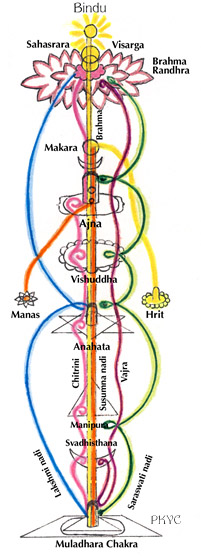 According to Traditional Kundalini Science, Kundalini Shakti constantly strives to attain a lasting Oneness experience by elevating to Bindu, the pinnacle where she can reside in union with Pure Consciousness. For her ascent, there are six routes, the Shakti nadis, through which she is able to elevate. The Shakti nadis are: Susumna, Vajra, Chitrini, Brahma, Saraswati, and Lakshmi. The most common risings are through Susumna, Vajra, Saraswati nadis. There are also various energy center (chakra) levels in these routes at which she might act or take up residence in the course of her efforts until she can go higher.
The kind of rising a person gets depends on the vitality and dynamics occurring in their subtle body at the time of the initial Kundalini release. This, along with their individual nature based on the pattern of past karmas they carry, determines the types of experiences they have. Non-ordinary experiences can occur at any level. An advanced healthy rising is full of peace, awareness, and understanding.
Correct spiritual practice can affect the quality of a rising, as can factors such as lifestyle behaviors and the interference of subtle influences. The kind of risings people have, along with the past karmas they carry, determine the types of experiences they go through. It is the effect of the rising on vayu (energy) dynamics and the contents of the person’s mind that creates the experienced phenomena reported by people with a Kundalini rising.
To prevent or remedy a blocked rising and to assure spiritual development, careful effort is required to make the individual’s container (body, energy, mind, discernment) strong and pure so Kundalini Shakti can function comfortably and spiritual growth can be attained. Therefore, the great spiritual traditions provide methods that serve to unblock or divert incomplete risings to make them stable and allow them to proceed to spiritual results.
Names of Kundalini Risings
The following terms designate the major stages and types of spiritual process as described in Kundalini Vidya:
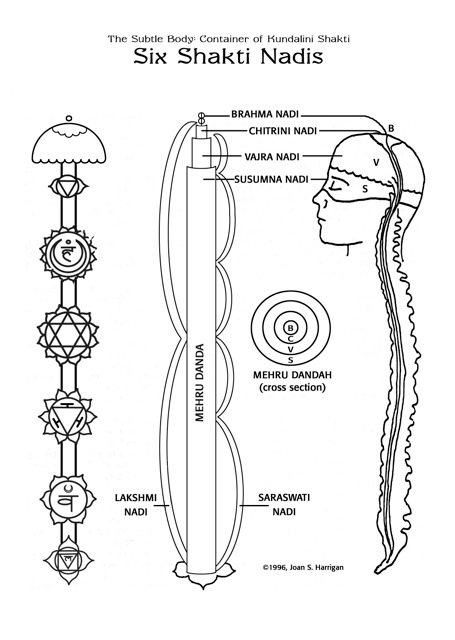 No Rising, Kundalini Stirring, Kundalini Arousal, Kundalini Release, Partial Rising and Intermediate Rising (in Susumna nadi), Deflected Rising (in Saraswati nadi or Vajra nadi), Faux Full Rising, Full Rising (at Makara Point), Upper Process Routes, Complete Process (Pinnacle at Bindu), Bindu direct from Muladhara, Kaula Marga Vajra Diversion Process, Plateau (Samadhi Experiences; Advanced process), and Omega (Liberation, Turiya, Moksha).
These categories provide a framework for discussing the major stages of spiritual development as described through the format of Kundalini process according to Traditional Kundalini Science. A closer look will convey the great variety of experiences possible in the stages of development in Kundalini process.
No Rising
Kundalini Shakti remains unreleased, contained in Muladhara chakra, the Root center subtly corresponding to the perineum at the base of the spine. This is the state of an ordinary person, one with no release or rising and no special vayu dynamic in Muladhara.
Kundalini Stirring
Kundalini Shakti is shaken within Muladhara due to stimulation of the vayus (energies). The vayus in Muladhara spin, but Kundalini Shakti maintains her place at the mouth of Susumna nadi and does not uncoil her grip from around its base, and so she is not released or arisen. The experiencer may shake, weep, dance, run, jerk, laugh, cry out, or have glossalalia or other remarkable phenomena. This may inspire or motivate the experiencer to repeat the behavior that was the catalyst for the stirring.
Kundalini Arousal
Kundalini Shakti uncoils within Muladhara chakra and withdraws from the opening of Susumna nadi due to stimulation of the vayus, but the energy vitality is too weak and the mind too unfocused or not sufficiently spiritually engaged to support an actual release from the Root center. After an arousal, there is no rising, but Kundalini Shakti stays uncoiled at the Root center, unaware of and unrelated to her Source, for she is no longer facing upward through Susumna to see her Goal. She does not recoil her grip around the base of Susumna nadi, and she resides ungrounded and disturbed. If there is no training for the person to remain focused on virtue, she might be distracted by negative downward pulls and enter the dark substrata minor chakras below Muladhara, there to become engaged in nefarious traits and behaviors.
Kundalini Release
Kundalini Shakti uncoils, withdraws from the opening to Susumna, and, having enough energy and focus in the subtle system, is able to exit Muladhara chakra. This can take place when the pranic system is sufficiently vital and clear and when specific conditions, including intense mental and emotional focus, created by spiritual practice or life shock, are present. Kundalini Shakti can then enter one of the six available Shakti nadis and elevate to whatever level she is able to reach at that time. The nadi she enters depends on the conditions present in the individual at the moment of the Kundalini release.
Partial Rising (Susumna to Heart)
Kundalini Shakti breaks the cap of Swayambhu linga (one of three such structures in Susumna nadi) in the Root chakra and goes through the whirlwind above it, rising into Susumna nadi and elevating to the level of Anahata chakra, the Heart center, under the cap of Bana linga. Such a rising is unstable, meaning that Kundalini Shakti does not stay at the Heart level but goes up and down intermittently within the lower levels of Susumna, with her base camp at Muladhara, the Root center. This causes mild to moderate fluctuating experiences until she is able to break through the Bana linga cap at the Heart and elevate higher in Susumna.
Intermediate Rising (Susumna to Throat or Lower Brow)
Kundalini Shakti rises through Susumna nadi, breaks the cap of Bana linga at the Heart center, and elevates to the level of Vishuddha chakra, the Throat center, or to Lower Ajna chakra, the Brow center. These are stable risings, as Kundalini Shakti remains steadily positioned at the level she has attained and from there attempts to ascend and break the cap of Itara linga in Ajna chakra, the Brow center, so she can reach Makara point at the top of Ajna. Practical talents may be bestowed on people with these risings, but over harvesting them may dissipate and strain the subtle system, delaying spiritual progress.
Deflected Rising (Vajra and Saraswati nadis)
At the time of her initial release, Kundalini Shakti, deflected from entering Susumna nadi, enters either Vajra nadi or Saraswati nadi, whereupon she rises immediately up to Sahasrara, the Thousand Petaled Lotus, and opens brain centers there, only to swiftly descend back to Muladhara, which becomes her base camp. From there, she intermittently goes up and down within the nadi she has entered, making these risings unstable. Saraswati nadi has three granthis (knots) that must be opened, and Vajra nadi has five bands in women and two bands in men that must be aligned. Due to brain center activation, various talents and remarkable experiences might result from deflected risings, but there may be some strain also, as Kundalini Shakti cannot reach the pinnacle (Bindu) from either of these cul-de-sac nadis and so becomes frustrated in her efforts to unite with the One. Such a rising must be diverted into a culminating nadi, usually Susumna, and then must be elevated from there to Makara point in Upper Ajna chakra in order to access the Upper Process nadis that lead to Bindu.
Faux Full Rising (Upper Sankhini nadi)
Kundalini Shakti elevates through Susumna nadi and pierces the cap of Itara linga in Upper Ajna chakra, but rather than proceding to Makara point, she is made to stay at Introspector point, which is below Makara point. There she might access Upper Sankhini nadi rather than proceeding upward, if so special powers, such as persuasion, which worldly leaders can utilize to control their domains or take over new realms, may result. This is an esoteric, non-culminating rising that is not spiritual in its intent.
Full Rising (at Makara)
Kundalini Shakti elevates through Susumna nadi, breaking through the cap of Itara linga at Ajna, the Brow chakra, and reaching Makara point at the top of the Brow chakra. From this entry point to the upper nadi regions that go through Sahasrara, the Thousand Petaled Lotus, Kundalini Shakti determines which of the culminating Upper Process routes she will take for her ascent to Bindu, the pinnacle. With a Full rising, which is active in the region after Makara and before Bindu, Kundalini Shakti is in Upper Process, where spiritual life truly begins as the aspirant is blessed, purged, purified, educated, and strengthened inwardly. With the aspirant’s sincere cooperative support, Kundalini Shakti is able to go through the Sahasrara lotus, emptying out old karmas while remaining centered and objective.
Upper Process Routes
From her new stable command center at Makara point in the upper Brow chakra, Kundalini Shakti is easily able to direct the functions of her vayus (energies) throughout her container to heal, purify, and renovate it. This restoration project is the essential task of the phase between Makara and Bindu, which involves the strengthening, repairing, and detoxifying of the entire subtle body (which includes the energy, mind, and discernment levels of the person). The Sahasrara system, with its many brain centers correlated to the petals of the six chakras, is also refurbished, improving brain function and endorphin production. This phase can take some time and may be physically and emotionally uncomfortable as the subconscious mind, with its karmic vasanas and samskaras (mental impressions and drives), is unloaded and the entire subtle body system is improved. It can be made easier through skilled spiritual guidance and by the individual’s support of the process through healthy lifestyle and devoted spiritual practices, perspective, understanding, and dedication.
Upper Process routes include:
Upper Vajra nadi process, which initiates a chakra-by-chakra purge and purification orchestrated from Makara via the brain center petals of Sahasrara;Upper Chitrini nadi process, which can cause spontaneous body, hand, and breath movement patterns via Brahma Randhra;
Upper Brahma nadi process, which offers increased awareness and now-ness perspective through the Stopping Stations or Guru Triangle routes as well as Hrit process, which gives the holiness and beatitude qualities of the Sacred Heart and yields Bindu experience even before eliminating all the karmic residue (samskaras and vasanas).
Other Upper Process routes include: Upper Saraswati process, the Kabbalah Tree of Life, the Celtic Holy Grail, the Egyptian Inner Chamber, and other spiritual traditions’ special ways.
Complete Process (Pinnacle at Bindu)
At the top of Sahasrara (the Thousand Petaled Lotus), Kundalini Shakti goes through the five steps of Brahma Randhra, which is the innermost circle of Sahasrara and the blossom of Chitrini nadi. There she enters into spiritual communion at Visarga, the last part of Brahma nadi, and finally merges into oneness with Pure Consciousness at Bindu, the pinnacle of Brahma nadi.The initial arrival of Kundalini Shakti at Bindu is called Pinnacle experience. It is the culmination of a rising but not the final stage of spiritual development. It can be without significant vasanas and samskaras or with, if the subtle body purging has yet to be finished.
Bindu Direct from Muladhara
A complete rising may also rarely occur following an initial release of Kundalini Shakti from Muladhara, the Root chakra, into Chitrini nadi or Brahma nadi. A release into one of these sacred nadis always culminates with Complete process at Bindu. Chitrini nadi process from Muladhara offers a scenic route to Bindu, going through the entire subtle body system chakra by chakra. Brahma nadi process from Muladhara is extremely rare and bestows a direct immediate route to Bindu.
Kaula Marga Vajra Diversion Process
In special circumstances with qualified spiritual direction, the Kundalini Shakti of a spiritually focused, vowed married person with a Vajra nadi rising can divert to Susumna nadi at Muladhara, the Root chakra, and elevate up to Vishuddha chakra, the Throat chakra. There she re-diverts to Vajra nadi at Vishuddha’s Amrita point and elevates, touching Makara at the end of Susumna and ascending directly to Bindu via Brahma Randhra (entering Upper Chitrini and then Upper Brahma nadis), yielding profound ecstasy and brain center capacity. Unloading then happens. This uncommon process is a Left path method provided as a blessing for noble rulers so they have the spiritual and worldly capacity to help their people. An even rarer variation is a diversion from Vajra nadi into Chitrini nadi or Brahma nadi at Muladhara.
Plateau Samadhi Experiences (Advanced process)
Once Bindu has been reached, Kundalini Shakti sets up a temporary base camp location at or below Bindu and commutes from there to Bindu, to which she returns repeatedly until, through the aspirant’s regular spiritual practice, she becomes proficient at quickly and volitionally returning to Bindu to enjoy Oneness experience, which is beyond all phenomena. The phase from Bindu to Omega is called Plateau or Advanced process. Through repeated experience, the aspirant becomes able to go to Bindu easily, to stay there for increasingly long periods of time, and to be able to return to external functioning efficiently. Plateau is a term used to describe the stages of Samadhi progressively experienced after Bindu.This Plateau phase, in which Kundalini Shakti visits Bindu increasingly often and for more extended periods, removes any residual deep level karmic material so the practitioner is transformed as he or she progresses through the increasingly subtle and profound levels of Samadhi. The three stages of Plateau experience are: Shuddha beha, which purifies the physical system, Pranava beha, which improves brain function, and Jnana beha, which refines higher intelligence.
Omega (Liberation, Turiya, Moksha)
Eventually, the advanced practitioner resides in Oneness experience at all times. This is called Moksha, Liberation, Turiya, Nirvikalpa samadhi, or the eternal union of the soul with the One. We refer to this culmination of Plateau experience as Omega. It is the ultimate goal of the spiritual quest and can result in the individual becoming a realized saint, sage, or adept.
Jivanmukti (Liberated being)
Many levels of advancement are available to liberated holy ones Jivanmuktis. The realized ones are each unique, and each retains some essence of their own temperament and conditioning. Realized beings might travel to give spiritual guidance, they might stay in one place and teach only those who come to their door, they might live incognito as ordinary people, or they might live as hidden hermits, spending their days in Oneness. Those with a special body of knowledge may be invited by the One to serve humanity as adepts. These are able to maintain some presence on the celestial plane while also merging in Pure Consciousness.
The Purpose of PKYC
The specialty of PKYC is to assist the qualified sincere spiritual seeker to reach Makara point in Upper Ajna chakra and then to support the seeker to culmination with deepening proficiency of Oneness experience at Bindu. After Makara, Kundalini Shakti determines which Upper Route process she will take and then strives in that way toward realization, sponsored by the dedicated cooperation and correct support of the individual aspirant. During this phase, PKYC also provides individualized spiritual education, support, guidance, and recommendations so the seeker can more skillfully and devotedly help Kundalini Shakti make good progress as the individual progresses through Full process to Bindu, the pinnacle. One then becomes more proficient in Oneness Experience in the Complete process Plateau phase with deepened spiritual advancement, which can culminate in Omega, full spiritual realization, Liberation.


