Showing posts with label quantum theory. Show all posts

Wednesday, 15 October 2014

What is Multi-Dimensional Space?


Tesseracts visually represent the four dimensions, including time. Blogger Ref http://www.p2pfoundation.net/Multi-Dimensional_Science


  • Written By: Alan Rankin
  • Edited By: Melissa Wiley
  • Image By: Clay Shonkwiler
  • Last Modified Date: 15 September 2014
2003-2014 Conjecture Corporation          


Humans experience day-to-day reality in four dimensions: the three physical dimensions and time. According to Albert Einstein’s theory of relativity, time is actually the fourth physical dimension, with measurable characteristics similar to the other three. An ongoing field of study in physics is the attempt to explain both relativity and quantum theory, which governs reality at very small scales. Several proposals in this field suggest the existence of multi-dimensional space. In other words, there may be additional physical dimensions that humans cannot perceive.

The science surrounding multi-dimensional space is so mind-boggling that even the physicists who study it do not fully understand it. It may be helpful to start with the three observable dimensions, which correspond to the height, width, and length of a physical object. Einstein, in his work on general relativity in the early 20th century, demonstrated that time is also a physical dimension. This is observable only in extreme conditions; for example, the immense gravity of a planetary body can actually slow down time in its near vicinity. The new model of the universe created by this theory is known as space-time.

Ad
Since Einstein’s era, scientists have discovered many of the universe’s secrets, but not nearly all. A major field of study, quantum mechanics, is devoted to learning about the smallest particles of matter and how they interact. These particles behave in a very different manner than the matter of observable reality. Physicist John Wheeler is reported to have said, “If you are not completely confused by quantum mechanics, you do not understand it.” It has been suggested that multi-dimensional space can explain the strange behavior of these elementary particles.

For much of the 20th and 21st centuries, physicists have tried to reconcile the discoveries of Einstein with those of quantum physics. It is believed that such a theory would explain much that is still unknown about the universe, including poorly understood forces such as gravity. One of the leading contenders for this theory is known variously as superstring theory, supersymmetry, or M-theory. This theory, while explaining many aspects of quantum mechanics, can only be correct if reality has 10, 11, or as many as 26 dimensions. Thus, many physicists believe multi-dimensional space is likely.


The extra dimensions of this multi-dimensional space would exist beyond the ability of humans to observe them. Some scientists suggest they are folded or curled into the observable three dimensions in such a way that they cannot be seen by ordinary methods. Scientists hope their effects can be documented by watching how elementary particles behave when they collide. Many experiments in the world’s particle accelerator laboratories, such as CERN in Europe, are conducted to search for this evidence. Other theories claim to reconcile relativity and quantum mechanics without requiring the existence of multi-dimensional space; which theory is correct remains to be seen.


Source Ref


wiseGEEK
clear answers for common questions

Friday, 28 September 2012

The Fundamental Fysiks Group.


From Wikipedia, the free encyclopedia

Blogger Reference Link http://www.p2pfoundation.net/Multi-Dimensional_Science


Jump to: navigation, search

External images
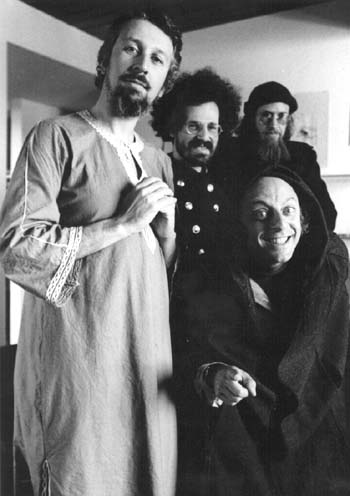
The Fundamental Fysiks Group, City Magazine, 1975. Left to right: Jack Sarfatti, Saul-Paul Sirag, Nick Herbert, and Fred Alan Wolf (seated)
The Fundamental Fysiks Group was founded in San Francisco in May 1975 by two physicists, Elizabeth Rauscher and George Weissmann, at the time both graduate students at the University of California, Berkeley. The group held informal discussions on Friday afternoons to explore the philosophical implications of quantum theory. Leading members included Fritjof Capra, John Clauser, Philippe Eberhard, Nick Herbert, Jack Sarfatti, Saul-Paul Sirag, Henry Stapp, and Fred Alan Wolf.[1]
David Kaiser argues, in How the Hippies Saved Physics: Science, Counterculture, and the Quantum Revival (2011), that the group's meetings and papers helped to nurture the ideas in quantum physics that came to form the basis of quantum information science.[2] Two reviewers wrote that Kaiser may have exaggerated the group's influence on the future of physics research, though one of them, Silvan Schweber, wrote that some of the group's contributions are easy to identify, such as Clauser's experimental evidence for non-locality attracting a share of the Wolf Prize in 2010, and the publication of Capra's The Tao of Physics (1975) and Zukav's The Dancing Wu Li Masters (1979) attracting the interest of a wider audience.[3]
Kaiser writes that the group were "very smart and very playful," discussing quantum mysticism and becoming local celebrities in the Bay Area's counterculture. When Francis Ford Coppola bought City Magazine in 1975, one of its earliest features was on the Fundamental Fysiks Group, including a photo spread of Sirag, Wolf, Herbert, and Sarfatti.[4]

Contents

[hide]

[edit] Research

[edit] Bell's theorem and no-cloning theorem

Hugh Gusterson writes that several challenging ideas lie at the heart of quantum physics: that electrons behave like waves and particles; that you can know a particle's location or momentum, but not both; that observing a particle changes its behavior; and that particles appear to communicate with each other across great distances, known as nonlocality and quantum entanglement. It is these concepts that led to the development of quantum information science and quantum encryption, which has been experimentally used, for example, to transfer money and electronic votes.[5] Kaiser argues that the Fundamental Fysiks Group saved physics by exploring these ideas, in three ways:
They self-consciously opened up space again ... for the kind of spirited philosophical engagement with fundamental physics that the Cold War decades had dampened. More than most of their generation, they sought to recapture the big-picture search for meaning that had driven their heroes—Einstein, Bohr, Heisenberg, and Schrödinger—and to smuggle that mode of doing physics back into their daily routine.Second, members of the Fundamental Fysiks Group latched onto a topic, known as "Bell's theorem," and rescued it from a decade of unrelenting obscurity. The theorem ... stipulated that quantum objects that had once interacted would retain some strange link or connection, even after they had moved arbitrarily far apart from each other. ... Working in various genres and media, the Fundamental Fysiks Group grappled with Bell's theorem and quantum entanglement. ... In the process, they forced a few of their physicist peers to pay attention to the topic ... From these battles, quantum information science was born.
The hippie physicists' concerted push on Bell's theorem and quantum entanglement instigated major breakthroughs ... The most important became known as the "no-cloning theorem," a new insight into quantum theory that emerged from spirited efforts to wrestle with hypothetical machines dreamed up by members of the Fundamental Fysiks Group.[6]
Specifically, in 1981, Nick Herbert, a member of the group, proposed a scheme for sending signals faster than the speed of light using quantum entanglement.[7] Quantum computing pioneer Asher Peres writes that the refutation of Herbert's ideas led to the development of the no-cloning theorem by William Wootters, Wojciech Zurek, and Dennis Dieks.[8]
In a review of Kaiser's book in Physics Today, Silvan Schweber challenges Kaiser's views of the importance of the Fundamental Fysiks Group. He writes that Bell's Theorem was not obscure during the preceding decade, but was worked on by authors such as John Clauser (who was a member of the group) and Eugene Wigner. Schweber also mentioned the work of Alain Aspect, which preceded Nick Herbert's 1981 proposal.[9]

[edit] Remote viewing

Given quantum theory's implications for the study of parapsychology and telepathy, the group cultivated patrons such as the Central Intelligence Agency, Defense Intelligence Agency, and human potential movement. The CIA and DIA set up a program called ESPionage, financing experiments into remote viewing at the Stanford Research Institute, where the Fundamental Fysiks Group became what Kaiser calls its house theorists.[10]

[edit] See also

[edit] Notes

  1. ^ Kaiser, David. How the Hippies Saved Physics: Science, Counterculture, and the Quantum Revival. W W Norton & Co Inc, 2011, p. xi–xvii, xxiii, 43ff, 101.
  2. ^ Kaiser 2011, p. xi–xvii.
  3. ^ Johnson, George. "What Physics Owes the Counterculture", The New York Times, June 17, 2011.
  4. ^ Kaiser lecture,[dead link] 21:00 mins, 23:22 mins; Kaiser 2011, p. xviii.
  5. ^ Gusterson, Hugh. "Physics: Quantum outsiders", Nature, 476, 278–279, August 18, 2011.
  6. ^ Kaiser 2011, pp. xiii–xxxv.
  7. ^ Herbert, Nick. "FLASH—A superluminal communicator based upon a new kind of quantum measurement", Foundation of Physics, vol 12, issue 12, 1982, pp. 1171–117.
  8. ^ Peres, Asher. "How the No-Cloning Theorem Got its Name", Fortschritte der Physik, vol 51, issue 4–5, May 2003, pp. 458–461.
  9. ^ Schweber, Silvan. "How the Hippies Saved Physics - Reviewed by Silvan Schweber", Physics Today, September 2011, 59-60.
  10. ^ Kaiser, David. "Lecture: How the Hippies Saved Physics", WGBH PBS, April 28, 2010, around 28:00 mins.

[edit] Further reading

Books

Reviving the Ancient Polymath Spirit to Meet Modern Challenges We can embrace interdisciplinary learning for innovative problem-solving. Posted January 16, 2025 | Reviewed by Gary Drevitch

  by   Nigel R. Bairstow Ph.D. Disconnection Dynamics Psychology Today Key points Ancient Arab polymaths excelled by integrating diverse kno...