Monday, 14 July 2014

Eschatology


From Wikipedia, the free encyclopedia

Jump to: navigation, search
"Last Things" redirects here. For the C. P. Snow novel, see Strangers and Brothers.
Eschatology Listeni/ˌɛskəˈtɒləi/ is a part of theology concerned with what are believed to be the final events of history, or the ultimate destiny of humanity. This concept is commonly referred to as the "end of the world" or "end time".
The word arises from the Greek ἔσχατος/ἐσχάτη/ἔσχατον, eschatos/eschatē/eschaton meaning "last" and -logy meaning "the study of", first used in English around 1550.[1] The Oxford English Dictionary defines eschatology as "The department of theological science concerned with ‘the four last things: death, judgment, heaven and hell’."[2]
In the context of mysticism, the phrase refers metaphorically to the end of ordinary reality and reunion with the Divine. In many religions it is taught as an existing future event prophesied in sacred texts or folklore. More broadly, eschatology may encompass related concepts such as the Messiah or Messianic Age, the end time, and the end of days.
History is often divided into "ages" (Gk. aeons), which are time periods each with certain commonalities. One age comes to an end and a new age, where different realities are present, begins. When such transitions from one age to another are the subject of eschatological discussion, the phrase, "end of the world", is replaced by "end of the age", "end of an era", or "end of life as we know it". Much apocalyptic fiction does not deal with the "end of time" but rather with the end of a certain period of time, the end of life as it is now, and the beginning of a new period of time. It is usually a crisis that brings an end to current reality and ushers in a new way of living, thinking, or being. This crisis may take the form of the intervention of a deity in history, a war, a change in the environment, or the reaching of a new level of consciousness.
Most modern eschatology and apocalypticism, both religious and secular, involve the violent disruption or destruction of the world; whereas Christian and Jewish eschatologies view the end times as the consummation or perfection of God's creation of the world. For example, according to ancient Hebrew belief, life takes a linear (and not cyclical) path; the world began with God and is constantly headed toward God’s final goal for creation, which is the world to come.
Eschatologies vary as to their degree of optimism or pessimism about the future. In some eschatologies, conditions are better for some and worse for others, e.g. "heaven and hell".


Futures studies and transhumanism[edit]

Researchers in futures studies and transhumanism investigate how the accelerating rate of scientific progress may lead to a technological singularity in the 21st century that would profoundly and unpredictably change the course of human history, and result in Homo sapiens no longer being the dominant life form on Earth.[3][4][5]

Astronomy[edit]

A diagram showing the life cycle of the Sun.
The Sun will turn into a red giant in approximately 5 billion years. This red giant Sun will have a maximum radius beyond the Earth's current orbit. The Sun's expansion will not lead to the end of the Universe; its effects will be limited to the Solar System. Life on Earth will become impossible due to a rise in temperature long before the planet is actually swallowed up by the Sun.[6]

Eschatology in religions[edit]

Bahá'í[edit]

In Bahá'í belief, creation has neither a beginning nor an end.[7] Instead, the eschatology of other religions is viewed as symbolic. In Bahá'í belief, human time is marked by a series of progressive revelations in which successive messengers or prophets come from God.[8] The coming of each of these messengers is seen as the day of judgment to the adherents of the previous religion, who may choose to accept the new messenger and enter the "heaven" of belief, or denounce the new messenger and enter the "hell" of denial. In this view, the terms "heaven" and "hell" are seen as symbolic terms for the person's spiritual progress and their nearness to or distance from God.[8] In Bahá'í belief, the coming of Bahá'u'lláh, the founder of the Bahá'í Faith, signals the fulfilment of previous eschatological expectations of Islam, Christianity and other major religions.[9]

Buddhism[edit]

Main article: Buddhist eschatology
Some forms of Buddhism hold a belief in cycles in which the life span of human beings changes according to human nature. In the Cakkavati sutta, the Buddha explained the relationship between life span of human beings and their behaviour. According to this sutta, unwise behavior was unknown among the human race in the past. As a result, people lived for an immensely long time — 80,000 years — endowed with great beauty, wealth, pleasure, and strength. Over the course of time, though, they began behaving in various unwise ways. This caused the human life span gradually to shorten, to the point where it now stands at 100 years, with human beauty, wealth, pleasure, and strength decreasing proportionately.[citation needed]
Ultimately, conditions will deteriorate to the point of a "sword-interval," in which swords appear in the hands of all human beings, and they hunt one another like game. A few people, however, will take shelter in the wilderness to escape the carnage, and when the slaughter is over, they will come out of hiding and resolve to take up a life of wise and virtuous action again. With the recovery of virtue, the human life span will gradually increase again until it reaches 80,000 years, with people attaining sexual maturity at 500.[citation needed]
According to Tibetan Buddhist literature, the age of the first Buddha was 1,000,000 years and his height was 100 cubits while the 28th Buddha, Siddhartha Gautama (563BC–483BC) lived 80 years, and his height was 20 cubits.[citation needed]
In other traditions, such as Zen, a somewhat utilitarian view is taken. The notion often exists that within each moment in time, both birth and death are manifest. As the individual "dies" from moment to moment, they are equally "reborn" in each successive moment, in what one perceives as an ongoing cycle. Thus, the practitioner's focus is shifted from considerations regarding an imagined future endpoint, to mindfulness in the present moment. In this case, the worldview is taken as a functional tool for awakening the practitioner to reality as it exists, right now.[citation needed]

Christianity[edit]

Christian eschatology
Eschatology views
Christianity portal
Main article: Christian eschatology
Christian eschatology is concerned with death, an intermediate state, Heaven, hell, the return of Jesus, and the resurrection of the dead. Several evangelical denominations include a rapture, a great tribulation, the Millennium, end of the world, the last judgment, a new heaven and a new earth (the World to Come), and the ultimate consummation of all of God's purposes. Eschatological passages are found in many places, esp. Isaiah, Daniel, Ezekiel, Matthew 24, The Sheep and the Goats, and the Book of Revelation, but Revelation often occupies a central place in Christian eschatology.
The Second Coming of Christ is the central event in Christian eschatology. Most Christians believe that death and suffering will continue to exist until Christ's return. There are, however, various views concerning the order and significance of other eschatological events.
The book of Revelation is at the core of Christian eschatology. The study of Revelation is usually divided into four approaches. In the Futurist approach, Revelation is chiefly seen as referring to events which as yet have not come to pass, but which will come to pass at the end of the age, and the end of the world. This is the approach which most applies to eschatological studies. In the Preterist approach, Revelation chiefly refers to the events of the first century, such as the struggle of Christianity to survive the persecutions of the Roman Empire, the fall of Jerusalem in 70 AD, and the desecration of the temple in the same year. In the Historicist approach, Revelation provides a broad view of history, and passages in Revelation are identified with major historical people and events. In the Idealist (or Spiritualist or Symbolic) approach, the events of Revelation are neither past nor future, but are purely symbolic, dealing with the ongoing struggle and ultimate triumph of good over evil.

Hinduism[edit]

Main article: Hindu eschatology
Contemporary Hindu eschatology is linked in the Vaishnavite tradition to the figure of Kalki, the tenth and last avatar of Vishnu before the age draws to a close who will reincarnate as Shiva simultaneously dissolves and regenerates the universe.
Most Hindus believe that the current period is the Kali Yuga, the last of four Yuga that make up the current age. Each period has seen successive degeneration in the moral order, to the point that in the Kali Yuga quarrel and hypocrisy are the norm. In Hinduism, time is cyclic, consisting of cycles or "kalpas". Each kalpa lasts 4.1 - 8.2 billion years, which is a period of one full day and night for Brahma, who in turn will live for 311 trillion, 40 billion Years. The cycle of birth, growth, decay, and renewal at the individual level finds its echo in the cosmic order, yet is affected by vagaries of divine intervention in Vaishnavite belief. Some Shaivites hold the view that Shiva is incessantly destroying and creating the world.
After this larger cycle, all of creation will contract to a singularity and then again will expand from that single point, as the ages continue in a religious fractal pattern.[10]

Islam[edit]

Main article: Islamic eschatology
Islamic eschatology is documented in the sayings of the Prophet Muhammad, regarding the Signs of the Day of Judgment. The Prophet's sayings on the subject have been traditionally divided into Major and Minor Signs. He spoke about several Minor Signs of the approach of the Day of Judgment, including:
  • Abu Hurairah reported that Muhammad said: "If you survive for a time you would certainly see people who would have whips in their hands like the tail of an ox. They would get up in the morning under the wrath of God and they would go into the evening with the anger of God."[11][12]
  • Abu Hurairah narrated that Muhammad said, "When honesty is lost, then wait for the Day of Judgment." It was asked, "How will honesty be lost, O Messenger of God?" He said, "When authority is given to those who do not deserve it, then wait for the Day of Judgment."[13]
  • 'Umar ibn al-Khattāb, in a long narration, relating to the questions of the angel Gabriel, reported: "Inform me when the Day of Judgment will be." He [the Prophet Muhammad] remarked: "The one who is being asked knows no more than the inquirer." He [the inquirer] said: "Tell me about its indications." He [the Prophet Muhammad] said: "That the slave-girl gives birth to her mistress and master, and that you would find barefooted, destitute shepherds of goats vying with one another in the construction of magnificent buildings."[11][13]
  • "Before the Day of Judgment there will be great liars, so beware of them."[13]
  • "When the most wicked member of a tribe becomes its ruler, and the most worthless member of a community becomes its leader, and a man is respected through fear of the evil he may do, and leadership is given to people who are unworthy of it, expect the Day of Judgment."[13]
Regarding the Major Signs, a Companion of the Prophet narrated: "Once we were sitting together and talking amongst ourselves when the Prophet appeared. He asked us what it was we were discussing. We said it was the Day of Judgment. He said: 'It will not be called until ten signs have appeared: Smoke, Dajjal (the Antichrist), the creature (that will wound the people), the rising of the sun in the West, the Second Coming of Jesus, the emergence of Gog and Magog, and three sinkings (or cavings in of the earth): one in the East, another in the West and a third in the Arabian Peninsula.'" (note: the previous events were not listed in the chronological order of appearance)
According the Ahmadiyya sect in Islam, the modern era represents the end times, or the latter days as prophecized in the Qur'an but also the sayings of Muhammad and the previous scriptures. With this view, the community considers Mirza Ghulam Ahmad, the messiah promised in the scriptures, whose purpose, among many, was to fight spiritual battles against onslaughts of the Dajjal.

Judaism[edit]

Main article: Jewish eschatology
Judaism addresses the end times in the Book of Daniel and numerous other prophetic passages in the Hebrew scriptures, and also in the Talmud, particularly Tractate Avodah Zarah.

Zoroastrianism[edit]

See also[edit]

References[edit]

  1. Jump up ^ Dictionary - Definition of Eschatology Webster's Online Dictionary
  2. Jump up ^ "Eschatology, n.", def. a, Oxford English Dictionary, accessed 2012-01-29.
  3. Jump up ^ Sandberg, Anders. An overview of models of technological singularity
  4. Jump up ^ "h+ Magazine | Covering technological, scientific, and cultural trends that are changing human beings in fundamental ways". Hplusmagazine.com. Retrieved 2011-09-09. 
  5. Jump up ^ Yudkowsky, Eliezer. The Singularity: Three Major Schools
  6. Jump up ^ Zeilik, M.A.; Gregory, S.A. (1998). Introductory Astronomy & Astrophysics (4th ed.). Saunders College Publishing. p. 322. ISBN 0-03-006228-4. 
  7. Jump up ^ Smith, Peter (2008). An Introduction to the Baha'i Faith. Cambridge: Cambridge University Press. p. 112. ISBN 0-521-86251-5. 
  8. ^ Jump up to: a b Smith, Peter (2000). "Eschatology". A concise encyclopedia of the Bahá'í Faith. Oxford: Oneworld Publications. pp. 133–134. ISBN 1-85168-184-1. 
  9. Jump up ^ Buck, Christopher (2004). "The eschatology of Globalization: The multiple-messiahship of Bahā'u'llāh revisited". In Sharon, Moshe. Studies in Modern Religions, Religious Movements and the Bābī-Bahā'ī Faiths. Boston: Brill. pp. 143–178. ISBN 90-04-13904-4. 
  10. Jump up ^ Hooper, Rev. Richard (April 20, 2011). End of Days: Predictions of the End From Ancient Sources. Sedona, AZ. p. 156. 
  11. ^ Jump up to: a b Muslim
  12. Jump up ^ Sunan Imam Ahmed
  13. ^ Jump up to: a b c d Bukhari

Further reading[edit]

External links[edit]

Friday, 4 July 2014

The All-Seeing Eye: Sacred Origins of a Hijacked Symbol

  • 89
    Share
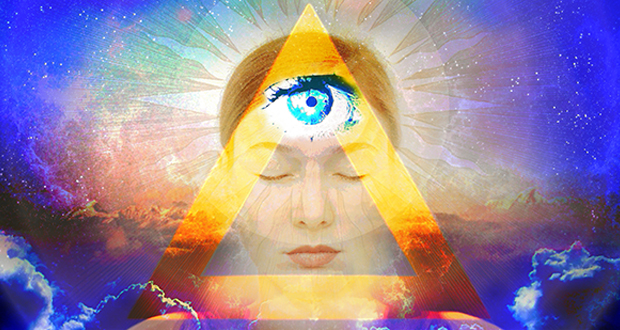
Is the all-seeing eye a symbol of divine omniscience or sinister influence? Today it symbolises control and domination by a shadowy elite, but its original use was quite different. This article traces its use and meaning back to ancient times, when it was a symbol of divine providence, powerfully representing spiritual truth and awakening.

Humanity is Losing Its Precious Symbology

The all-seeing eye is a powerful esoteric symbol which is widely misunderstood and misused today; few know what it originally stood for. It was originally symbolic of a higher spiritual power or God, a watchful caretaker of humanity or an awakened spiritual part within. But these days it has quite different associations.
Today the all-seeing eye is more likely to be seen as an “Illuminati” symbol of control and surveillance by elites who to a large degree run the show on this planet at this time. This is because, over time, dark sinister forces have taken over esoteric symbols that for thousands of years were used to convey positive, helpful, uplifting spiritual messages and principles.  The all-seeing eye is a prime example of how spiritual symbols have been hijacked and inverted. There has not really been much push to understand the symbol’s original meaning or to reclaim it for the spiritual significance it first conveyed.
This is the first in a series of articles I am presenting that will take a closer look at individual symbols, and delve into their origins and history to uncover their deeper esoteric significance. I am writing these as part of an effort to reclaim these positive esoteric symbols and restore them to their previously esteemed state.

Universal Nature of Symbolism

Symbolism has long been used by humanity to communicate ideas which are best crystallised in a compact form. As the well-known saying goes, a picture tells a thousands words! Esoteric symbols are alive today as they were in the ancient past, but there is much confusion surrounding their usage, history, intent, and meaning.
In ordinary life we use symbols to show at a glance important information such as traffic and road signs amongst many other symbols which are widespread and common today. Some other examples are corporate logos and certification statuses.
Symbolism is also especially used in the communication of non-physical, spiritual ideas, phenomena, and processes.
The all-seeing eye is one of the most powerful and widely used  and misused  symbols of all. In this article I trace its use from the earliest of times through to the 18th century, and show what the symbol originally stood for. My next article will examine its use from 18th century freemasonry onwards, and show how it has since been hijacked and misused.

Use of the All-Seeing Eye in Ancient Cultures

India


Shiva’s third eye
We perhaps find the precursor to what eventually became known as the all-seeing eye in the Rig Veda, a sanskrit text thought to have been written over 3,000 years ago and one of the oldest known texts. In it there are many references to the sun and to other deities as being an eye in heaven, as an eye which reveals creation, or an eye which never closes.
One can liken this to being symbolic of a high level of awakened consciousness that advanced spiritual beings have and which an ordinary person can potentially attain.
The Hindu god Shiva has three eyes. The third eye or brow chakra eye is known as the eye of Shiva, possessor of all knowledge, which when opened will destroy anything it sees. Thus it is a symbol of knowledge which destroys evil and ignorance.
This again can be likened to an awakened higher spiritual part of a person which sees the truth of things and can then eliminate within a person’s psyche that which is opposite to and blocks divine consciousness from manifesting more. In this way it is a “creative destruction” of evil to transform it into higher consciousness.
Even in modern times, the eye of Shiva is used in jewellery to give protection against evil to its wearer and to gain wisdom and understanding from the world, from life events and from the self, for positive transformation.

Nepal

Buddha_all_seeing_eye
Buddha’s all seeing eye
In Buddhism, Buddha is referred to as the Eye of the World. It is typical for temples in Nepal to display a graphic of the “Eyes of Buddha” as shown to the right – notice it includes a mark for the “third eye” as well. The eyes are also known as the eyes of wisdom and compassion.
Statues of Buddha typically show a dot in the mid-brow to represent the third eye.

Ancient Egypt

Eye of Osiris

It is interesting to find that the Egyptian hieroglyph for their god Osiris contains an eye as shown below. So as with  Hinduism and Buddhism we find a spiritual deity being represented in ancient times as an eye.
Osiris
Hieroglyph for “Osiris” contains an eye

Eye of Horus

In ancient Egypt, the all-seeing eye was known as the Eye of Horus or the Eye of Ra and also formed part of the symbology of Wad-jet. Through various myths they were symbols of protection, healing and restoration. The left eye of Horus was said to be the moon and his right eye the sun.
Wadjet-Eye-of-Horus-All-Seeing
The all seeing eye is a major part of Egyptian spirituality / Image credit: Hajor
Horus was a falcon-headed sun god and it could be said the Eye of Horus was styled like an eye of a lanner falcon with its marking beneath the eye.

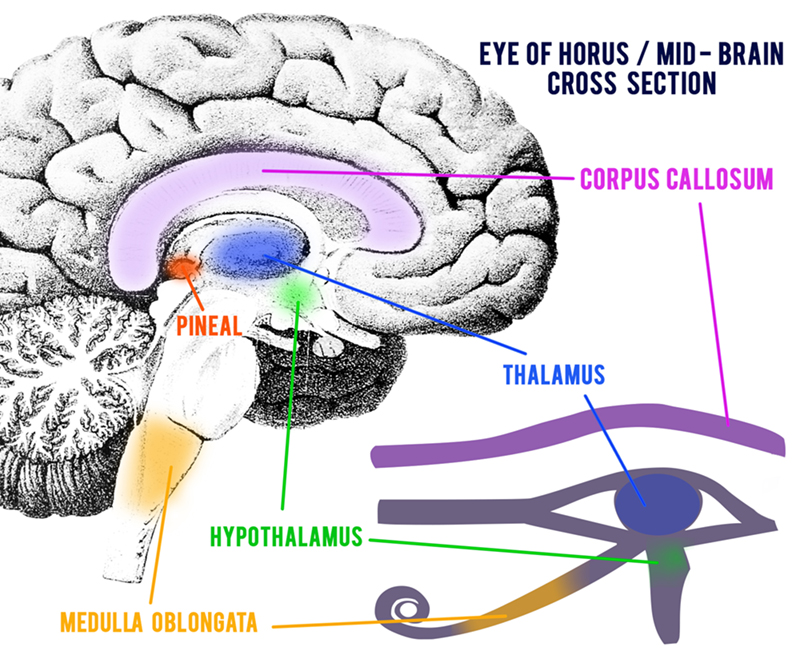
Could the Eye of Horus represent parts of the brain used to manifest consciousness?
It is also very interesting to note that the drawing of the Eye of Horus very much matches the cross section of the mid brain where the thalamus, the pineal and pituitary glands are situated. The pineal gland is often said to be the “third eye” and a centre of spirituality and of spiritual insight, which can be developed in a person.
It’s as if the Eye of Horus could be a depiction of the thalamus as the eye ball with the corpus callosum the eye brow above and the medulla oblongata (brain stem) and the hypothalamus being the two markings below. If this is what they were drawing but calling it the Eye of Horus, does it suggest they considered the mid brain to be the seat of consciousness or even of divine consciousness or “Horus consciousness”? Horus being a sun god and symbolic of the universal Christ, a spiritual force which a suitably prepared person can merge with.

Middle East/Asia – Hamsa

hamsa_hand_jewish
A Jewish Hamsa
In the Middle East the all-seeing eye has been known in the form of a hand-eye symbol called either Hamsa, Khamsa or Hamesh.
It’s the symbol of an eye in the palm of a hand, usually the right hand. Again it is a symbol of protection against the evil eye (bad luck caused by jealousy from others) and danger in general and can been seen as a good luck charm in that way.

Detail from “The Divine World” by Kahil Gibran
It is also known as the hand of Fatima in Islam and the hand of Miriam in Judaism. In India it is known as Humsa Hand. The Jains also have a form of the Hamsa in their symbolism with the word ahimsa (meaning non-violence) inside a wheel instead of where the eye would be. The Hamsa has been used for thousands of years and is still in use today as amulets, charms or wall hangings. It would seem to have its origins from ancient Mesopotamia with the hand of Ishtar being a symbol of divine protection although it did not contain the eye in the palm.
A more Christian-themed representation of the Hamsa is an art work called “The Divine World” by Kahlil Gibran, a Lebanese Maronite Catholic prominent in the early 20th century as a poet, painter, writer, philosopher, theologian.
Nazar_All_Seeing_Eye
A Nazar / Image credit: Alborz Fallah
In Greece and Turkey they have something similar to the Hamsa which they call a “Nazar”. It is just an eye without the hand but it is used in the same way and has the same meaning as the Hamsa, that is, to ward off the evil eye, in the form of amulets or hanging ornaments usually made from blue glass.
Similarly in Buddhism there is the “eye of Buddha” amulet to ward off the evil eye.
rattlesnake_disc_hamsa
The enigmatic rattlesnake disc  Image credit: Dennis Vesper
The symbol of an eye in a hand also appears in Aztec and Mayan cultures and in Native American artworks although archaeologists are not sure what meaning it had for these cultures.
To the right is a Native American example referred to as “The Rattlesnake Disc” which was unearthed by a farmer in Moundville, Alabama in the 1800′s. Some archaeologists think its symbolism may have represented a portal to spiritual dimensions. It is the most elaborately decorated artwork found at Moundville giving rise to the belief it was of the most importance to its creators. Other artworks found there also contain the hand-eye symbol.

Ancient Ecuador

There is also the amazing discovery in 1984 in La Mana, central Ecuador, of an ancient artefact referred to as the Black Pyramid amongst 300 artefacts found there of unknown origin.
It is not known what culture they come from and the many objects found are baffling and seemingly out of place for this part of the world, such as an object designed as a hooded King Cobra of south east Asia. Cobras don’t exist in South America.
The so-called Black Pyramid is made from black stone with an eye at the apex. The stone has gold inlays forming 13 levels of “bricks” and an eye at the top. These inlays glow when under black light. Overall it looks like a representation of the great pyramid of Giza (7,470 miles away) and also amazingly just like the eye pyramid symbol used on the Great Seal of America and the US $1 bill.
It is also interesting to note the cobra artefact has another similarity with ancient Egypt where the raised cobra is associated with the Eye of Horus/Ra and Wad-jet in their protective aspects with it being worn on the foreheads of Pharaohs at the mid-brow right where the third eye is located.  This symbolises the raising of a person’s energies to a higher vibration which internally leads to the awakening of psychic faculties such as those latent in the third eye.
LaMana_pyramid_all_seeing_eye
Images via YouTube user Wellington Marin – Illuminati Pyramid from Ecuador
It is not known how old these objects are as dating them has not been possible but they are thought to pre-date the known ancient cultures of the region. There is also a pre-Sanskrit type language (making it very old) engraved on some of the objects including on the underside of the black pyramid where there are also markings which appear to map out the stars of the Orion constellation, which the pyramids at Giza also map. The 4 pre-Sanskrit markings are thought to translate as saying “the son of the creator comes”.
Given the care taken to create this object it would seem to have been an important symbol for its creators although it is not clear how they interpreted it.

Ancient Greek

In the Hymns of Orpheus, the hymn To The Sun describes it variously as thus;
as an “eternal eye with broad survey” ;
and compares it to being the “Father of ages” ;
and as “Immortal Jove, all searching, bearing light” ;
then later as the “Great eye of Nature and the starry skies” ;
followed by “Faithful defender, and the eye of right”
So here we see in an ancient text of the western world similar representation of the sun like that presented in the ancient text of the east, the Rig Veda, as being an eye of the creator and an all-seeing never closing eye watching over and protecting the good.

Christianity

“The light of the body is the eye: if therefore thine eye be single, thy whole body shall be full of light.” (Jesus in Matthew 6:22)
“The eyes of the Lord are on the righteous, and his ears are open to their cry;” (Psalms 34:15)
“The eyes of the Lord are in every place, beholding the evil and the good.” (Proverbs 15:3)
The_Talpiot_Tomb_triangle_circle
Does the Talpiot tomb display an all seeing eye?
A possible first known use of the all-seeing eye symbol in Judeo-Christianity is the so-called “Jesus tomb” from 1st century AD discovered in 1980, which uses a similar symbol over the entrance to the tomb. Regardless of whose tomb it is, could this be a first known or early use of the eye-pyramid symbol in the Judeo-Christian tradition?
In Christianity, the all-seeing eye or “Eye of Providence” or “Eye of God” has been used as a symbol from at least the 16th century as seen in the following painting below which depicts a scene from Luke 24: 13-32 where after his resurrection, Jesus has supper with two disciples.
Pontormo_All_Seeing_Eye
16th century Christian painting – dated 1525 by Italian artist Pontormo (student of Da Vinci), called Supper in Emmaus – depicts Luke 24: 13-32
The eye is inside a triangle, and surrounded by rays of light, with the triangle representing the holy trinity and the whole symbol meaning God’s omnipresence and all-seeing eye watching over creation.
Some claim that the eye in triangle symbol was added to the painting soon after the Council of Trent 1545- 1563, to conform with its canons and decrees but even if that is so that would still place its use in the 16th century.
In Alsace, France, the fresco painted above the altar of the Abbey Church of Saint-Jean-Baptiste (1763) shows a large example of the eye-in-pyramid symbol, with the rays of glory breaking through the clouds.
Another example is on the Aachen cathedral in Germany. It was originally built in the late 8th century under the Emperor Charlemagne and then enlarged in the middle ages with various other changes and updates along the way. It would seem the all-seeing eye symbol was placed on the cathedral in 1766 to mark the renovations done that year.
Note that these first two examples pre-date the founding of the Bavarian Illuminati (1776) although Freemasonry already existed in England and Europe by this time. Perhaps it was a masonic influence that saw these symbols used on these cathedrals yet it was not until about 1797 that masons are regarded as beginning to use the eye-in-pyramid symbol.
The eye-in-pyramid symbol also features prominently on the front facade of the Hartegbrugkerk Church in Leiden, the Netherlands, built in 1835-36. The Latin words “Hic Domus Dei est et Porta Coeli” translates to “This is the House of God and the Gateway to Heaven.”
St_Jean_Baptiste_All_Seeing_Eye
An all-seeing eye in the St. Jean-Baptiste Abbey Church / Image credit: Ralph Hammann
Aachen_All_Seeing_Eye
Aachen Cathedral all-seeing eye / Image credit: Trexer
Hartebrugkerk_All_Seeing_Eye
Another all-seeing eye atop Hartegbrugkerk Church, Netherlands / Image credit: Robbiedoes


These are just some Christian examples of many that appear in Europe.

Conclusion

As we have seen, throughout history there has been a strong tradition across time, continents and cultures of using eye symbolism to generally represent a benevolent creator force watching over, helping and protecting humanity and to represent a spiritual part within.
In my next article I will continue to trace the use of the all-seeing eye symbolism over the last 240 years and reveal how it has been inverted and increasingly used for sinister aims in current times.
- See more at: http://consciousreporter.com/conspiracy-against-consciousness/corruption-sacred-symbols-all-seeing-eye/#sthash.lMOD8QNE.dpuf

The ABOVE is from the following blog


The Conscious Reporter

Tuesday, 1 July 2014

Thrive: The Power of Evidence-Based Psychological Therapies


Front Cover


I learnt about the book on Radio 4, and it appears to be a very credible, and scholarly work on the high success rate of CBT. However, I think though that our understanding of psychology could overtime be revolutionised if Multi-Dimensional Science were seriously developed. Moreover, existing therapies could be improved, and further, enhanced http://www.p2pfoundation.net/Multi-Dimensional_Science

Richard Layard, David Clark (Google e-Book)
Penguin UK, 3 Jul 2014 - Psychology - 176 pages
 
A ground-breaking argument for better treatment of mental health from Richard Layard (author of Happiness) and David M. Clark.

Britain has become a world leader in providing psychological therapies thanks to the work of Richard Layard and David Clark. But, even so, in Britain and worldwide the majority of people who need help still don't get treatment. This is both unjust and a false economy.

This book argues for change. It shows that mental ill-health causes more of the suffering in our society than physical illness, poverty or unemployment. Moreover, greater spending on helping people to recover from mental health problems - and stay well - would generate massive savings to national economies, as those who suffer from depression and anxiety disorders account for nearly a half of all disability and are predominantly of working age. Modern talking therapies, such as CBT (Cognitive Behavioural Therapy), are highly effective, and if more sufferers got these treatments, lives would be turned around and the cost would be fully covered by the huge savings.

Thrive explores the new effective solutions to the misery and injustice caused by mental illness. It describes how successful psychological treatments have been developed and explains what works best for whom. It also urges us to do all we can to prevent these problems in the first place, through better schools and a better society. And, most importantly, it offers real hope.


'This book is an inspiring success story and a stirring call to further action. Its message is as compelling as it is important: the social costs of mental illness are terribly high and the costs of effective treatments are surprisingly low' Daniel Kahneman

'Extremely easy and pleasurable to read. It's the most comprehensive, humane and generous study of mental illness that I've come across' Melvyn Bragg

'Remarkable . . . presents the issues in a style that easy for the professional, the general public, and policy makers to understand' Aaron T Beck

'Professors Layard and Clark (the Dream Team of British Social Science) make a compelling case for a massive injection of resources into the treatment and prevention of mental illness. This is simply the best book on public policy and mental health ever written' Martin Seligman


RICHARD LAYARD is one of the world's leading labour economists, and in 2008 received the IZA International Prize for Labour Economics. A member of the House of Lords, he has done much to raise the public profile of mental health. His 2005 book Happiness has been translated into 20 languages.

DAVID M. CLARK, Professor of Psychology at Oxford, is one of the world's leading experts on CBT, responsible for much progress in treatment methods. With Richard Layard, he was the main driver behind the UK's Improving Access to Psychological Therapies programme.

Reviving the Ancient Polymath Spirit to Meet Modern Challenges We can embrace interdisciplinary learning for innovative problem-solving. Posted January 16, 2025 | Reviewed by Gary Drevitch

  by   Nigel R. Bairstow Ph.D. Disconnection Dynamics Psychology Today Key points Ancient Arab polymaths excelled by integrating diverse kno...